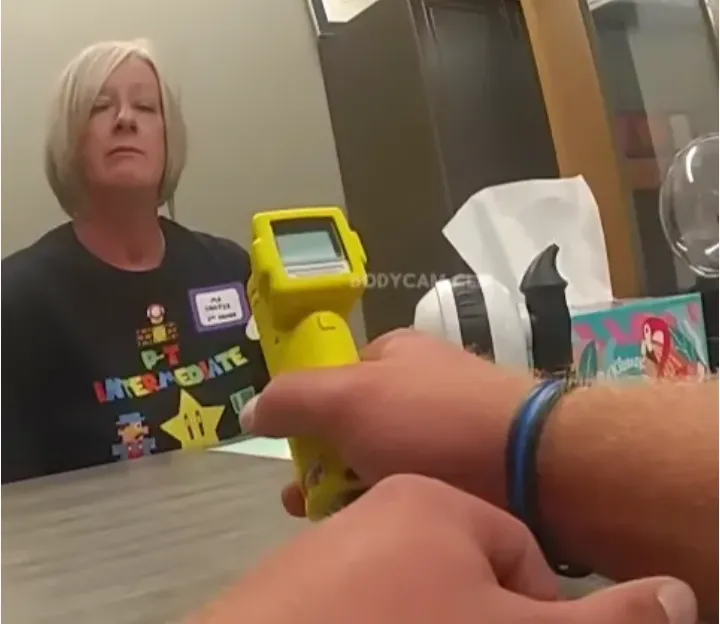
The bodycam footage begins on what was supposed to be a normal first day of school, with students returning to classrooms and teachers settling into routines.
Instead, concern quickly spread among staff members who noticed one teacher behaving in an unusual and inconsistent manner.
According to statements later recorded, the teacher appeared distracted, unsteady, and struggled to maintain focus during early interactions.
Other teachers did not immediately assume wrongdoing.
They observed quietly, comparing notes and noting that the behavior seemed out of character for the start of a school year.
As time passed, their concern grew rather than subsided.
Staff members reported the observations to the school principal, following established internal procedures.
The principal met with the teacher privately to assess the situation.
The bodycam footage begins shortly after, when law enforcement is asked to assist with a welfare and safety check.
Officers arrive on campus calmly, without urgency or visible alarm.
Their presence is low-key, aimed at understanding what had been reported rather than escalating the situation.
They speak with school administrators first to gather context.
Administrators explain that the concern is not disciplinary, but related to safety and fitness to teach.
They emphasize that the goal is to ensure students and staff are protected.
Officers then speak directly with the teacher in a private area away from students.
The teacher appears cooperative but confused by the situation.
Her speech is slower than expected, and her explanations are not always clear.
Officers ask standard questions to assess awareness and condition.
They do not accuse her of wrongdoing or mention any conclusions.
Instead, they explain that concerns were raised and that a check is required.
The teacher insists that she is fine and capable of teaching.
She denies consuming anything that would affect her ability to work.
The bodycam captures officers explaining the next step carefully.
They state that, based on observations and reports, a formal evaluation is necessary.
The explanation is procedural and calm.
The teacher expresses frustration and disbelief.
She repeats that she has not been drinking at school and does not understand the concern.
Officers listen without interruption and acknowledge her statement.
They clarify that the evaluation is not an accusation.
It is a way to determine whether she can safely continue her duties.
The bodycam records the officer explaining how the evaluation works.
He describes the process in simple terms, ensuring she understands.
There is no pressure applied beyond the explanation of procedure.
The teacher agrees to proceed, though she appears uneasy.
As the evaluation continues, officers document their observations aloud.
They note balance issues and delayed responses to simple instructions.
The tone remains factual, with no emotional commentary.
The teacher continues denying any consumption at school.
She states that she is being misunderstood and insists the situation is unfair.
Officers do not argue.
They continue following protocol, explaining that results will determine next steps.
The bodycam captures the moment when test results are obtained.
Officers state the results clearly and without exaggeration.
They explain that the reading is significantly above the legal limit for operating a vehicle.
This statement marks a shift in the interaction.
The teacher reacts with shock.
She immediately denies drinking while at school and repeats that she would never do that.
Officers acknowledge her denial and explain that the test reflects recent consumption, not intent.
They clarify that where and when consumption occurred will be addressed later.
The focus at this moment is safety and procedure.
The bodycam shows officers explaining that, based on the results, she cannot continue teaching that day.
They also explain that further steps are required under the law.
The explanation is calm and deliberate.
There is no raised voice or sudden movement.
The teacher appears emotional, her earlier frustration turning into distress.
She asks what will happen next.
Officers respond by outlining the process clearly.
They explain transport, paperwork, and what the immediate steps will be.
They avoid discussing employment consequences, stating that those decisions are handled separately.
Throughout the interaction, officers maintain a respectful distance.
They do not speak about students or classrooms directly.
Their focus stays on the teacher and the procedure unfolding.
The bodycam records how the school environment remains quiet.
Students are kept away from the situation.
Administrators manage the campus while officers handle the matter discreetly.
This separation helps minimize disruption.
The footage highlights how internal reporting worked as intended.
Other teachers noticed something was wrong and spoke up.
The principal followed protocol.
Law enforcement responded methodically.
No one acted impulsively.
Online viewers later debate whether the response was necessary.
Some focus on the denial of drinking at school.
Others point to the results and the importance of safety.
The bodycam footage itself does not take sides.
It documents a sequence of decisions based on observation and procedure.
One recurring theme in the footage is denial versus documentation.
The teacher repeatedly denies consuming anything at school.
Officers repeatedly state that the results speak to condition, not intent.
This distinction remains central throughout the interaction.
The bodycam also shows how first-day-of-school settings add pressure.
Expectations are high.
Stress levels are elevated.
But safety standards remain the same.
The footage does not speculate on causes.
It does not suggest motive or background.
It shows how concerns move through proper channels.
From teachers.
To administrators.
To law enforcement.
As the interaction concludes, officers prepare to leave campus with the teacher.
They explain each step before it happens.
She complies, though visibly upset.
There is no resistance or confrontation.
The bodycam captures a quiet, controlled departure.
The school day continues behind them.
Students return to class.
The incident is handled without public spectacle.
For viewers, the video becomes a reminder of accountability in professional roles.
Especially roles involving children.
It also shows how checks exist to prevent harm, not to assign blame prematurely.
The footage emphasizes process over punishment.
Observation.
Reporting.
Evaluation.
Action.
Each step follows the last.
The camera records this progression without commentary.
In the end, the bodycam does not resolve the broader questions.
It does not determine intent.
It does not decide outcomes.
Those matters belong to other processes.
What it does show is how a concern on the first day of school became a formal response.
Not because of rumor.
But because multiple people noticed something was wrong.
And chose to speak up.
The camera documents that choice.
Quietly.
Carefully.
And without drama.
Leaving viewers to reflect on how safety decisions are sometimes uncomfortable.
But necessary.
Especially when responsibility is shared.
And when the priority is protecting others.
The bodycam ends with no conclusion.
Only record.
A record of a day that did not begin as expected.
And a reminder that procedure exists for moments exactly like this.