My Parents Celebrated Christmas Without Me—Then Asked What Happened to the $285,000 House I Was Giving Them
PART 4
I didn’t go home immediately after Dad hung up.
I stayed in the bungalow.
The silence inside that little house felt different now.
Before, it had felt like possibility.
Now it felt like a question.
I walked through every room slowly.
The kitchen where Mom had planned to hang curtains.
The living room where Dad had measured the wall for his television.
The second bedroom where he had planned to put his reading chair.
And then I noticed something I hadn’t seen before.
A small scratch on the floor near the hallway closet.
I crouched down.
There was a narrow wooden panel beside it.
I pulled gently.
It opened.
Behind it was a shallow storage compartment.
Inside were several old property documents.
Not mine.
The previous owner’s.
I sorted through them carefully.
Most were ordinary.
Maintenance records.
Insurance papers.
Utility receipts.
Then I found a letter dated eleven years earlier.
It was from the previous owner’s attorney.
The letter mentioned an easement connected to the backyard.
I read it twice.
Then I understood.
The property wasn’t as simple as I had thought.
There was an old access agreement allowing the neighboring property owner to use part of the driveway.
It wasn’t a problem.
The title was still clear.
But something else caught my attention.
A paragraph mentioning a small charitable trust.
The original owner had apparently wanted the property to remain available for community use if the buyer ever chose to donate or transfer it for that purpose.
It wasn’t legally binding.
But it explained something.
The bungalow had history.
It had once been used to help families who were transitioning out of temporary housing.
I thought of Laya.
Her question came back to me.
Is the whole cake really for us?
I sat on the floor.
Maybe that was why the house had felt different the first time I walked through it.
Maybe I had been trying to give my parents the wrong kind of gift.
I didn’t know yet.
But I knew one thing.
I wasn’t going to make another decision based on guilt.
I took the documents to my attorney the following morning.
He reviewed them carefully.
“The trust isn’t active anymore,” he said. “But you could establish something similar if you wanted.”
“What would that involve?”
“Depends on what you want to accomplish.”
I told him about Monica and Laya.
He listened.
Then he said, “If you’re serious about using the property for transitional housing, we should speak with a nonprofit that already has the infrastructure to manage it.”
I nodded.
“I don’t want to become someone’s landlord.”
“You wouldn’t have to.”
That was exactly what I wanted.
I wanted help to be structured.
Not emotional.
Not dependent on whether someone cried.
Not based on family pressure.
We contacted a local housing organization.
They inspected the property.
They told me the bungalow could accommodate a small family comfortably.
There would be paperwork.
Background checks.
Insurance.
A formal agreement.
Professional case management.
Everything would be done properly.
I wasn’t giving the house away impulsively.
I was making a deliberate decision.
Then I received a message from Mom.
Please come over. Your father and I need to explain everything.
I stared at it for several minutes.
Then I replied:
I’ll come tomorrow at 2.
The next afternoon, I arrived at my parents’ house.
Mom opened the door.
She looked exhausted.
Dad was sitting at the dining table.
Neither of them spoke at first.
“I need you to understand something,” I said. “I wasn’t planning to abandon you. I was planning to help you live independently.”
Mom cried harder.
“The bungalow was supposed to be yours,” I continued. “No rent. No mortgage. No asking me for money every month. You could live there comfortably.”
Dad nodded.
“We know.”
“But you saw it as something else.”
He looked at me.
“Yes.”
“What?”
“Security.”
I shook my head.
“No. You saw it as leverage.”
Dad didn’t deny it.
That silence told me everything.
I stood.
“There’s something else.”
Mom looked frightened.
“What?”
“Leah.”
Dad’s face tightened.
“What about her?”
“She told me you planned to let her stay in the bungalow.”
Mom closed her eyes.
Dad sighed.
“She needed somewhere.”
“I know.”
“She lost her job.”
“I know.”
“She was embarrassed.”
“I know.”
“Then you understand.”
“No.”
My voice remained calm.
“I understand why you wanted to help her. What I don’t understand is why you decided I would be responsible for it without asking me.”
Dad stared at the table.
“I thought you’d say yes.”
“That was the problem.”
He looked up.
“You’ve always said yes.”
I nodded slowly.
“And you decided that meant you didn’t need to ask.”
Nobody spoke.
Then Mom said something I never expected.
“We’re sorry.”
I looked at her.
She wiped her eyes.
“Not because you canceled the house.”
That mattered.
“Because we treated your love like an obligation.”
The room became very quiet.
Dad finally nodded.
“We were wrong.”
I wanted to believe them.
But forgiveness and trust were not the same thing.
“I believe you’re sorry,” I said. “But that doesn’t mean everything goes back to normal.”
Mom nodded.
“I understand.”
“No more access to my accounts.”
“Yes.”
“No more asking other people about my finances.”
Dad nodded.
“No more assuming gifts are promises.”
“Yes.”
“And no more excluding me from family events while expecting me to continue funding them.”
Mom looked down.
“That was cruel.”
“Yes.”
Dad’s voice was barely audible.
“It was.”
I took a breath.
“The bungalow is no longer yours.”
Mom’s face fell.
“I know.”
“But that doesn’t mean I’m leaving you without options.”
She looked up.
“What do you mean?”
“I found a housing program.”
Dad frowned.
“A program?”
“Yes.”
I explained everything.
The organization.
The property.
The case management.
The fact that I was considering placing the bungalow into a structured transitional-housing arrangement.
Mom stared at me.
“You’re really giving it away.”
“I’m giving someone an opportunity to have a safe home.”
Dad looked down.
“Like you did for us.”
“Yes.”
He swallowed.
“I suppose we don’t deserve it.”
I shook my head.
“That’s not how I see it.”
“What do you mean?”
“I’m not taking the house away because you don’t deserve it. I’m choosing what to do with something that belongs to me.”
That distinction mattered.
For the first time, Dad nodded without arguing.
Then Mom asked:
“Can we still see you?”
That question broke something inside me.
Because underneath all the anger, I was still their daughter.
“Yes.”
“But you won’t pay for everything.”
“No.”
She nodded slowly.
“Then we’ll learn.”
I smiled sadly.
“I hope you do.”
I left shortly afterward.
Outside, the winter air was cold.
But I felt lighter than I had in years.
Still, there was one person I hadn’t spoken to.
Leah.
I drove to her friend’s house.
She opened the door wearing an oversized sweater.
When she saw me, she immediately looked worried.
“What happened?”
“I talked to Mom and Dad.”
She stepped aside.
“Come in.”
We sat in the small living room.
“I know about the bungalow,” I said.
She looked embarrassed.
“I didn’t ask them for it.”
“I know.”
“I swear.”
“I believe you.”
She looked down.
“Did they tell you about my husband?”
“Yes.”
Her eyes filled with tears.
“He took money from our joint account before he left.”
I said nothing.
“I thought I could fix everything myself.”
“You don’t have to.”
She looked at me.
“What?”
“You don’t have to do everything yourself.”
She laughed through her tears.
“That’s funny coming from you.”
I smiled.
“Fair.”
We talked for a long time.
Then I made her an offer.
Not money.
Not a blank check.
I offered to help her find a financial counselor and job placement service.
I offered to review her résumé.
I offered to help her make a realistic budget.
But I made one rule.
“I won’t rescue you,” I said.
She nodded.
“I don’t want you to.”
That was the beginning of something different between us.
Not dependence.
Not competition.
Sisterhood.
Two weeks later, the housing organization finalized the paperwork.
The bungalow became part of a transitional housing program.
Monica and Laya were eventually selected as one of the first families.
When I gave Monica the keys, she stared at them for several seconds.
“You’re sure?”
“Yes.”
“For how long?”
“Until you’re ready for the next step.”
She started crying.
Laya ran through the front door.
Then she came back outside.
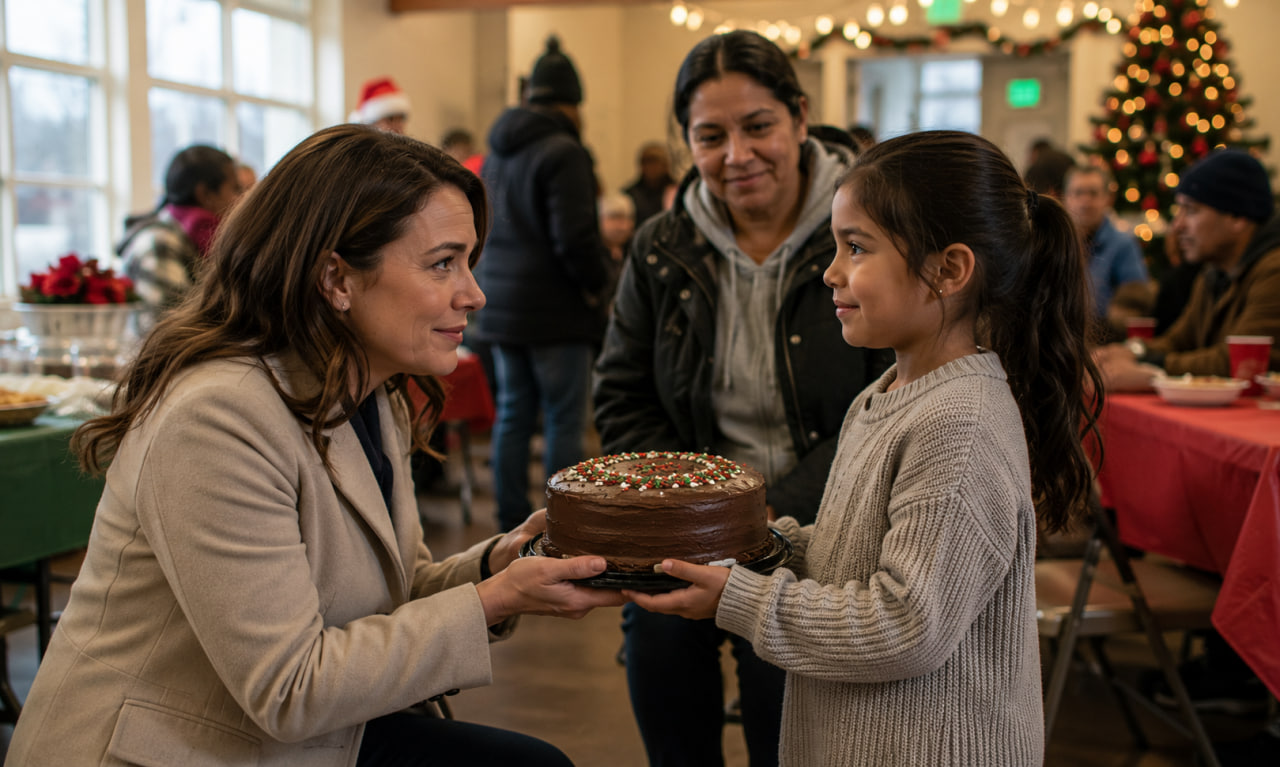
“Can I still have Christmas cake next year?”
I laughed.
“If you want.”
She hugged me.
That tiny hug stayed with me.
Not because she was grateful.
Because she wasn’t afraid.
She wasn’t asking whether the house was really hers.
She wasn’t calculating what I could provide next.
She simply trusted that someone had helped her.
And that was enough.
Months passed.
My parents changed slowly.
Not perfectly.
But genuinely.
Dad started volunteering twice a week at the community center.
Mom joined a senior walking group.
They downsized their expenses and stopped asking me to cover every unexpected bill.
They eventually moved into a smaller apartment they could comfortably afford.
It wasn’t the bungalow.
It didn’t have a bay window.
It didn’t have a big yard.
But it was theirs.
One Sunday afternoon, Mom invited me to dinner.
I almost declined.
Then I accepted.
When I arrived, Dad opened the door.
He smiled.
“Your mother made too much food.”
I laughed.
“She always does.”
Mom came from the kitchen.
For a second, everything felt like it used to.
Then she stopped.
“You don’t have to stay if you’re uncomfortable.”
I looked at her.
“I know.”
She nodded.
“I just wanted you to know that.”
We ate dinner.
No arguments.
No financial discussions.
No hidden expectations.
Just conversation.
Afterward, Dad brought out a small envelope.
“I want you to have this.”
I opened it.
Inside was a handwritten letter.
Not a legal document.
Not a request.
Just words.
He had written:
We spent years believing that because you were strong, you didn’t need protecting. Then we confused your strength with permission to lean on you forever. We were wrong. You didn’t abandon us when you stopped paying for everything. You finally gave us the chance to stand on our own. I’m sorry it took losing your trust for me to understand that.
I read it twice.
Then I looked at him.
“Thank you.”
He nodded.
Mom was crying.
I reached across the table and held her hand.
We didn’t magically become a perfect family.
We never would.
Some wounds don’t disappear simply because someone apologizes.
But things changed.
And that mattered.
A year after that Christmas, I returned to the bungalow.
Snow covered the yard again.
But this time, there were lights in the windows.
Children’s drawings were taped to the glass.
I knocked.
Laya opened the door.
She was taller.
Her ponytail was longer.
And she smiled before throwing her arms around me.
“It’s you!”
“It’s me.”
Monica appeared behind her.
“We’re doing okay,” she said.
“I can see that.”
She smiled.
“I got a full-time job.”
“That’s wonderful.”
“And we’re moving into our own apartment next month.”
I smiled.
“Then the bungalow will help another family.”
“Yes.”
Laya looked disappointed.
“Does that mean we have to leave?”
“No,” I said. “It means you’re ready.”
She thought about that.
Then she smiled.
“Mom says that’s a good thing.”
“It is.”
She hugged me again.
Before I left, Monica handed me something.
A small paper box.
Inside was a slice of chocolate cake.
I laughed.
“You remembered.”
“Of course.”
She smiled.
“Some gifts stay with you.”
I drove home that evening thinking about the Christmas when I had almost given my parents everything.
I had thought the house was the gift.
It wasn’t.
The real gift was learning that love doesn’t require self-abandonment.
You can love your parents and still say no.
You can love your sister without solving her life.
You can forgive someone without giving them the same access to you.
And sometimes, the most loving thing you can do for someone is stop making their life easier in the wrong way.
A few days before Christmas that year, Mom called.
“Chocolate cake or apple pie?”
I smiled.
“What’s the occasion?”
“Christmas.”
I laughed.
“Which day?”
She laughed too.
“Christmas Day. We checked the calendar this time.”
Dad shouted something in the background.
“What did he say?”
Mom covered the phone.
Then she came back.
“He said he wants apple pie.”
“And you?”
“Chocolate cake.”
“Then bring both.”
There was a pause.
“Are you coming?”
I looked out my window.
Snow was beginning to fall.
“Yes, Mom.”
Her voice became quiet.
“Good.”
And for the first time in a long time, I didn’t feel like I was walking back into an obligation.
I was walking into a family.
A family that had finally learned that love wasn’t measured by how much one person could sacrifice.
The following Christmas morning, I arrived at my parents’ apartment carrying two desserts.
Mom opened the door.
Dad was standing behind her.
And for a moment, nobody said anything.
Then Dad smiled.
“You brought both.”
“I did.”
Mom hugged me.
Dad hugged me too.
It wasn’t perfect.
It wasn’t the family I had imagined when I bought the bungalow.
But it was real.
And sometimes real is better than perfect.
Later that afternoon, my phone buzzed.
A message from Laya.
Merry Christmas! We have our own apartment now!
Below it was a picture of her standing beside a tiny Christmas tree.
I stared at the photograph for a long time.
Then I smiled.
Because one year earlier, I had been sitting alone in a grocery-store parking lot, holding a chocolate cake I no longer had anyone to give it to.
I had thought Christmas had been ruined.
I had thought my family had taken something from me.
But they hadn’t.
They had only shown me something I had been too afraid to admit.
My worth was never determined by what I provided.
The house hadn’t been the ending.
It had been the beginning.
The beginning of boundaries.
The beginning of forgiveness.
The beginning of a healthier relationship with my parents.
And the beginning of a little girl’s journey from temporary shelter to a home she could finally call her own.
I never regretted canceling that gift.
Not once.
Because the best decision I made that Christmas wasn’t taking something away from my parents.
It was finally understanding that giving should come from love—not fear, guilt, or the belief that people will only stay if you keep paying the price.
And that Christmas, for the first time in years, I came home with an empty purse.
No property documents.
No checks.
No promises.
Just two empty cake boxes…
and a heart that finally felt full.



One Comment on “PART4: My Parents Celebrated Christmas Without Me—Then Asked What Happened to the $285,000 House I Was Giving Them”