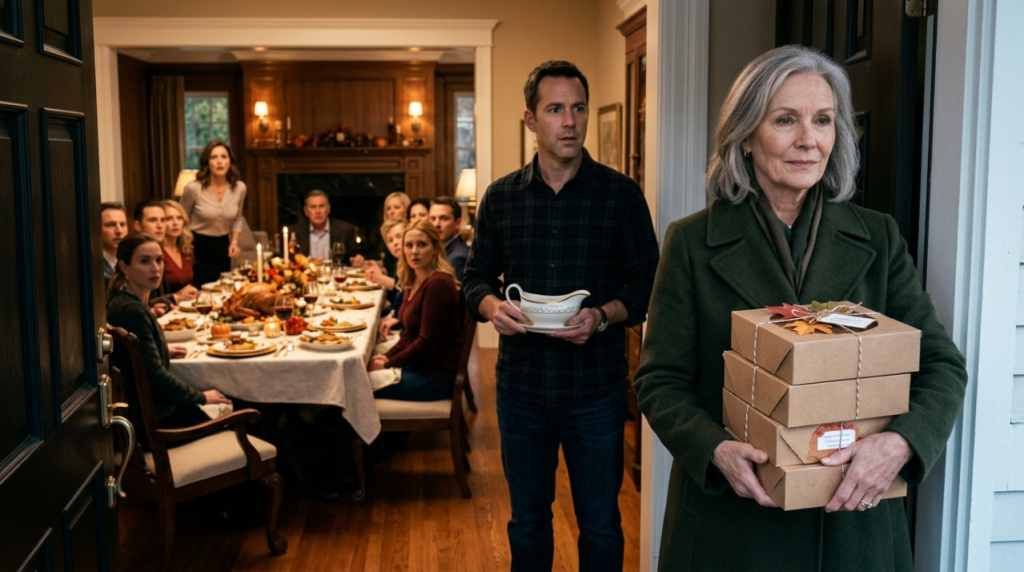
PART4: The Thanksgiving Table — The Pie Baker Who Was Never Invited…
PART4
She was crying so hard that her words came out uneven.
“I didn’t steal it.”
I looked at her.
“I didn’t say you did.”
She wiped her cheeks.
“Your son gave it to me.”
I turned toward David.
He looked stunned.
“Mom, I didn’t remember.”
“You didn’t remember?”
“I thought it was Melissa’s family’s.”
Melissa shook her head quickly.
“No. You said your mother wouldn’t want it.”
I stared at my son.
That sentence hurt more than I expected.
Not because of the bowl.
Because of what it meant.
He had taken something from my home after his father died and handed it away because he believed I wouldn’t notice.
Or maybe because someone had told him I wouldn’t.
I looked at the gravy boat.
That little white thing had held my mother’s gravy every Thanksgiving since I was twelve.
I remembered my mother polishing the gold rim with an old dish towel.
I remembered my father scraping the last spoonful from it.
I remembered my husband laughing the first year I made too much gravy.
“Nobody needs this much,” he’d said.
And then he’d gone back for thirds.
I smiled despite myself.
“I don’t want an apology for the gravy boat.”
Melissa looked surprised.
“I don’t?”
“No.”
I took the boat from David.
“I want the truth.”
The room stayed silent.
I held the porcelain against my coat.
“All of it.”
David looked at his wife.
Melissa looked at her mother.
Her mother looked back at her.
Then Melissa sat down.
“Three years ago,” she began, “I was angry.”
Nobody interrupted.
“David and I had just bought the house. My parents had helped with the down payment. His mother kept offering to help too, and I felt like she was always comparing herself to them.”
I almost laughed.
“I never compared myself to your parents.”
“I know that now.”
“Now?”
Melissa covered her face.
“I was insecure.”
Her mother’s expression hardened.
“That is not an excuse.”
“I know.”
David stood motionless.
Melissa continued.
“The first Thanksgiving, your mother called and asked what time dinner was.”
I waited.
“I told her we were doing something small.”
“You told me that.”
“I know.”
“And?”
“I told you it was just family.”
I nodded slowly.
“And you considered me not family?”
“No.”
She cried harder.
“I considered you dangerous.”
The room went quiet.
I could have reacted.
Instead I asked, “Dangerous?”
“Not physically.”
She swallowed.
“You were strong. You knew David better than anyone. I was afraid that if you were here, everyone would compare me to you.”
I looked at her.
“Melissa, nobody was comparing you to me.”
“You were the woman who had raised him. You knew all his habits. You knew how he liked things cooked. You knew his childhood stories. You knew his father.”
Her voice cracked.
“And I was terrified I would never measure up.”
I said nothing.
Because there was something tragic about being hated for qualities you never used against anyone.
“So you lied,” I said.
She nodded.
“Yes.”
“You told me David wanted a small Thanksgiving.”
“Yes.”
“You told David I didn’t want to come.”
“Yes.”
“And everyone else?”
She looked down.
“I told them you were difficult.”
I heard a quiet breath from someone at the table.
Her mother looked horrified.
“Melissa.”
“I know.”
“No,” her mother said. “You don’t.”
Melissa began to sob.
“I thought it would be one year.”
“Then two.”
“Yes.”
“Then three.”
She nodded.
I looked at my son.
“What did you think happened?”
He rubbed his forehead.
“I thought you were hurt because you felt rejected by Melissa.”
I nodded.
“And I thought maybe giving you space was better.”
“You never called me.”
“I called.”
“Twice.”
He looked down.
I knew then.
He had called after Thanksgiving.
Not before.
Never before.
A mother notices those things.
“I waited for you,” I said.
He looked up.
“I know.”
“No. You don’t.”
My voice remained calm.
“I sat at my little kitchen table every Thanksgiving and waited for the phone to ring before dinner. I told myself you were busy. I told myself the children were tired. I told myself Melissa’s family had plans. I told myself you would call after dessert.”
I touched the gravy boat.
“And every year I said the same thing to myself.”
My son whispered, “What?”
“Maybe next year.”
His face crumpled.
He turned away.
I looked at the fourteen people around the table.
“I didn’t come here to destroy your Thanksgiving.”
No one moved.
“I came because I was tired of being imaginary.”
That sentence broke something.
My son walked toward me.
“Mom.”
I held up my hand.
“Not yet.”
He stopped.
I could see the boy he had been inside the man he had become.
The child who once slept beside my bed when storms frightened him.
The teenager who stole the car and came home at midnight.
The young man who called me from college because he didn’t know how to wash a white shirt.
My son.
Still my son.
But not innocent.
“I forgive you,” I said.
His eyes filled.
“But I don’t forgive what you failed to ask.”
He nodded.
“I should have asked.”
“Yes.”
“I should have come to your house.”
“Yes.”
“I should have noticed.”
“Yes.”
He wiped his face.
“I’m sorry, Mom.”
The room waited.
I believed him.
But forgiveness isn’t the same thing as pretending it never happened.
So I looked at Melissa.
“And you?”
She stood.
“I am sorry.”
I waited.
She took another breath.
“I don’t expect you to forgive me today.”
“Good.”
She nodded.
“Because I know I don’t deserve it.”
Her mother rose.
“Melissa, your father and I will help you clean up after dinner.”
Melissa nodded.
Then her mother looked at me.
“Mrs. Bennett, I’m ashamed.”
I shook my head.
“Don’t be.”
“I should have known.”
“None of you knew.”
“Your daughter-in-law told us you wanted to be alone.”
I nodded.
“That was the whole point.”
Her father cleared his throat.
He had been silent the entire time.
“Would you like to stay?”
I looked at him.
The question came gently.
No pressure.
No pity.
Just an invitation.
For a moment I looked at the table.
Fourteen chairs.
Fourteen plates.
And one empty space that had apparently been reserved for a lie.
Then I looked at my son’s face.
I could have said no.
Part of me wanted to.
Part of me wanted to take the gravy boat home, close my door, and make my own little Thanksgiving where nobody could exclude me because nobody else would be there.
But then I looked at the sweet potato pie.
My pie.
The one with extra nutmeg.
The family recipe.
And suddenly I remembered what my mother used to say.
Food tastes different when eaten angry.
So I smiled.
“I’ll stay for dinner.”
My son exhaled like a man who had been holding his breath for three years.
Melissa began crying again.
But this time, she smiled through it.
I walked into the dining room.
One of the children jumped up.
“Grandma!”
I froze.
My granddaughter came running across the room.
She threw her arms around me.
I held her tightly.
“Grandma, why didn’t you tell me you worked here?”
I laughed softly.
“I didn’t think it was a very interesting secret.”
She pulled back.
“You’re the pie lady?”
“Apparently.”
She grinned.
“I’ve been eating your pies for years!”
“So I hear.”
She hugged me again.
Then she whispered, “I missed you.”
That was when I almost cried.
Not because I had been forgotten.
Because I realized somebody had remembered.
I sat down.
Not at the head.
Not beside my son.
Just wherever there was room.
Because that day I finally understood something.
A place at a table does not prove you belong.
But sometimes being invited is how a family begins learning to make room.
Dinner started awkwardly.
Nobody knew what to say.
Then my granddaughter asked me why the gravy was so good.
I laughed.
“That’s my mother’s recipe.”
My son looked at me.
“Can you teach me?”
I raised an eyebrow.
“To make gravy?”
“Everything.”
I looked at him for a long moment.
Then I smiled.
“Yes.”
The dinner went on.