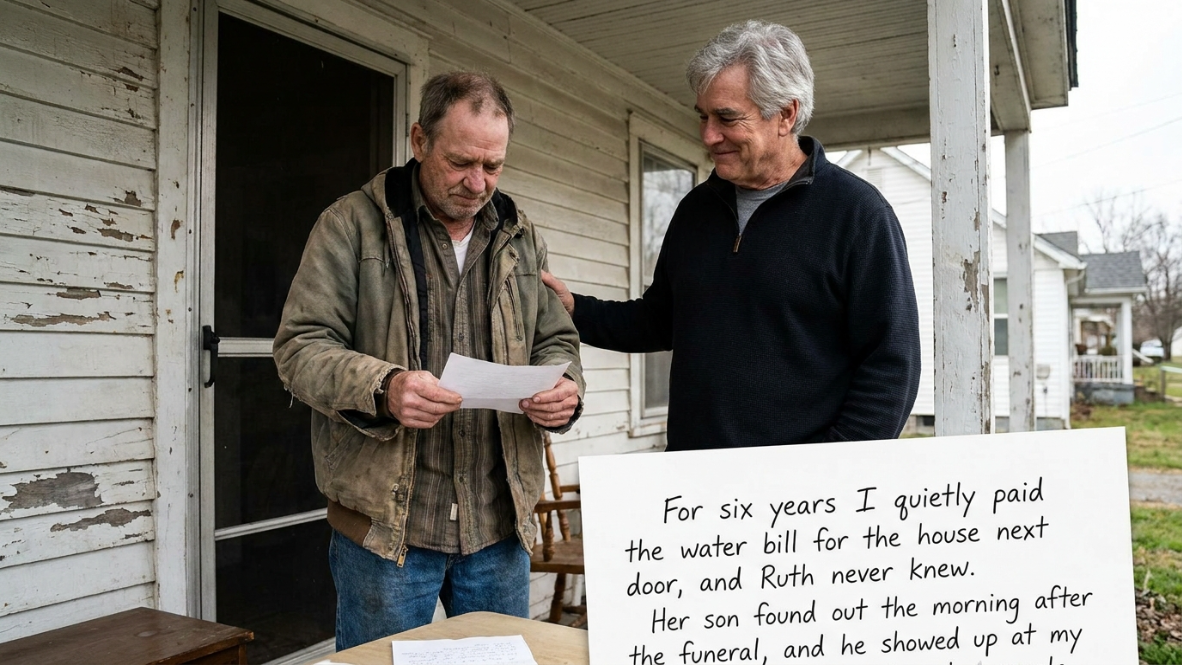
PART5-The Neighbor Who Paid Her Water Bill for Six Years — Then Her Son Discovered the Truth
PART 5
The next morning, I walked across the small patch of grass between our houses.
For six years, I had walked that path carrying groceries, newspapers, flowers, and sometimes just myself.
But that morning felt different.
I unlocked Ruth’s door with the spare key she had given me years ago.
The first thing I noticed was the smell.
Lavender.
She always kept lavender sachets around the house.
“You know why I like lavender?” she once told me.
“Because it smells nice?”
“No.”
She smiled.
“Because it reminds me that small things matter.”
I stood in the doorway for a long time.
I didn’t want to touch anything.
It felt wrong.
Like entering a room where someone had just left.
On the table was a small envelope with my name on it.
Mary.
Just my first name.
No Mrs. Doyle.
No formal words.
Just Mary.
My hands shook slightly as I opened it.
Inside was a handwritten letter.
Dear Mary,
If you are reading this, then I suppose I am no longer able to annoy you by asking if you have eaten lunch yet.
I laughed.
Even then, she was still Ruth.
I know you will probably be angry when you learn about the house.
You will say you didn’t do anything special.
You will say you only paid a bill.
You will say you were just being a neighbor.
But Mary, I need you to understand something.
People think kindness is measured by grand gestures.
They think you have to save someone’s life or give away everything you own.
That is not true.
Sometimes kindness is noticing.
Noticing the porch light is off.
Noticing someone hasn’t opened their curtains.
Noticing a person has become invisible.
You noticed me.
I stopped reading.
My eyes blurred.
I wiped them and continued.
My son loves me. I want you to know that.
But he spent so much time trying to protect what I had that he forgot to protect who I was.
You did the opposite.
You protected my dignity.
You allowed me to remain Ruth.
Not an old woman.
Not a burden.
Not a bank account.
Just Ruth.
The tears came before I could stop them.
I sat down at her kitchen table.
The same table where we had shared coffee every Sunday morning.
The same table where she had beaten me at cards hundreds of times.
The same table where she told me she was scared.
The letter continued.
I want you to have the house because I know you will not let it become empty.
I know you will open the curtains.
I know you will keep the flowers alive.
I know you will remember that a home is not made of walls.
It is made of people.
But there is one more thing.
I turned the page.
My heart started beating faster.
Please do not give Gerald the house.
I froze.
That was not what I expected.
Not because I hate him.
Not because I want to punish him.
But because I need him to understand something.
For years, he believed he was entitled to everything I had because he was my son.
But family is not proven by inheritance.
Family is proven by presence.
I read the sentence twice.
Then a sound came from behind me.
The front door.
I turned.
Gerald stood there.
I almost dropped the letter.
“What are you doing here?”
He looked exhausted.
Older than he had three days earlier.
“I came to apologize.”
I folded the letter slowly.
“You’re too late for that.”
He nodded.
“I know.”
For once, there was no anger.
No lawyer.
No accusations.
Just a tired man standing in his mother’s house.
“I read the rest of the documents,” he said.
I didn’t respond.
“I know what she wrote.”
I looked at him.
“And?”
He swallowed.
“And she was right.”
That surprised me.
“I spent years thinking my mother was going to leave everything to me because I was her son.”
He looked around the room.
“But I forgot she was a person before she was my mother.”
The silence between us was heavy.
“I don’t want the house,” he said.
I studied his face.
“What?”
“I don’t want it.”
“Why?”
“Because she wanted someone here who loved it.”
He looked at the photographs on the wall.
“I haven’t been here in two years except for holidays.”
He laughed sadly.
“I knew the value of the house.”
A pause.
“But I forgot the value of the woman inside it.”
For the first time, I saw Ruth’s son.
Not Gerald the angry man.
Not Gerald the lawyer’s client.
Just a son who lost his mother and finally understood what he had lost.
“What happens now?” I asked.
He looked at me.
“I don’t know.”
Neither did I.
But then he walked over to the kitchen counter and picked up an old photograph.
It was Ruth and Gerald.
He was about eight years old.
She was holding his hand.
Both of them were smiling.
“She kept this here my whole life,” he whispered.
“Yes.”
“She never took it down.”
“No.”
He closed his eyes.
“She really loved me.”
“Yes,” I said.
“She did.”
He nodded.
Then he asked the question I never expected.
“Can I come here sometimes?”
I looked at him.
“Why?”
He looked around the house.
“Because I want to know my mother.”
The answer broke something open inside me.
Because that was the one thing Ruth wanted.
Not money.
Not revenge.
Not for Gerald to suffer.
She wanted him to understand.
And maybe, finally, he did.
But there was still one final thing Ruth had arranged before she died.
Something neither Gerald nor I knew.
Something that would change everything about the house next door.
Three weeks later, when the official papers arrived, we discovered Ruth’s final request.
And it wasn’t about who owned the house.
It was about who needed it most.


One Comment on “PART5-The Neighbor Who Paid Her Water Bill for Six Years — Then Her Son Discovered the Truth”