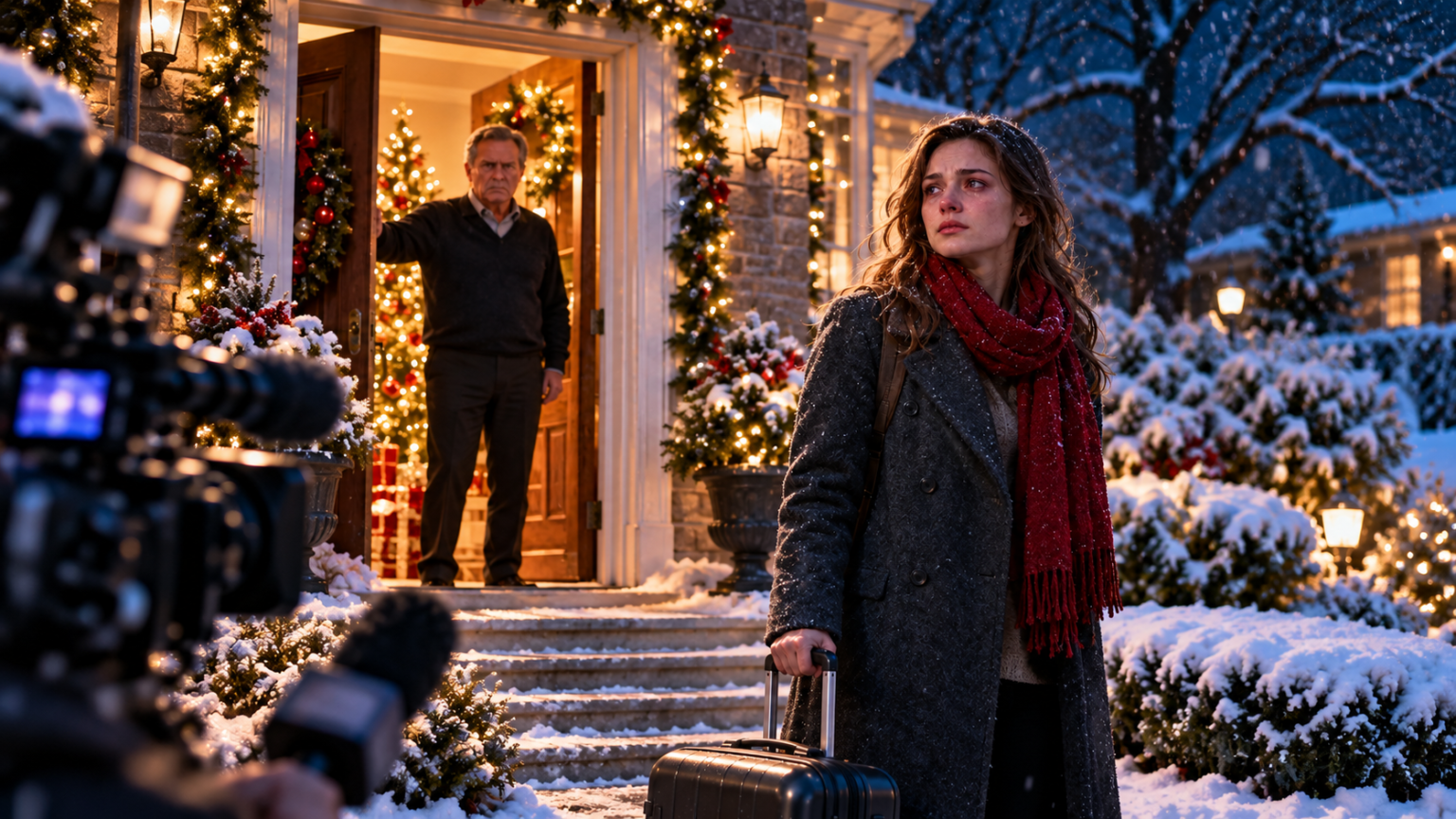
The wall between my father and me finally began to crack while I was three hundred yards from a jackknifed fuel tanker on a Colorado interstate, on a night when the snow came in sideways and the wind screamed loud enough to swallow a person’s voice whole.
I was shouting into a radio, requesting a medical evacuation helicopter that could not safely fly through that wind. Emergency lights pulsed through the whiteout, turning the snow around us red, then blue, then a strange ghostly white, over and over, like the world itself couldn’t decide what color the night should be.
I did not know that my name was about to appear on television screens across the country.
I did not know that the man eating Christmas dinner without me was about to see my face on the evening news and drop a wineglass onto his kitchen floor.
All I knew was that a stranger’s life was fading in front of me, and I might be the only person close enough to change the outcome.
But to understand that night, you have to understand the phone call that came three days before it.
My father called at seven in the evening, just as I was locking my office for the night. I remember the exact moment because I had my winter coat hanging halfway off one shoulder and my keys in my hand, and I almost let the call go to voicemail. Almost.
“Don’t come this year,” he said.
There was no hello. No question about my day. No attempt to soften the words. Just four words, dropped like stones.
I stood in that dark hallway with the phone pressed to my ear, and for several seconds I honestly believed I had misunderstood him. That the connection had cut out. That he’d meant something else entirely.
“Jason’s going to be here,” he continued, as though that explained everything.
“Okay,” I said slowly. “That’s fine, Dad. I haven’t seen Jason in a while.”
“I don’t want you making things awkward for him.”
Something inside my chest went completely still. It was the kind of silence that arrives right before training takes over — the half second when your instincts warn you that whatever comes next is going to hurt, and hurt in a way you won’t be able to un-hear.
“Awkward how?” I asked, although a tired and resigned part of me already knew.
My father sighed. It was not a spontaneous sigh. It sounded practiced, like he had run through this conversation several times in his head before he ever dialed my number. Like he’d been rehearsing my role for me too, and I was already going off script by asking questions.
Jason had recently gotten married. His new in-laws would be attending Christmas dinner. So would several neighbors and family friends. My father did not want anyone asking me about the Army, my deployments, or my work. He did not want my presence to make Jason feel overshadowed.
“He’s finally settling down with Erica,” my father said. “They’re building something together. I don’t want the attention pulled in another direction. Not this year.”
I want you to understand something about who I was in that moment. I had stood in briefing rooms with generals. I had presented operational plans to colonels twice my age without letting my voice shake. I had eighteen years in uniform and a rank most people never reach.
But something about my father’s tone made me eighteen years old again.
Standing there in that hallway, I could suddenly see myself in our old driveway with a duffel bag at my feet, the morning I left for basic training. My father had been in the yard that day, but he wasn’t looking at me. He was shaking Jason’s hand, congratulating him — for what, I honestly can’t remember anymore. Some award. Some game. Something that wasn’t even Jason’s graduation, on the day his daughter was leaving for the Army.
Jason was my stepbrother. My father had remarried several years after my mother died, and Jason had come into our lives as a teenager. He wasn’t a bad kid. He wasn’t cruel. But somewhere along the way, my father began treating him as the son he had always wanted.
And I became the daughter who was assumed to be fine.
That’s the thing nobody warns you about. Families don’t always push you out with a fight. Sometimes they just quietly stop setting your place at the table, and by the time you notice, the seat has been gone so long that asking for it back feels like causing a scene.
“I understand,” I said into the phone.
That was all. I did not argue. I did not ask him to reconsider. I did not remind him that I had already purchased a plane ticket, or that I had rearranged my holiday duty schedule months earlier, trading favors with other officers, just to be free those four days.
Eighteen years in uniform had taught me which battles were worth fighting and which ones required you to walk away while your dignity was still intact.
This was the second kind.
I ended the call, drove back to my small apartment near the base, and sat on the edge of my bed for a long time. The apartment was quiet the way it’s always quiet. A framed photo of my mother sat on the dresser. Her Christmas tablecloth — the one thing of hers I’d asked for after she died and never gotten, because it stayed at my father’s house — flashed through my mind, and I pushed the thought away.
Then I did what I always did when emotions became too complicated to organize.
I opened my laptop and canceled the flight.
Two clicks. A confirmation email. Done. It’s strange how the biggest wounds in a family can be handled with the smallest gestures. Nobody screams. Nobody slams a door. You just click a button that says “Cancel Reservation,” and a piece of you clicks off with it.
My team learned about the change two days later, when Sergeant Alvarez asked what time my plane departed on the twenty-third.
“Plans changed,” I told her.
She studied me for a moment. Alvarez had been with me for six years, through two deployments and more bad nights than either of us would ever talk about. She could read me better than anyone alive. But she did not press. Good soldiers know when a subject has been closed.
An hour later, however, she cornered me near the motor pool, wiping grease off her hands with a rag and blocking my path like it was an accident.
“My sister’s house,” she said. “Christmas dinner. You’re invited. No argument accepted.”
“I have the duty roster to think about.”
“Ma’am. With respect. My sister makes tamales that would end wars. You’re coming.”