FINAL PART
I nodded, unable to speak.
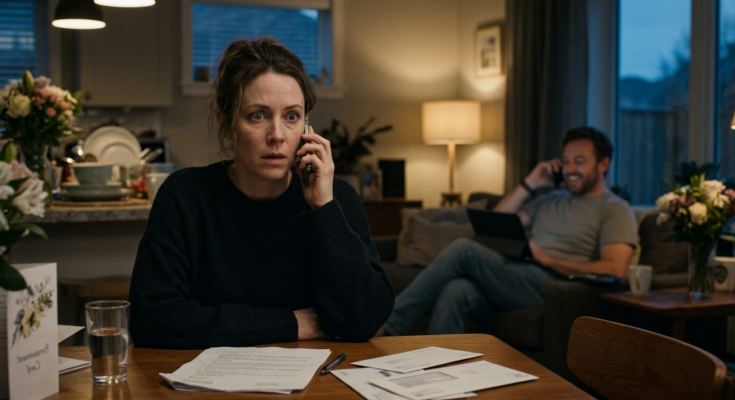
After Gloria left, Paul and I stood alone in the dining room.
He looked exhausted.
For a moment, I saw the man I had married at 33. The man who had held my hand at my mother’s funeral, who had helped me through difficult years at work, who had once driven through a snowstorm because I was sick and wanted soup from my favorite restaurant.
Those memories were real.
But so were the emails.
So was the hidden loan.
So was the way he had treated my father’s death as the beginning of his retirement.
“Can we fix this?” he asked.
I wanted to say yes.
I wanted to return to the safety of what I had always believed about us.
But love was no longer enough to answer the question.
“I don’t know,” I said. “But I know we can’t fix it by pretending it never happened.”
He sat down and covered his face with his hands.
For the first time since the funeral, he didn’t argue.
He didn’t blame Thomas.
He didn’t mention the money.
He simply sat there.
And I realized that I no longer needed him to admit everything before I could begin protecting myself.
I could take the next step without knowing the final answer.
Over the following weeks, Thomas completed the initial estate review.
Dad’s assets were substantial, although the final distribution took time. His estate paid its legitimate obligations, and the outstanding loan to Paul was handled according to the agreement and the available records.
The review also confirmed that the estate arrangements Dad had created gave me financial security without requiring me to hand control of my inheritance to anyone else.
I didn’t suddenly become a different person.
I was still Nora.
I still missed my father every morning.
I still cried when I heard his favorite song or found one of his handwritten notes in an old book.
But I began making decisions differently.
I met with an independent financial adviser.
I reviewed my own accounts.
I learned exactly what I owned, what I owed, and what I could afford.
And I made one decision that surprised everyone, including me.
I did not give Paul control of the inheritance.
I also refused to hand out money simply because relatives had already begun imagining how they would spend it.
Denise eventually closed her struggling business location through a plan she developed with her creditors. I offered to help her find a qualified financial counselor, but I did not pay her $200,000.
Gloria remained in her apartment for the time being. She eventually found a smaller home within her own budget, and I wished her well.
Neither woman received the windfall Paul had promised.
But neither was left without the ability to make her own choices.
As for Paul, the weeks that followed were difficult.
He initially insisted that his decisions were no different from any husband making plans for retirement.
Then he accused me of letting my father’s lawyer turn me against him.
Finally, when I showed him the emails Denise had shared, he stopped arguing.
He admitted he had assumed the inheritance would be large enough to cover everything.
He admitted he had been embarrassed about the old business loan.
And he admitted he had convinced himself that telling me after the fact was easier than risking an argument beforehand.
“I didn’t think you would say no,” he told me one evening.
I looked at him across the table.
“That is exactly the problem.”
We tried counseling.
For several months, we attended appointments and discussed the patterns that had shaped our marriage. Paul began to understand that his habit of making decisions first and asking for forgiveness later was not generosity.
It was control disguised as good intentions.
But understanding something and changing it are different things.
I watched carefully.
I waited to see whether he could accept a boundary without punishing me for setting it.
Sometimes he could.
Sometimes he couldn’t.
Eventually, I realized that I could forgive him for the pain he had caused without agreeing to continue living the same way.
We separated.
The decision was not made in anger, and it wasn’t about punishing him with money. We worked with separate attorneys to address our finances and the practical questions involved in ending a 22-year marriage.
I kept the inheritance that legally belonged to me, subject to the terms of the estate and applicable law. Our marital assets were addressed separately through the proper process.
Paul had to make his own decisions about work, retirement, and the future he wanted.
For the first time in years, neither of us could make those decisions on behalf of the other.
On the anniversary of Dad’s death, I drove to the cemetery with a small bouquet of white roses.
I sat beside his headstone and told him everything.
I told him about the inheritance, the loan, the arguments, and the marriage I had tried so hard to save.
I told him that I still loved Paul in some ways, even though I could no longer live with him.
And I told him I was sorry I hadn’t understood sooner what he meant by giving me choices.
The wind moved gently through the trees.
For a long time, I sat in silence.
Then I remembered another line from Dad’s letter.
You don’t have to prove your love by giving everything away.
I placed the roses beside his name.
“I understand now, Dad,” I whispered.
“I really do.”
A year later, I was sitting in the small sunroom of the house I had chosen for myself.
It wasn’t a mansion.
It wasn’t a grand display of wealth.
It was a quiet home with a garden, a comfortable kitchen, and enough room for the people I loved to visit without making me feel that I owed them anything.
I still worked because I wanted to, not because I was afraid of running out of money.
I spent more time with friends.
I took a trip I had postponed for years.
And I learned that peace was worth more than the approval of people who only felt comfortable when I agreed with them.
One afternoon, Paul called.
We spoke politely about a few practical matters that still needed attention.
Before hanging up, he said, “I wish I had handled everything differently.”
I believed that he meant it.
But I had learned that regret could not undo a decision, and an apology did not obligate me to return to the life I had left.
“I wish that too, Paul,” I replied.
Then we said goodbye.
After the call, I walked into the garden and sat beneath the tree I had planted in Dad’s memory.
I thought about the question Thomas had asked me that first morning.
Has anyone already started spending money they think you inherited?
At the time, I thought the question was about money.
It wasn’t.
Not really.
It was about the people who had mistaken my future for their opportunity.
It was about the difference between sharing a life with someone and surrendering the right to make decisions about it.
And it was about a father who had understood that his daughter might one day need permission to choose herself.
I never learned every thought my father had carried into his final months.
Perhaps he had worried about Paul. Perhaps he had simply understood my generous nature and wanted to protect my choices.
But I knew what he had left me.
More than investments, property, or money, he had left me a reminder that my life belonged to me.
And that was the inheritance I would never give away.


One Comment on “FINAL PART: My Husband Quit His Job 3 Days After My Father Died—Then Promised My Inheritance to His Family Before I Even Knew How Much I’d Get”