PART4
After we hung up, I made tea and opened the notebook I’d taken to Brian’s office.
On the first page, I wrote three things.
My health. My money. My independence.
Under each heading, I made a list.
My health: schedule an appointment with my doctor for a proper driving assessment, discuss my eyesight, and ask whether there were any concerns I needed to address.
My money: review my accounts, check the Buick title paperwork, and speak with an attorney about my rights.
My independence: find safe ways to get around town, including my bicycle, the bus, and rides with friends.
I didn’t write those things because I intended to prove Brian wrong.
I wrote them because I needed to know the truth for myself.
That afternoon, I called the clinic and scheduled an appointment.
Then I called a local attorney whose advertisement I’d seen in the newspaper.
His name was Mr. Collins, and his receptionist offered me an appointment for the following Tuesday.
Finally, I called Brian’s wife.
Megan answered while I could hear children playing in the background.
“Evelyn! How are you?”
“I’m well, dear. I was wondering if you knew what happened to the Buick.”
There was a pause.
“What do you mean?”
“Brian sold it.”
Another pause, longer this time.
“Oh.”
That single word told me more than a whole speech might have.
“You knew?”
“I knew he was worried about you driving. I didn’t know he’d actually sold it.”
I leaned back in my chair.
“Did he discuss it with you?”
“He said he was handling it.”
“Handling what?”
“I don’t know, Evelyn. Your car, I suppose.”
I heard a door close on her end.
“Listen,” she said quietly, “Brian’s been under a lot of pressure lately. Work has been difficult, and the kids’ school expenses are piling up. He’s been worried about everything.”
“I understand that.”
“He thought he was helping.”
“Perhaps. But helping someone doesn’t mean you get to decide everything for them.”
“No,” Megan said. “I suppose it doesn’t.”
Her voice sounded tired.
I almost asked whether Brian had told her something else, but I decided not to.
Instead, I said, “I hope you’re doing well, dear. Give the children a kiss for me.”
After we hung up, I sat quietly for a while.
I loved my son. I loved his wife. I loved my grandchildren.
Nothing about that had changed.
But love, I was beginning to understand, could not be the only rule in a family.
There had to be respect, too.
And sometimes, respect had to be taught to people who had forgotten how to give it.
On Tuesday morning, I arrived at Mr. Collins’s office with my notebook, the Buick paperwork, and a folder containing every document I could find.
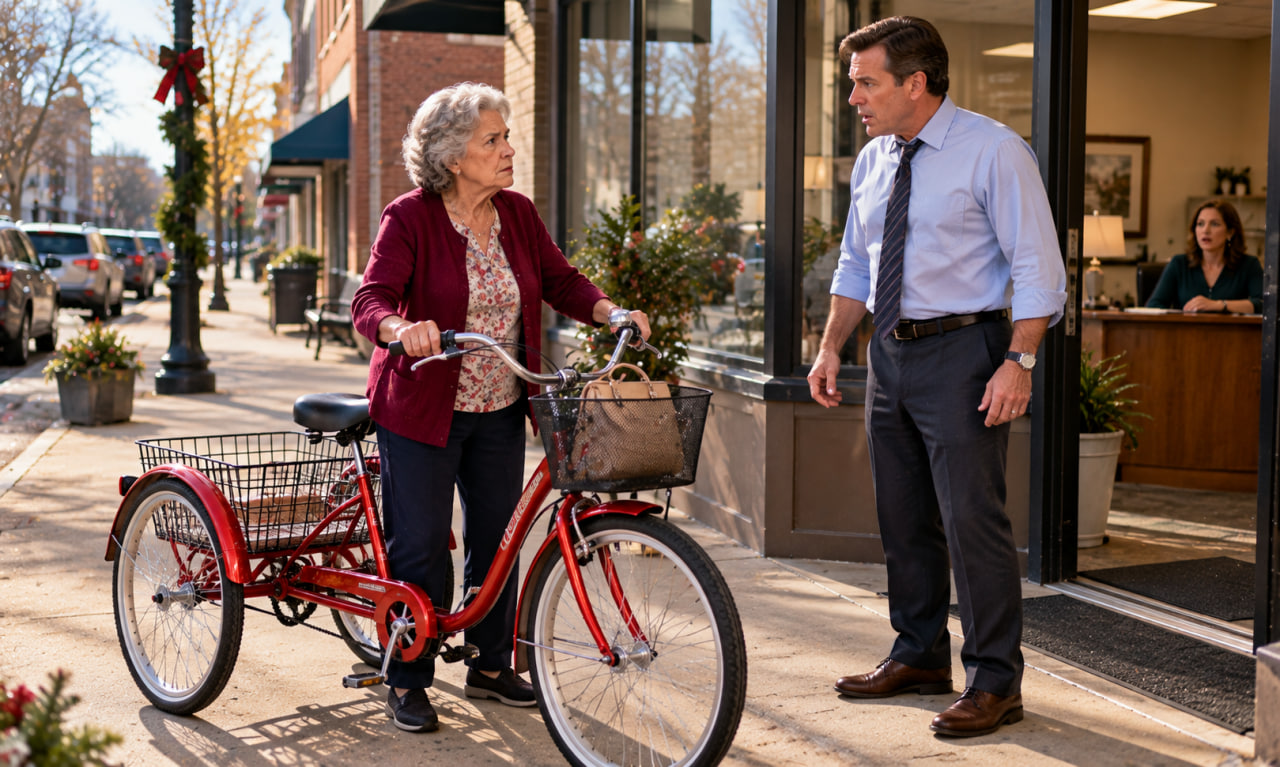
I had ridden the bicycle to the end of my street before calling Wilma to take me the rest of the way. I was learning that independence did not require me to do everything alone.
It required me to decide when to ask for help.
Mr. Collins was a small, silver-haired man with round glasses and a habit of listening without interrupting.
When I finished explaining what had happened, he examined the title and the sale documents.
“Because the title lists both of you with the word ‘or,’ your son may have had the authority to transfer the vehicle under state law,” he said. “I would need to review the full paperwork and applicable law before reaching a conclusion. But legal authority to sell a vehicle is not the same thing as having your informed agreement.”
“So I may not be able to get the Buick back?”
“Not necessarily. That depends on the documents, the transaction, and the circumstances. We should also find out what happened to the proceeds.”
I looked at the cashier’s check.
“Brian gave me this.”
“Have you deposited it?”
“No.”
“Good. Keep it safe while we determine exactly what it represents.”
He made copies of everything and asked whether Brian had ever been given authority to manage my bank accounts.
“No. He helps me with paperwork sometimes, but the accounts are mine.”
“Do you have a will?”
“Yes.”
“An updated one?”
I hesitated.
My husband and I had prepared our wills years ago. After he died, I had changed a few things, but that had been six years earlier.
Mr. Collins suggested reviewing it, along with my financial records, medical directives, and any documents that might grant someone authority to act on my behalf.
He was careful not to frighten me.
“Mrs. Bennett, planning ahead isn’t an accusation against your son. It’s a way to make sure your wishes remain clear, whatever happens.”
I liked that.
For years, I had believed that preparing for the future meant trusting my family to do what was best.
Now I understood that it also meant making sure they knew what I considered best.
Before I left, I asked one final question.
“Mr. Collins, what if my son truly believes he’s doing the right thing?”
He folded his hands.
“Then an honest conversation may help him understand the difference between protecting you and controlling you. But you are not required to surrender your rights simply because someone has good intentions.”
I walked out feeling lighter than I had in weeks.
The law had not handed me a magical solution.
It had given me something better.
A place to begin.
That evening, Brian called.
I was sitting at the kitchen table, writing in my notebook, when his name appeared on my phone.
“Hello, sweetheart.”
“Mom, did you go to a lawyer?”
I stopped writing.
“Who told you?”
“I called the house. You weren’t there. Wilma said she’d taken you to an appointment.”
“Then you already have your answer.”
He exhaled sharply.
“Why would you do that?”
“Because I wanted advice.”
“From a lawyer?”
“Yes, Brian. That’s generally what lawyers are for.”
“This is ridiculous. I’m your son.”


One Comment on “PART4: My Son Sold My Buick on My 76th Birthday—So I Rode a $389 Bicycle to His Office”