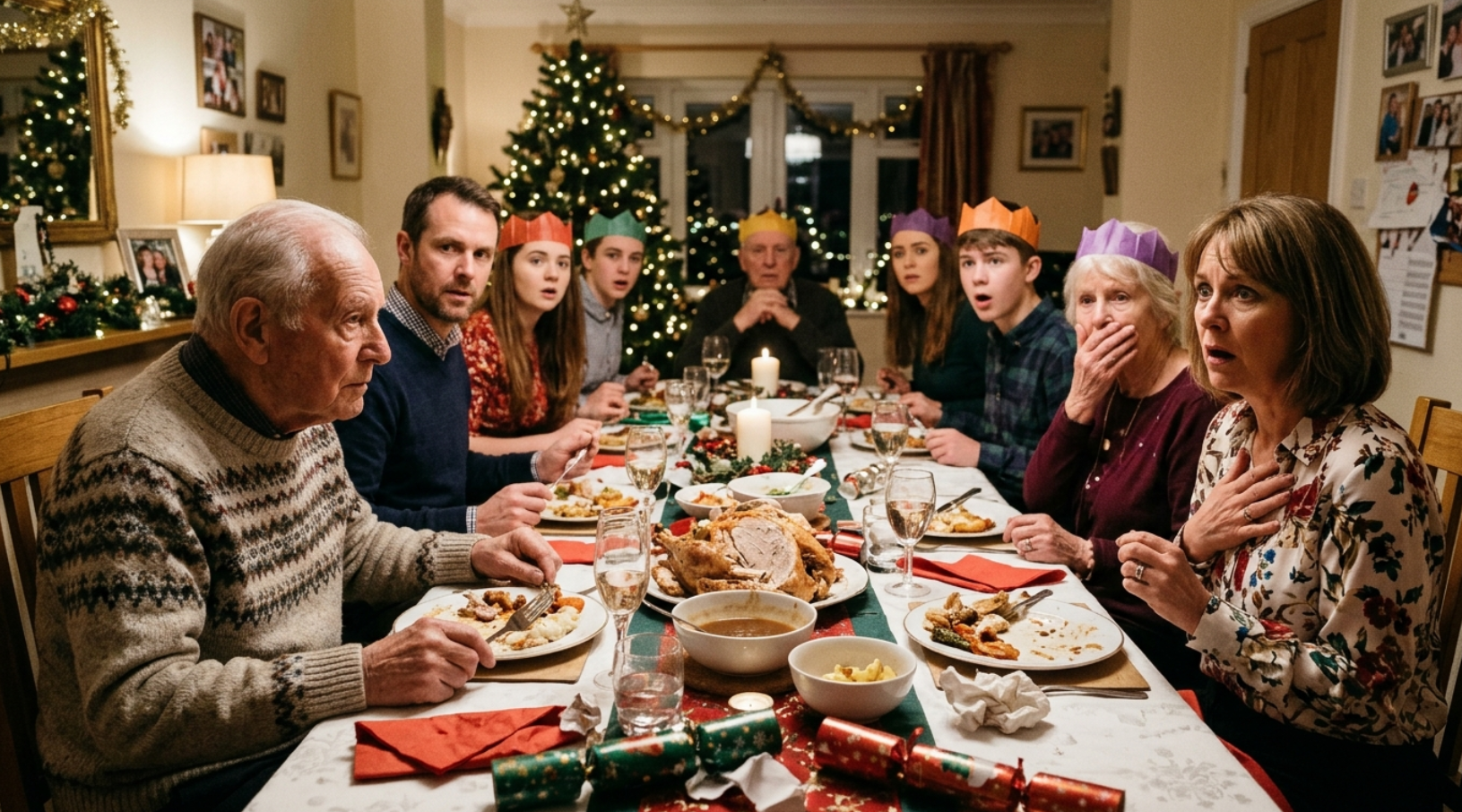
For Six Years, My Family Thought Grandpa Was Deaf—Until Christmas Dinner, When He Revealed He’d Heard Every Cruel Word They Said About His Inheritance
PART 3
My uncle Gary slowly lowered his fork. “Dad,” he said, forcing a laugh that sounded painfully unnatural, “come on. It’s Christmas. Whatever you think you heard, I’m sure there’s been some misunderstanding.”
Grandpa turned toward him. “Misunderstanding?” He opened the small green notebook.
“November 26, 2020. Thanksgiving dinner. You spent twenty minutes telling your wife that my combine would bring at least sixty thousand dollars at auction. You said you wanted the keys before I died so you could sell it without dealing with the other family members.”
Gary’s face lost its color. “That was just a conversation.”
“Yes,” Grandpa replied. “A conversation you had about selling my property while I was sitting three feet away from you.”
Nobody moved.
Grandpa turned another page.
“December 24, 2021. Christmas Eve. Brett asked you whether the old man would notice if you took the antique tractor from the barn. You told him I wouldn’t notice if he took the entire barn.”
My cousin Brett immediately sat up.
“That’s not what I meant!”
Grandpa looked directly at him.
“Then perhaps you can explain what you meant.”
Brett opened his mouth, but nothing came out.
I had seen my family argue countless times. I had watched them blame each other for broken fences, unpaid bills, missing tools, and ruined holidays.
But I had never seen them this afraid of a man they had spent years treating as though he didn’t exist.
Grandpa closed the notebook.
“I didn’t bring this up because I wanted to ruin Christmas,” he said. “I brought it up because your grandmother isn’t here anymore, and I’m tired of pretending I don’t know what kind of people you’ve become.”
His voice softened when he mentioned Grandma.
For the first time that evening, I saw the sadness underneath his anger.
He had lost the woman he loved after sixty-two years of marriage. The house was quieter now. Her chair beside the window remained empty. Her favorite blue mug still sat on the kitchen shelf because Grandpa couldn’t bring himself to put it away.
And instead of gathering around him, comforting him, or helping him through his grief, his children had spent the past eight months discussing how to divide his life.
Grandpa glanced toward the empty chair.
“Your mother used to tell me that family is the one thing money can’t replace. I believed her. I still do. But she also taught me that loving someone doesn’t mean allowing them to destroy you.”
Then he looked toward the front door.
“Katie, please bring Mr. Dawson inside.”
I stood so quickly that my chair scraped against the wooden floor.
“Of course, Grandpa.”
As I walked toward the porch, I heard Linda whisper urgently to Gary.
“What did he do? What has he signed?”
I didn’t stop.
I already knew that whatever Grandpa had planned, it wasn’t something he had decided that afternoon.
He had been preparing for this moment for years.
And I had a feeling the green notebook was only the beginning.
The December wind hit my face as I stepped onto the porch.
Mr. Dawson was sitting in his parked car, reading a document beneath the glow of the dashboard. He was Grandpa’s attorney, a quiet man in his late sixties who had helped Grandma and Grandpa manage their affairs for nearly thirty years.
When I knocked on his window, he looked up.
“Is he ready?” he asked.
“Yes. Everyone is inside.”
Mr. Dawson gathered his papers.
“Then let’s go.”
As we crossed the porch, I noticed the farmhouse looked different from the outside. Warm light spilled through the windows. Snow rested along the fence posts. The old barn stood dark against the winter sky, its enormous doors closed for the night.
I had spent most of my childhood here.
I had learned to ride a bicycle in the driveway, collected eggs from Grandma’s chickens, and helped Grandpa repair the fence after storms. I remembered him carrying me on his shoulders during the county fair because I was too small to see over the crowd.
Back then, the farm had never seemed like something valuable that could be sold.
It was home.
It was where Grandma taught me to bake apple pie, where Grandpa showed me how to plant corn, and where my parents brought me whenever life became too complicated.
But somewhere along the way, my relatives had stopped seeing the farm as a home.
They had begun seeing it as a number.
A number that could pay off mortgages.
A number that could eliminate debts.
A number that could buy boats, new cars, and comfortable retirements.
And now they were about to learn that the person who owned that number had been listening all along.
When we entered the dining room, every eye turned toward us.
Grandpa gestured toward an empty chair.
“Thank you for coming, James.”
Mr. Dawson nodded.
“Of course, Henry.”
Linda immediately stood.
“James, thank goodness you’re here. Perhaps you can explain what’s happening. Dad seems to believe we’ve been discussing his death behind his back.”
Mr. Dawson removed his coat and placed it over the back of his chair.
“Henry asked me to attend this evening because he has several matters he wants to discuss with the family. I suggest everyone sit down.”
“Several matters?” Gary repeated.
“Yes.”
“About the farm?”
Grandpa looked at his son.
“About my life, Gary. The farm is only one part of it.”
That sentence seemed to unsettle Gary more than anything else.
He sat down slowly.
Mr. Dawson opened his briefcase and removed a thick folder.
Before he could speak, Linda interrupted.
“Dad, if you’ve changed your will because you’re angry about some jokes, I hope you’ll reconsider. We’re your children. We have a right to know what you’ve decided.”
Grandpa tilted his head.
“A right?”
Linda hesitated.
“Well, we’re your family.”
“That’s true.”
“Then you should trust us.”
Grandpa stared at her for several seconds.
“Linda, do you remember what you told your mother in the hospital last February?”
Her eyes widened.
“What?”
“Your mother was still conscious. She was weak, but she could hear you. You stood beside her bed and asked me whether we had updated the will. You wanted to know if the farm would be sold immediately after she passed away.”
Linda’s lips parted.
“I was trying to help.”
“You also told her that keeping the farm was a waste of money and that I would be better off in a care facility.”
“I didn’t mean—”
“You said that the place was too much work for an old man and that you could sell it before the next planting season.”
Grandpa paused.
“Your mother started crying after you left the room.”
Linda lowered her eyes.
For a moment, the only sound was the ticking of the old clock above the fireplace.
“I didn’t know she was crying,” Linda whispered.
“No,” Grandpa said. “You didn’t stay long enough to find out.”
Those words struck harder than any accusation.
My grandmother had spent her final months hoping her children would come together. She had asked about birthdays, school performances, grandchildren’s jobs, and whether everyone would come for Sunday dinner.
Even when she was too weak to leave her bedroom, she asked Grandpa to save leftovers for Linda because Linda was always busy.
She had loved them without keeping score.