PART7
“I like the toy car better than a tablet.”
Emma hugged Mr. Buttons.
“I like Grandma’s present too.”
Vanessa looked at her children as though they had all betrayed her.
Then she turned to me.
“Well, Marion, I hope you’re happy.”
I stood slowly, gathering my handbag from beside the door.
“No, Vanessa. I’m not happy.”
For the first time, I looked directly into her eyes without trying to make her comfortable.
“I’m sad. I’m disappointed. And I’m going home.”
Rob immediately stood.
“Mom, please stay.”
I looked at him.
“I came here because I wanted to celebrate my birthday with my family. I didn’t come to fight.”
“I know.”
“Then let me leave with what little peace I have left.”
He nodded, tears running down his face.
I kissed each grandchild goodbye.
Tyler hugged me again and slipped the pocket watch carefully into his pocket.
Madison asked if she could call me that evening.
Ethan wanted to know whether the toy car could be repaired.
Emma made me promise that I would teach her how to knit a rabbit someday.
I promised all four of them.
Then I walked to the front door.
Rob followed me outside.
The afternoon sun was warm, and the familiar street looked exactly as it had when I arrived.
But something had changed.
My son stood beside my car with his hands hanging awkwardly at his sides.
“Mom?”
I turned.
He looked like a little boy again.
“Can I come see you tomorrow?”
I studied his face.
“To apologize?”
“To talk.”
“Those are not always the same thing.”
He nodded.
“I know.”
I waited.
Then he said, “I want to understand what Dad meant. I want to understand how I let things get this bad.”
For the first time that day, I believed he might actually be asking.
“You can come tomorrow,” I said. “But come alone. I want to speak to my son, not have another argument with your wife.”
He nodded.
“I understand.”
I got into my car and drove home.
When I reached my little house, I made myself a cup of tea and sat at the kitchen table.
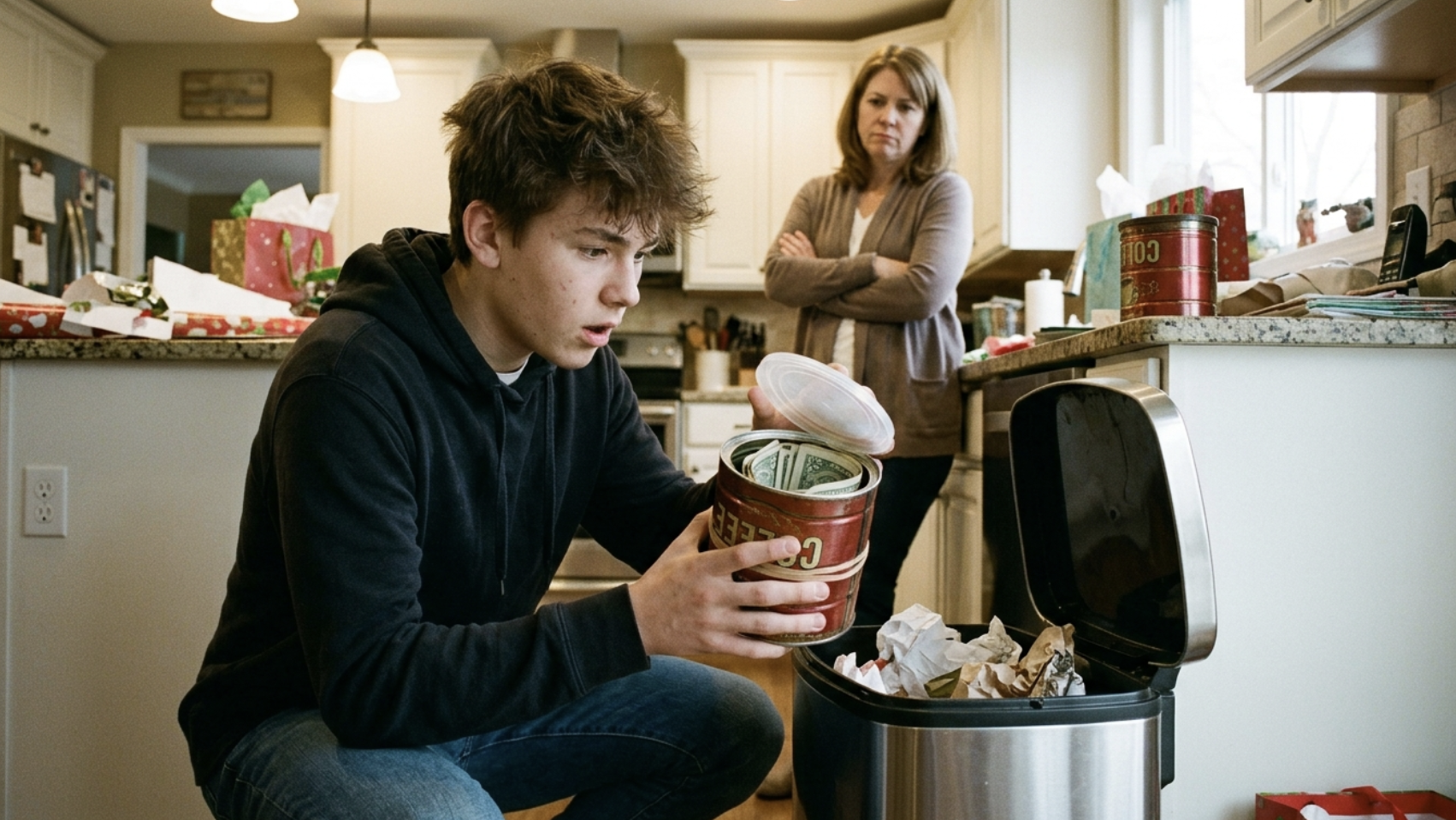
The fourth can had remained in my hands when I left Vanessa’s house.
It belonged to Emma.
I had forgotten to give it to her.
I placed it beside my teacup and removed the rubber band.
Inside was a letter, a photograph, and a small envelope with her name on it.
I smiled at the photograph.
It showed Walter sitting on the back porch, holding Emma when she was only a few months old.
His eyes were closed, and her tiny hand rested against his chest.
I could almost hear him laughing.
“Look at that, Marion,” he had said when I took the picture. “She thinks I’m the whole world.”
I had replied, “You are, Walter. To her, you are.”
He had looked down at the baby.
“Then I hope we teach her that the world is bigger than anything money can buy.”
I placed the photograph back inside the can.
Then I opened the small envelope.
Inside was a note in my handwriting, written years ago.
I had forgotten the exact words.
Dear Emma,
Your grandfather believed that the smallest things often carry the greatest love.
When you were a baby, he used to sing to you while he rocked you to sleep. He had a terrible singing voice, but you never seemed to mind.
He told me that when you grew up, he hoped you would become the kind of woman who noticed people other people overlooked.
He said the world already had enough people trying to be important.
What it needed was more people trying to be kind.
Love always, Grandma.
I folded the note and placed it back inside the can.
Then I sat quietly for a long time.
I was eighty years old.
My husband was gone.
My pension was small.
My house needed repairs.
And I had spent too many years believing that my only choice was to accept whatever scraps of affection my family could spare.
But that afternoon, something had happened that I had not expected.
My grandchildren had seen me.
Not as the old woman who couldn’t afford designer gifts.
Not as an obligation on a holiday schedule.
Not as a person whose worth could be calculated by what she put inside an envelope.
They had seen me as their grandmother.
And perhaps, finally, my son had begun to see me too.
I finished my tea and went to bed early.
I did not know what tomorrow would bring.
I only knew that for the first time in a very long time, I was no longer willing to trade my dignity for a place at someone else’s table.
And I had a feeling that the hardest part of this story was still waiting to unfold.
Because the following morning, when Rob arrived at my little house, he carried something I had not seen in twelve years.
His father’s old leather briefcase.
And when he placed it on my kitchen table, he looked at me with frightened eyes and said five words that changed everything.
“Mom, I found Dad’s papers.”
When Rob placed his father’s old leather briefcase on my kitchen table, I knew immediately that whatever happened next would change our family forever.
The leather was cracked along the edges. One of the brass clasps had lost its shine, and a thin layer of dust covered the handle.
I had not seen that briefcase since the week Walter died.
For twelve years, it had remained locked in a storage cabinet at Rob’s house.
Now my son stood in front of me, pale and exhausted, holding it as if it weighed far more than a few old papers.
“Where did you find it?” I asked.
“In the back of the study closet. Vanessa wanted me to clear out some old boxes last weekend. I almost threw it away.”
He swallowed.
“Then I remembered the letter Tyler read yesterday.”
I pulled out a chair.
“Sit down, Rob.”
He sat.
For a moment, neither of us spoke.
Then he opened the briefcase.
Inside were old tax returns, bank statements, photographs, insurance documents, and several envelopes tied together with a piece of string.
At the bottom lay a thick folder marked in Walter’s handwriting.


One Comment on “PART7: My Daughter-in-Law Demanded $1,500 in Birthday Gifts for My Grandchildren—So I Gave Them Four Coffee Cans”
Comments are closed.