PART6
My father had contested the arrangement.
He argued that I was financially irresponsible and emotionally unstable.
He wanted control of the entire trust.
Daniel had objected.
The dispute became bitter.
Then Daniel discovered that money had already been withdrawn from accounts associated with the estate.
He reported the transactions.
My father responded by accusing him of mismanagement.
Their relationship collapsed.
And then came the Christmas card.
“Your grandmother died believing you would always be protected,” Daniel said quietly. “I tried to tell you what was happening, but your father blocked my letters and messages.”
I stared at him.
“All those years?”
He nodded.
“I sent you birthday cards. Christmas presents. Letters. I even tried contacting your mother.”
“Did she know?”
Daniel looked down.
“Yes.”
My throat tightened.
“She knew you were alive?”
“She did.”
I looked toward the window.
The woman who had cried outside my house the previous day had known that my uncle was alive.
She had known I was being denied contact with someone who wanted to see me.
And she had allowed me to believe he was dead.
“Why?” I whispered.
Daniel opened a drawer and removed a folder.
“Because your father was afraid of what I knew.”
Inside were copies of correspondence, trust documents, and financial statements.
One document caught my attention.
It showed that a portion of my grandmother’s estate had been transferred to an account associated with Voss Development Group.
The amount was $412,000.
I looked up.
“Was this my money?”
“Part of it, yes.”
I felt sick.
“How much was supposed to be mine?”
Daniel placed another document in front of me.
According to the trust’s records, my original share had been valued at approximately $580,000, including investments and property interests.
But that wasn’t all.
The trust had also specified that the remaining funds should be distributed to support educational and creative opportunities for the grandchildren.
I looked at him.
“Why didn’t anyone tell me?”
“Because your father wanted you to believe you had received nothing.”
I leaned back.
Suddenly, the missing Christmas presents, the forgotten birthdays, the constant dismissal of my achievements, and the years of being portrayed as difficult felt connected in a way I had never understood.
My father had not merely forgotten me.
He had controlled what I knew.
Daniel placed a hand over mine.
“Elena, I need you to understand something. Your grandmother loved you very much. She used to talk about your drawings. She kept every picture you ever sent her.”
He stood and walked to a cabinet.
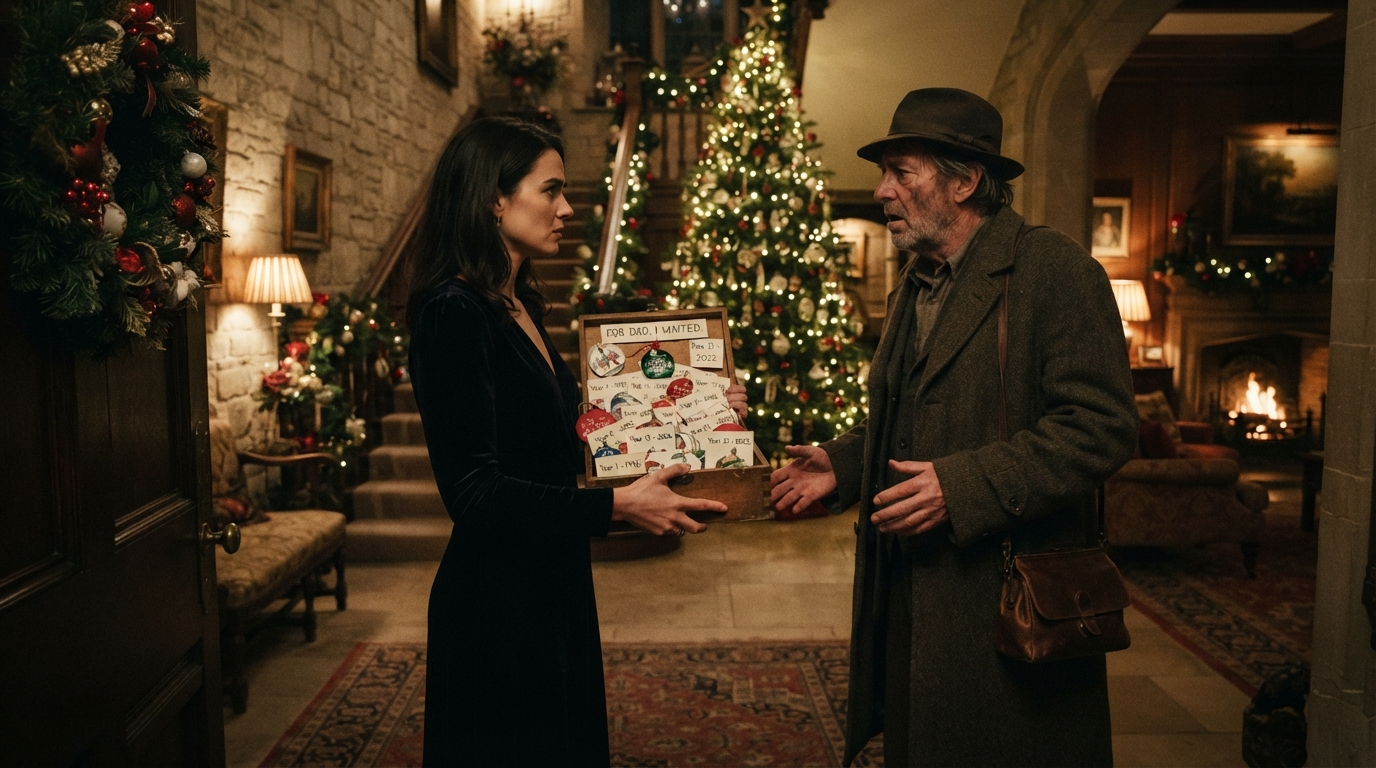
From a wooden box, he removed a collection of old papers.
Inside were my childhood drawings.
My first attempt at drawing a house.
A painting of a blue bird.
A Christmas illustration I had made when I was eight.
On the back of the illustration was my grandmother’s handwriting.
My little Elena will build beautiful things one day. I hope nobody ever makes her believe she isn’t special.
I began crying.
Not because of the money.
Not because of the property.
But because someone had remembered.
Someone had kept the drawings.
Someone had noticed me.
And for the first time in years, I felt that the little girl who had waited beside the Christmas tree had not been entirely forgotten.
When we returned to Sedona, Marcus immediately contacted the estate attorney listed in the documents.
The following week brought a series of developments.
The trust administrator confirmed that the estate had never been properly closed.
There were unresolved transactions.
There were unauthorized withdrawals.
And there was enough documentation to justify a full investigation.
Meanwhile, the financial investigators working on my father’s company had obtained additional records.
They discovered that my father had been using the supposed investment from my grandmother’s estate to support the company’s financial statements.
The same money had been presented to lenders as evidence of financial stability.
The same money had helped secure additional borrowing.
And the same money had been used to pay expenses connected to Nathan.
The situation was much larger than anyone initially believed.
My father had not simply forged one loan guarantee.
He had built years of financial decisions around money he had no authority to use.
The authorities began examining the records, and Marcus helped me file the necessary civil claims to protect my identity and challenge the unauthorized obligations.
For the first time, my father couldn’t simply call me dramatic and expect everyone to believe him.
There were bank statements.
There were emails.
There were signatures.
There were records.
And there were people who could verify them.
Three days before Christmas, my phone rang.
It was Nathan.
I almost ignored it.
But something made me answer.
“Elena.”
His voice sounded different.
Not confident.
Not irritated.
Just exhausted.
“What do you want?”
He hesitated.
“I need to talk.”
“You’ve already said plenty.”
“I know.”
I waited.
Then he said:
“Dad told me the house was supposed to belong to the family.”
I laughed quietly.
“Did he also tell you to bring a locksmith?”
Nathan didn’t answer.
“Did he tell you to use my signature?”
Another silence.
Finally, he whispered:
“I knew the lease wasn’t real.”
I closed my eyes.
There it was.
An admission.
“I thought it was just something temporary. Dad said we needed to establish residency before the bank moved against the company.”
“You knew it was fraudulent?”
“I knew it wasn’t exactly legitimate.”
I looked toward the courtyard.
“There’s no such thing as almost legitimate, Nathan.”
He sighed.
“I didn’t think you’d actually call the police.”
I almost couldn’t believe what I was hearing.
My brother had helped plan an illegal entry into my home, and his biggest disappointment was that I had refused to let him get away with it.
“Why did you do it?”
He finally answered.
“Because Dad said if the company collapsed, we’d lose everything.”
I spoke quietly.
“You mean you’d lose everything.”
He didn’t respond.
I continued.
“You had years to build something of your own. Instead, you spent Dad’s money, borrowed against things that weren’t yours, and expected me to rescue you.”
“You’re making it sound worse than it was.”
“No, Nathan. I’m finally describing it accurately.”
He began crying.
“Can you help me?”
I stared at the phone.
For years, that had been my role.
Whenever Nathan made a mistake, I was expected to understand.
Whenever he needed money, I was expected to contribute.
Whenever he embarrassed the family, I was expected to remain silent.
But I had learned something important.
Helping someone does not mean protecting them from accountability.
“I won’t lie for you,” I said. “I won’t give you money to cover what happened. But if you’re ready to tell investigators the truth, you should speak with your attorney and cooperate.”
“You’re really going to let this happen to your own brother?”
I took a breath.
“You let it happen to your own sister.”
Then I ended the call.




One Comment on “PART6: My Father Forgot Me Every Christmas for 31 Years—Until He Tried to Steal My $3 Million Manor and Discovered I Had Been Waiting for Him”
Comments are closed.