PART4
My mother had accidentally forwarded me an email intended for Claire.
The subject line read: RENT TRANSFER CONFIRMATION.
I almost deleted it.
Then I noticed the amount.
$2,850.
The message contained a bank notification showing a recurring payment from my mother’s personal checking account to a property management company.
The recipient was Claire’s apartment complex.
The payment date was the first of each month.
I read it twice.
Then I checked the previous message in the email chain.
There was another transfer confirmation.
And another.
The first payment had been made in May.
I sat very still.
My mother was paying Claire’s rent.
That alone wasn’t necessarily wrong. Parents sometimes help their adult children through difficult periods.
What bothered me was what happened next.
I opened the attached correspondence.
My mother had written to the property manager asking whether the payments could continue automatically without requiring Claire’s involvement.
She had also asked that any payment-related communication be sent directly to her private email address.
Then I saw a sentence that made my stomach tighten.
“Claire’s professional situation is temporary, and I don’t want her worrying about administrative details while she focuses on her career.”
I closed the email.
I wasn’t angry at Claire.
I was worried about her.
But I was beginning to understand that my mother wasn’t simply helping her daughter.
She was financing a carefully constructed image.
And she expected everyone else to keep believing it.
I didn’t confront her.
I didn’t call Claire.
I waited.
Over the following weeks, I noticed other things.
My mother mentioned Claire’s career more frequently than ever.
She told relatives about supposed meetings with senior partners. She described expensive business dinners. She spoke about Claire’s future as though she were personally involved in negotiating it.
At a family birthday dinner, she announced that Claire had recently been offered an opportunity to work on a major corporate case.
Claire sat beside her, smiling faintly.
I noticed that she barely touched her food.
When I asked her privately how she was doing, she whispered, “I’m trying to figure it out.”
I wanted to tell her that she didn’t owe anyone an explanation.
But she wasn’t ready.
So I kept quiet.
Then came Thanksgiving.
Linda’s dining room was decorated exactly as it had been for the previous fifteen years.
The white tablecloth.
The silver candlesticks.
The crystal wineglasses.
The framed photographs of Claire receiving academic awards, graduating from law school, and standing beside our mother at professional events.
There was one photograph of me.
It was from my college graduation.
It sat on a small table near the hallway, partially hidden behind a decorative bowl.
Fourteen relatives attended that evening.
Uncle David and Aunt Susan.
My mother’s younger brother, Michael.
Two cousins and their spouses.
My grandmother’s sister, who was visiting from New Jersey.
And several other relatives who had become accustomed to hearing about Claire’s achievements.
I arrived with a large arrangement of autumn flowers for the dining room.
My mother glanced at it.
“Oh, Gaia. You didn’t have to bring all that.”
“I wanted to.”
She pointed toward the kitchen.
“Just put it over there. We need the table cleared.”
Claire was already seated.
She looked tired.
When our eyes met, she gave me a small smile.
I returned it.
Dinner began normally enough.
Then Uncle David asked Claire about her work.
“So, how’s the firm?” he said, cutting into his turkey.
My mother answered before Claire could.
“Busy as ever. You know how it is when you’re dealing with important clients.”
Claire lowered her eyes.
I watched her carefully.
“That’s impressive,” Uncle David said. “You must be making a fortune.”
My mother laughed.
“She’s doing very well. We always knew Claire would go far.”
Then she turned toward me.
“And Gaia is still arranging flowers.”
A few people smiled politely.
I kept eating.
My mother continued.
“Nothing wrong with that, of course. Someone has to do those little creative things.”
I swallowed.
Then came the announcement.
“One daughter is a lawyer,” she said, raising her wineglass. “The other is a beggar.”
Uncle David burst out laughing.
The others followed.
Claire stared at her plate.
I smiled.
I didn’t defend myself.
I didn’t tell them about my business.
I didn’t explain that I had spent fourteen years building something from nothing.
I simply passed the gravy.
Twenty minutes later, my mother raised her glass again.
“To Claire,” she said proudly. “A daughter who understands the value of education, ambition, and hard work.”
Everyone lifted their glasses.
I set down my fork.
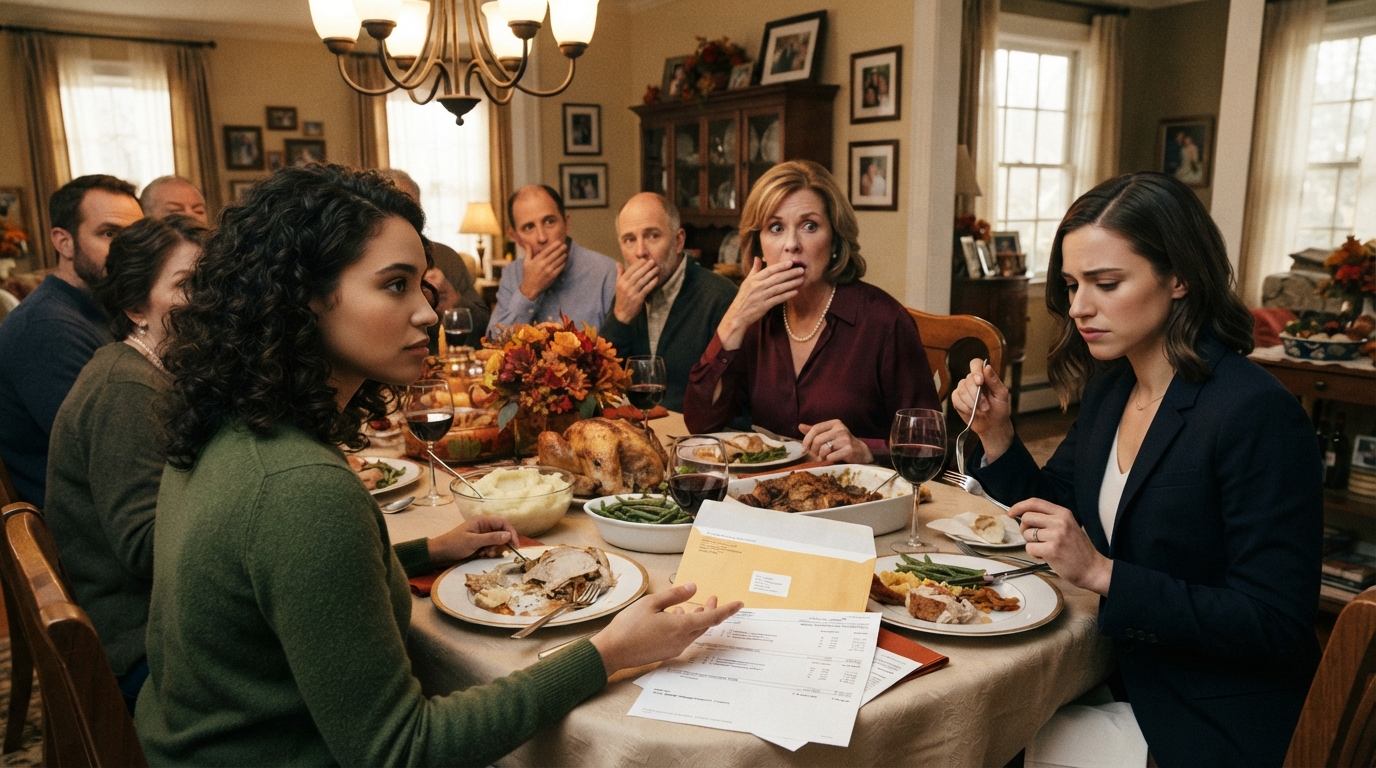
“Then why have you paid Claire’s rent since May?”
The silence was immediate.
My mother’s glass stopped halfway to her mouth.
Claire turned white.
Uncle David slowly lowered his fork.
“What?” my aunt Susan whispered.
My mother stared at me.
“Gaia, what are you talking about?”
I kept my voice calm.
“The $2,850 monthly payments to Claire’s apartment. You’ve been covering them since May.”
Nobody moved.
My mother put her glass down.
“That is a private family matter.”
“Of course,” I replied. “But since we’re discussing everyone’s financial success, I thought it was worth mentioning.”
“Stop it.”
“Why?”
“Because you have absolutely no idea what you’re talking about.”
I glanced at Claire.
She was gripping her napkin so tightly that her knuckles had turned white.
“Claire,” I said gently, “you don’t have to answer anything. I’m not angry with you.”
My mother immediately interrupted.
“Don’t drag your sister into your jealousy.”
Jealousy.
That was always her favorite explanation.
If I questioned her, I was jealous.
If I disagreed, I was bitter.
If I succeeded, I was lucky.
If Claire struggled, it was because she was under pressure from being exceptional.
I took a breath.
“I’m not jealous, Mom. I’m asking why you’ve spent months telling everyone Claire is thriving financially when you’ve been paying her rent.”
My mother’s expression changed.
For the first time that evening, she looked genuinely afraid.
Then she said something that made me realize the rent payments were only the beginning.
“You don’t know everything I’ve done for your sister.”
I looked at her.