The School Told My Grandson He Couldn’t Attend the Father-Son Breakfast Because His Dad Was Dead
PART 3
I remembered sending him toward the emergency station before returning to help contain the fire.
But I didn’t remember his name. The admiral smiled faintly. “My name was James Carrick. I was that nineteen-year-old sailor.”
A murmur traveled across the gymnasium. He turned toward me.
“Chief, you probably don’t remember what you said to me that day. But I remember every word.”
I shook my head slowly. “What did I say, sir?”
He swallowed. “You grabbed my shoulders and told me, ‘Son, being afraid doesn’t make you useless. Standing still when someone needs you does. Now get up and help me save your shipmates.’”
The admiral’s voice cracked. “Chief, I was certain I wasn’t going to survive that day. You gave me the courage to move. You saved my life.”
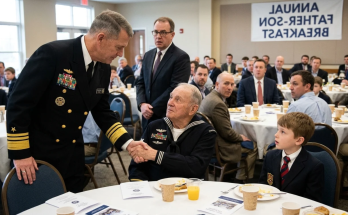
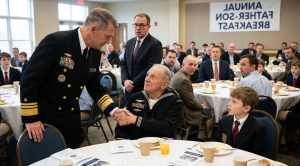
He extended his hand. I took it. Then, unexpectedly, he pulled me into a military embrace.
Two hundred people watched.
I felt Caleb’s little hand gripping the back of my uniform.
When the admiral finally stepped away, he looked down at my grandson.
“And who is this young man?”
Caleb swallowed.
“Caleb Halloran, sir.”
“Are you Chief Halloran’s grandson?”
“Yes, sir.”
The admiral nodded.
“Then you have quite a grandfather.”
Caleb looked at the floor.
“He’s not my dad.”
The words were barely audible.
But the admiral heard them.
He crouched until his eyes were level with Caleb’s.
“Young man, I know your father isn’t here. And I know that’s a hurt no breakfast invitation can fix.”
Caleb’s lower lip trembled.
“But I want you to understand something. Your father served this country. Your grandfather served this country. And the two of them gave something to people they might never meet.”
He stood.
“That is what family looks like. It doesn’t disappear because someone is no longer sitting at the table.”
The room was completely silent.
Then the admiral turned toward the headmaster.
“Dr. Prentiss, may I ask you something?”
The headmaster stood up so quickly that his chair scraped against the floor.
“Of course, Admiral.”
“Who decided this boy couldn’t attend this breakfast?”
Dr. Prentiss adjusted his bow tie.
“Well, Admiral, the event is designed around the father-son relationship. We have established guidelines to preserve the intended nature of the program. Unfortunately, Mr. Halloran’s attendance was not consistent with those guidelines.”
The admiral stared at him.
“Not consistent?”
“Yes, sir.”
“His father died serving this country, correct?”
“That is my understanding.”
“And his grandfather raised his hand to make sure this boy wouldn’t sit alone?”
Dr. Prentiss glanced toward me.
“I understand the emotional circumstances, Admiral, but schools must maintain consistent policies.”
The admiral slowly removed his glasses.
“Dr. Prentiss, I’ve spent nearly four decades watching people hide behind procedures when they don’t have the courage to make a decent decision.”
He placed his glasses on the table.
“Policies are supposed to serve people. People are not supposed to be sacrificed to make policies look tidy.”
A father near the front began clapping.
Then another.
Within seconds, the entire gymnasium erupted.
I didn’t clap.
I was looking at Caleb.
For the first time that morning, he was smiling.
But the admiral wasn’t finished.
He walked toward the podium and asked the event coordinator for the microphone.
“Before we continue, I want to make a change to today’s program.”
He looked across the room.
“Every year, this school celebrates fathers who have guided their sons. That’s a beautiful tradition. But today, I would like us to recognize something else.”
He pointed toward the back.
“The people who stand in the empty spaces.”
He began naming grandparents, uncles, older brothers, stepfathers, and other guardians.
“Because some boys have lost their fathers. Some have fathers serving overseas. Some have fathers who are no longer part of their lives. And some have fathers who never deserved the title in the first place.”
A few people nodded.
“None of those boys should ever be made to feel that their family is incomplete because it doesn’t resemble somebody else’s.”
Then he looked directly at Caleb.
“Young man, would you and your grandfather do me the honor of joining me at the front?”
Caleb looked at me.
I bent down.
“Your choice, son.”
He squeezed my hand.
“Let’s go, Grandpa.”
We walked toward the stage together.
And as we passed the tables, something happened that I hadn’t expected.
Men began standing.
One by one.
Not because the admiral had ordered them.
Not because anyone was watching.
They simply stood as we walked past.
A father in a navy suit leaned toward Caleb.
“My boy, your grandfather is a hero.”
Caleb looked up at him.
“He’s just Grandpa.”
The man smiled.
“Sometimes those are the same thing.”
When we reached the stage, the admiral handed Caleb the microphone.
“Would you like to say anything?”
Caleb looked frightened.
He looked at the crowd, then at me.
Finally, he spoke.
“My dad died when I was little. I don’t remember everything about him. I have one picture, though.”
He reached into his blazer pocket.
He pulled out the folded photograph he’d carried in his backpack that morning.
“My mom says he loved me very much. Grandpa tells me stories about him. Sometimes I wish he could come to school and eat breakfast with me.”
His voice broke.
“But today, Grandpa came.”
He looked at me.
“And he wore the uniform Dad used to wear.”
I felt my eyes burning.
Caleb continued.
“I thought I was going to have to eat breakfast in the library. But I got to sit with my family instead.”
He lowered the microphone.
That was all.
No grand speech.
No dramatic declaration.
Just nine-year-old honesty.
The applause that followed was unlike anything I’d heard in my life.
And I had attended military ceremonies on three continents.
But as the room began settling down, I noticed something else.
Dr. Prentiss was no longer standing.
He had taken a seat near the stage.
His face was pale.
He was looking at the photograph in Caleb’s hand.
And for reasons I couldn’t understand, he seemed more troubled by that little photograph than by the admiral’s entire speech.
Then a woman approached the stage.