PART4
She was wearing a navy-blue academy blazer and carrying a folder.
She whispered something to the admiral.
His expression changed.
He looked at me.
Then at Caleb.
Then back at the woman.
“Are you certain?” he asked.
She nodded.
The admiral took the microphone again.
“Before this event concludes, there’s something the school administration needs to address. Something involving the scholarship program that brought Caleb Halloran to this academy.”
I felt Caleb’s hand tighten around mine.
The admiral continued.
“And I believe this family deserves to hear the truth.”
What the admiral revealed next was something I never could have imagined when I walked through those gymnasium doors.
The woman introduced herself as Margaret Ellis, chairwoman of the academy’s scholarship foundation.
She stepped onto the stage and placed her folder on the podium.
“First, I want to apologize to Caleb and his family,” she said.
Dr. Prentiss immediately stood.
“Margaret, perhaps we should discuss this privately.”
She turned toward him.
“With respect, Daniel, this should have been handled privately before a nine-year-old boy was told to sit in a library while everyone else celebrated their fathers.”
The room became quiet again.
Margaret opened her folder.
“Caleb attends this academy through the Fallen Service Members Scholarship. The scholarship was established to honor children whose parents died while serving our country. It covers tuition, educational materials, and several school activities.”
She looked toward Caleb.
“Your father was one of the service members whose sacrifice made this scholarship possible.”
Caleb stared at her.
“Does that mean my dad helped me come here?”
Margaret smiled sadly.
“Yes, sweetheart. His service is the reason this scholarship exists.”
She turned another page.
“However, the foundation has received several complaints about how scholarship students have been treated during certain school activities.”
I glanced at Dr. Prentiss.
His fingers were gripping the edge of his chair.
Margaret continued.
“Last year, a young girl whose mother died during military service was told she couldn’t participate in the Mother’s Day luncheon because she didn’t have a mother available to attend.”
A few people exchanged uncomfortable looks.
“This year, Caleb was told to wait in the library.”
She closed the folder.
“These are not isolated misunderstandings. They represent a failure to understand the very purpose of our scholarship program.”
Dr. Prentiss stood again.
“Margaret, I assure you that no discrimination was intended. Our staff was simply following the event guidelines.”
The admiral turned toward him.
“Then perhaps your guidelines need changing.”
“That is a matter for the board.”
“Excellent,” the admiral replied. “Then I suggest we discuss it with the board.”
Margaret nodded.
“I’ve already scheduled an emergency review.”
The headmaster’s expression changed.
I had no interest in seeing a young man lose his career.
I had spent enough years in uniform to understand that mistakes could happen.
But I also understood something else.
A mistake becomes a character problem when someone refuses to correct it.
I leaned toward the admiral.
“Sir, I appreciate what you’re doing. But I don’t want this boy growing up believing he needs a four-star admiral to make people treat him properly.”
The admiral looked at me.
Then he nodded.
“That’s fair, Chief.”
I turned toward Margaret.
“I don’t want special treatment for Caleb. I don’t want a plaque. I don’t want a ceremony every time he walks into this building.”
My voice was stronger than I expected.
“I want him to be treated like every other boy in this school. If the other children can bring someone who loves them, then he should be allowed to do the same.”
Margaret closed her folder.
“That’s exactly what should happen.”
Then Caleb tugged my sleeve.
“Grandpa?”
“Yes, son?”
“Can we still eat breakfast?”
For a moment, I couldn’t speak.
Then the admiral laughed.
“Now that’s the most important question anyone has asked all morning.”
The room laughed with him.
The breakfast continued.
And this time, nobody asked us to leave.
A father sitting nearby moved his chair to make room.
Another father offered Caleb a plate of pancakes.
A little boy named Ethan introduced himself and asked Caleb whether he liked baseball.
Within minutes, the boy who had expected to spend the morning alone was discussing baseball statistics with three other children.
I sat quietly, watching him.
That was all I had wanted.
Not recognition.
Not applause.
Just a place for my grandson to belong.
But the day still had one more surprise waiting for us.
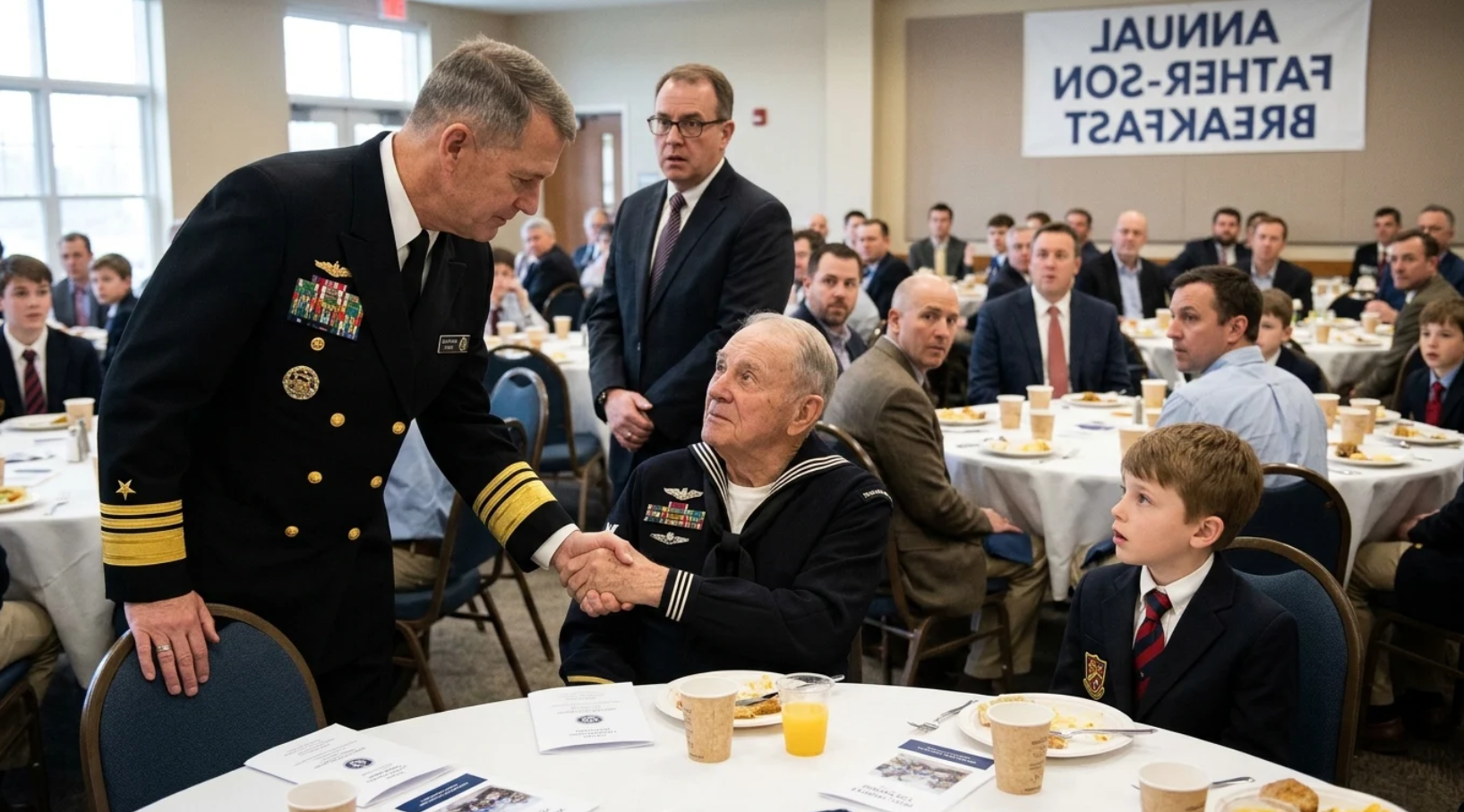
When breakfast ended, Admiral Carrick approached our table.
“Chief, could I speak with you for a moment?”
“Certainly, sir.”
He glanced at Caleb.
“Actually, I’d like to speak with both of you.”
He pulled out a chair.
“I’ve been thinking about something. The Navy has a program that connects young people from military families with veterans who can share stories about service, leadership, and sacrifice. Nothing political. Nothing about glorifying war. Just real conversations about duty and the people behind the uniforms.”
He looked at Caleb.
“Would you like to hear stories about your dad’s generation?”
Caleb nodded enthusiastically.
“Can you tell me stories about my dad?”
The admiral smiled.
“I would like nothing more.”
Then he turned to me.
“And Chief, I’d be honored if you’d help us.”
I looked down at my old uniform.
For years, I had kept it in a garment bag because putting it on brought back the worst day of my life.
My son’s funeral.
The folded flag.
The twenty-one-gun salute.
The unbearable silence after the bugle stopped playing.
I had convinced myself that those memories were all the uniform represented.
But perhaps I had been wrong.
Perhaps it could represent something else, too.
A connection between generations.
A reminder that a man’s life was not measured only by the day he died.
I nodded.
“I’d be honored, Admiral.”
Caleb smiled.
“Can I come?”
The admiral laughed.
“You’re the reason we’re having this conversation, young man.”



One Comment on “PART4: The School Told My Grandson He Couldn’t Attend the Father-Son Breakfast Because His Dad Was Dead”
Comments are closed.