FINAL PART
Derek laughed.
“He even photographed the foundation.”
“That sounds like your father.”
We walked inside.
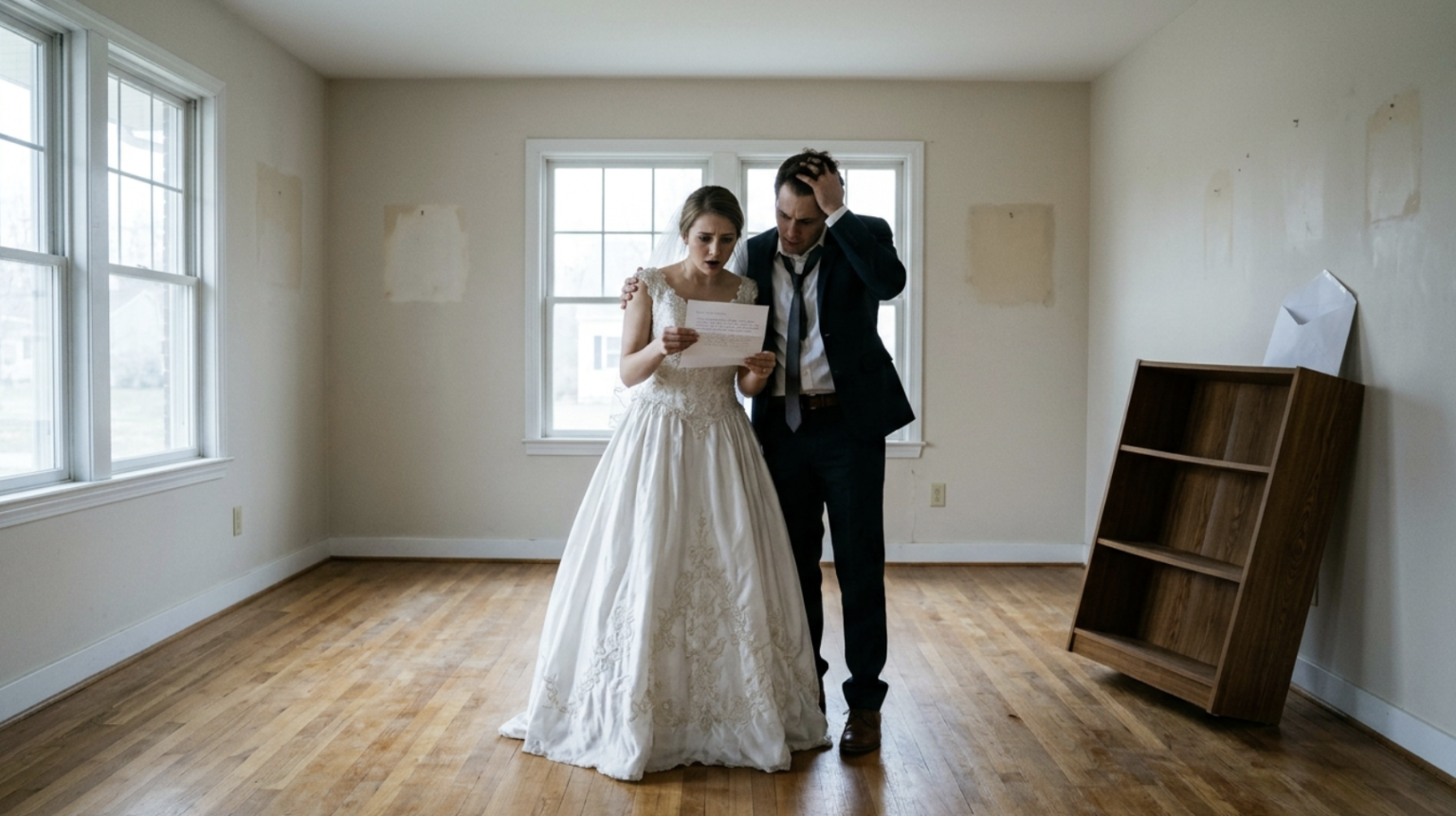
The rooms were empty, but they no longer felt abandoned.
Derek had brought the crooked pine bookshelf.
It stood in the living room, carefully cleaned and repaired.
He had even fixed the uneven leg.
I ran my fingers over the burned words.
Dad + me.
“He was so proud of this,” Derek said.
“He was proud of you.”
Derek looked away.
“I wish I had understood that earlier.”
I placed my hand on his shoulder.
“You cannot change what happened. But you can decide what kind of man you become afterward.”
He nodded.
Then he reached into his pocket.
It was a small wooden plaque.
He handed it to me.
I turned it over.
On the front, he had carved:
A HOME IS BUILT WITH LOVE, NOT INHERITANCE.
My eyes filled.
“Did you make this?”
“I tried. It isn’t as good as Dad’s work.”
I laughed through my tears.
“Your father would have said the same thing about his first attempt.”
Derek smiled.
For a moment, I could almost hear Richard laughing in the workshop.
A year passed.
I remained in my condominium.
I enjoyed my independence, my garden club, my books, and the peaceful mornings that belonged entirely to me.
Derek visited regularly.
Sometimes he brought groceries.
Sometimes he repaired something.
Sometimes he simply sat with me and talked about his work.
He never asked about the property trust.
He never asked what I intended to leave him.
One afternoon, he arrived carrying a small box.
“What’s that?” I asked.
“Something I found in Dad’s workshop.”
Inside was an old photograph.
Richard was standing beside the unfinished bookshelf, holding a hammer.
Derek was nine years old, grinning proudly beside him.
On the back, Richard had written:
My boy’s first furniture project. Not perfect, but made together.
Derek stared at it.
“I used to think Dad would want me to have the house.”
“He probably did want you to have a home someday.”
“What’s the difference?”
I smiled.
“A house is something you can own. A home is something you learn to protect.”
He nodded slowly.
Then he placed the photograph beside the bookshelf.
We sat together for a while without speaking.
And I realized something.
For months, I had believed that the worst thing Morgan had taken from me was the happiness of watching my only son get married.
But that wasn’t true.
The worst thing had been watching Derek forget what kind of family he came from.
And the greatest gift wasn’t the property, the money, or the inheritance I had once planned to give him.
It was seeing him finally understand that love was never supposed to come with a price tag.
Two years after the wedding that never included me, Derek met someone new.
Her name was Claire.
She was a school librarian, had a quiet sense of humor, and seemed genuinely interested in people.
The first time Derek brought her to my apartment, she arrived carrying a homemade apple pie.
She looked around my little living room.
“This is lovely,” she said.
“Thank you.”
Then she noticed the photograph of Richard and Derek beside the bookshelf.
“Is that your husband?”
“Yes. And that’s Derek when he was nine.”
She smiled.
“He looks so proud.”
“He was.”
Later, while Derek was helping me prepare dinner, Claire wandered toward the bookshelf.
She examined the crooked letters.
“Dad + me,” she read softly.
“It’s a little uneven,” she added.
I smiled.
“It was built by a father and son who were more interested in spending time together than getting everything straight.”
Claire looked at me.
“That’s actually beautiful.”
She didn’t ask about the house.
She didn’t ask about its value.
She didn’t ask what Derek might inherit.
She simply admired the photograph.
And that was when I knew my son had finally begun to understand the difference between someone who wanted to share his life and someone who wanted to collect its benefits.
On Richard’s birthday the following year, Derek and I visited the old property together.
The trust arrangements ensured that it would remain protected according to my wishes.
I had also made plans for the workshop to be preserved.
Derek brought flowers.
I brought Richard’s favorite coffee.
We stood beneath the maple tree for several minutes.
Then Derek said something that made me smile.
“Mom, I don’t need the house.”
I turned toward him.
“What?”
“I used to think getting that property would prove Dad had left me something important. But he already left me something important.”
He touched the photograph in his hand.
“He taught me how to build something. I just forgot that for a while.”
I took his arm.
“Your father would have liked hearing that.”
Derek looked toward the workshop.
“Do you think he’d forgive me?”
I considered the question.
Then I answered honestly.
“I think he would have wanted you to become better than the mistakes you made.”
Derek nodded.
We placed the flowers beneath the tree.
And before we left, he walked inside the workshop.
He stood beside the old workbench for a long time.
Then he picked up a piece of pine and began sanding it.
“What are you making?” I asked.
He smiled.
“Something for you.”
Several weeks later, Derek brought me a small wooden shelf.
It wasn’t elaborate.
The corners weren’t perfectly square, and one side leaned slightly.
I laughed when I saw it.
“You made another crooked bookshelf?”
He grinned.
“I thought it was a family tradition.”
I hugged him.
We placed it beside the old one.
Two generations.
Two imperfect pieces of furniture.
And one lesson that had taken far too long to learn.
That evening, after Derek left, I sat beside the window and looked at both bookshelves.
I thought about the rehearsal dinner.
I thought about Morgan’s twelve-second apology.
I thought about the empty living room, the cancelled wedding expenses, the property report, and the envelope that had turned a young bride pale.
For a while, I had wondered whether I had been too harsh.
Whether a mother should have simply forgiven everything.
Whether protecting my property had cost me my family.
But I finally understood something.
Forgiveness does not require surrender. Love does not require silence. And being someone’s mother does not mean allowing them to treat you as though you have no value beyond what you can provide.
I had spent thirty-one years helping strangers understand their rights.
It took one terrible family experience to understand that I had rights, too.
I had the right to say no.
The right to protect what my husband and I built.
The right to grow old peacefully.
And the right to be loved without having to purchase that love.
Before going to bed, I picked up Richard’s old photograph one more time.
His handwriting on the back was fading.
But I could still read the words.
My boy’s first furniture project. Not perfect, but made together.
I smiled.
The house was still standing.
The workshop was still there.
The crooked bookshelf was still leaning just a little.
And my son, finally, was learning how to build something that couldn’t be measured in dollars.
A life.
A family.
A future.
And this time, he was building it with his own hands.


One Comment on “FINAL PART: My Son’s Fiancée Told Me to Disappear From the Family—So I Cancelled the $700,000 Inheritance, and the Envelope I Left Behind Exposed Her Entire Plan”
Comments are closed.