FINAL PART
She had tears in her eyes.
After the lesson, I asked Dad how it went.
He smiled.
“Pretty good.”
“Just pretty good?”
He looked toward the little girl, who was proudly showing her parents what she had learned.
Then he said something I will never forget.
“I spent most of my life playing music for people who could afford to sit in expensive rooms. Now I get to play for children who might never have had the chance to touch a piano.”
He paused.
“That feels like a pretty good ending to my career.”
But it wasn’t the end.
Not even close.
One year later, my parents celebrated their fifty-first wedding anniversary.
We returned to the Grand Hotel.
This time, there was no reservation problem.
The staff welcomed them by name.
The manager had changed.
Daniel no longer worked there.
The new management team had introduced a strict policy protecting confirmed reservations and treating every guest with equal respect.
But the most beautiful change was in the lobby.
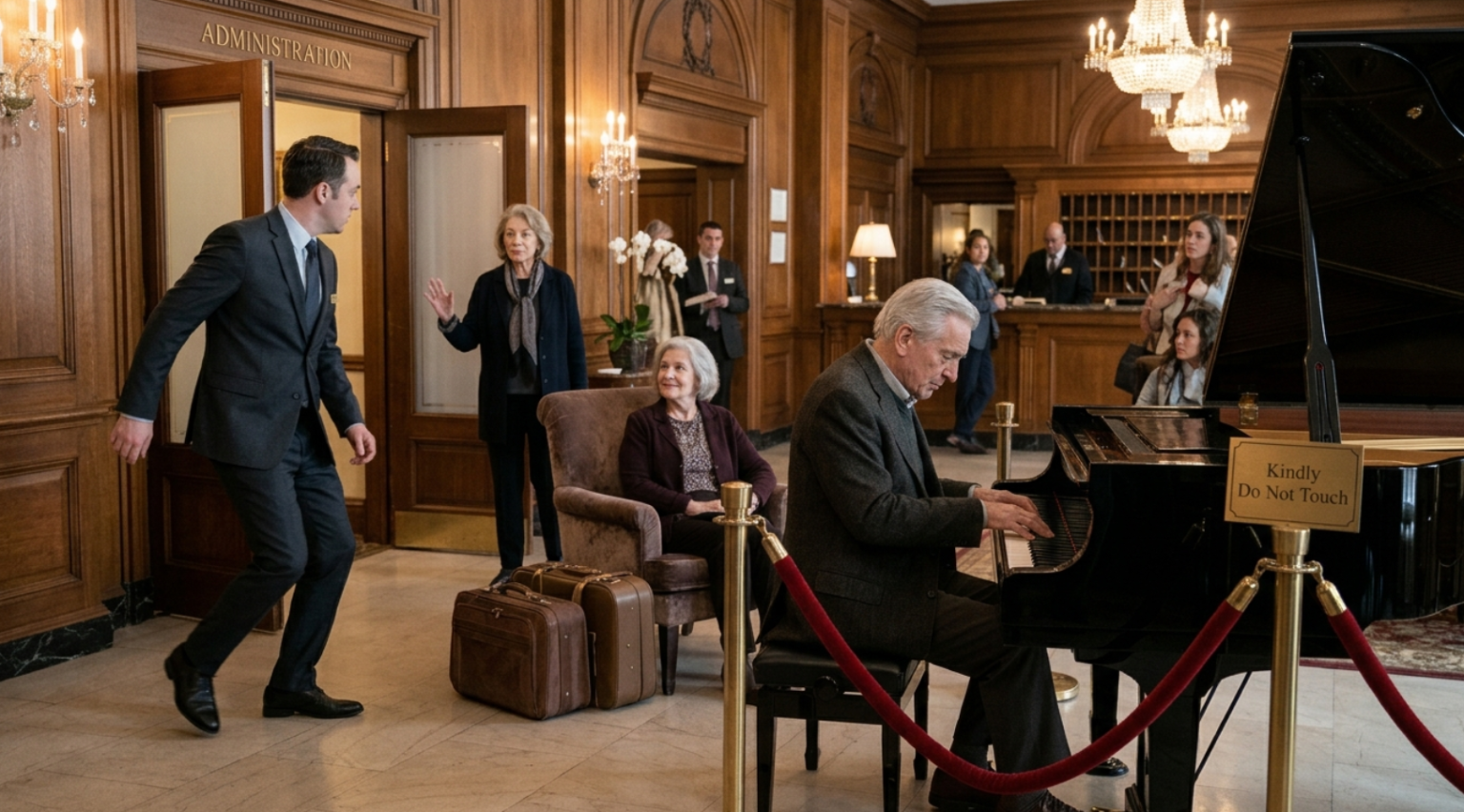
The velvet rope around the grand piano was gone.
Beside it stood a small brass plaque.
I read it slowly.
IN MEMORY OF ARTHUR HARLOW
AND IN HONOR OF FRANKIE AND MARGARET, WHO REMINDED US THAT A HOTEL’S TRUE VALUE IS MEASURED NOT BY THE ROOMS IT SELLS, BUT BY THE MEMORIES IT HELPS CREATE.
Dad stood in front of it for a long time.
Then he sat at the piano.
Mom took her familiar place beside him.
Evelyn was there too.
She had grown weaker over the past year and now used a wheelchair.
But she insisted on attending.
Dad looked at her.
“Which song would you like?”
She smiled.
“You already know.”
He placed his hands on the keys.
And he played the same song that had brought everything back to life.
The song he had played for Arthur in 1977.
The song Evelyn had been unable to hear for nearly fifty years.
When the final note faded, the lobby remained silent.
Then Evelyn began applauding.
Soon everyone joined her.
She looked at Dad with tears in her eyes.
“Arthur would have loved that.”
Dad nodded.
“I think he heard it.”
A few months later, Evelyn passed away peacefully.
She was ninety-one.
The hotel held a small memorial service in the ballroom.
My parents attended.
On the front table stood photographs of Arthur and Evelyn together.
There was also a photograph of my parents on their wedding day.
Evelyn had specifically requested it.
In her final letter to the hotel board, she had written:
“Please remember that buildings can be renovated, furniture can be replaced, and businesses can change hands. But the people who give a place its heart are irreplaceable.”
She also left instructions that the music scholarship must continue.
And it did.
Every year, more children received lessons.
Some learned piano.
Others learned violin, guitar, or drums.
A few eventually became professional musicians.
Dad continued visiting as long as his health allowed.
He never asked for payment.
He never asked for recognition.
He simply wanted to teach.
And every Saturday, before leaving the hotel, he would sit at the grand piano and play one song.
The same song.
The song that had once belonged to Arthur and Evelyn.
On my parents’ fifty-second anniversary, I visited them at home.
Dad was sitting in his favorite chair.
The gold pocket watch rested on the table beside him.
Mom was looking through their old wedding photographs.
I picked up one of them.
It showed Dad standing beside Mom in the ballroom in 1976.
They looked so young.
So full of hope.
I asked Dad something I had wanted to ask him for a long time.
“Do you ever think about what would have happened if you hadn’t played that piano that night?”
He smiled.
“Of course.”
“What do you think?”
He looked at the photograph.
“I think your mother and I would have gone upstairs, complained a little, and eventually forgotten about it.”
I laughed.
“Then why did you play?”
He considered the question.
“Because I wasn’t playing for the manager.”
He looked at Mom.
“I was playing for the place where I met your mother. I was playing for Arthur. I was playing for Evelyn. And I suppose I was playing for the young man I used to be.”
Mom reached over and held his hand.
Then Dad added:
“And because sometimes, when people forget who you are, you don’t need to remind them with words.”
He looked down at his hands.
“You just have to remember it yourself.”
I never forgot that sentence.
Not because my father had once been a talented pianist.
Not because an old hotel owner had left him a gift.
And not because a manager had been embarrassed in front of an entire lobby.
I remembered it because my father had been treated as though he didn’t matter.
He could have shouted.
He could have demanded attention.
He could have made a scene.
Instead, he sat at a piano and played.
And the music reminded everyone of something that money could never buy.
A lifetime of kindness.
A friendship that survived death.
A love that lasted fifty years.
And the simple truth that growing old should never mean becoming invisible.
The Grand Hotel gave my parents a room next to the ice machine because someone else tipped better.
But they had no idea that the elderly man they had pushed aside had helped give that hotel its soul.
And when he finally played that piano, he didn’t just reclaim a room.
He brought an entire forgotten history back to life.
Because some people leave behind money, some leave behind buildings, and some leave behind memories.
But the greatest people leave behind something that continues to make the world better long after they are gone.
And my father?
He left behind music.
And every time a child touches those piano keys at the Grand Hotel, a little piece of Frankie is still there. ❤️