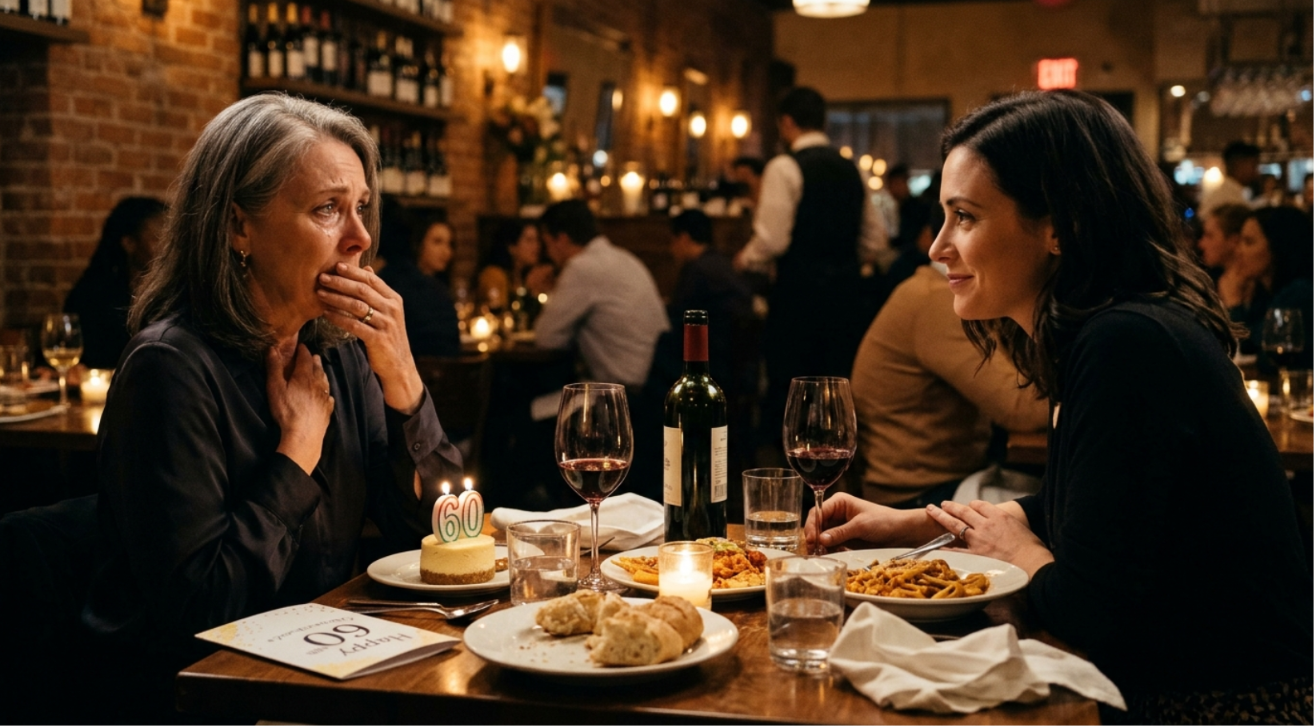
FINAL PART
I considered it.
“I don’t know.”
“Do you miss the old house?”
“Sometimes.”
She looked at me.
“Then do you regret selling it?”
I smiled.
“No. I miss the memories, not the way I was treated during the last few years.”
Margaret nodded.
I watched the waves move toward the shore.
For years, I had believed that growing older meant becoming less important.
I had watched my daughter make decisions for me, speak over me, and gradually take control of spaces that had once belonged to me.
But I had learned that age did not erase my right to choose.
It did not make my dreams less valuable.
And it certainly did not mean I had to accept disrespect simply because it came from someone I loved.
When I returned home, I found a message from Sarah.
Mom, Greg and I are separating.
I sat down.
I called her immediately.
She answered after the second ring.
“I’m sorry, sweetheart. Are you okay?”
She began crying.
“He says everything is my fault. He says if you hadn’t sold the house, we wouldn’t have gone through all of this.”
I listened.
Then I asked, “Do you believe that?”
“No.”
“Then don’t carry responsibility for a decision you didn’t make.”
She sniffed.
“I think I stayed with him because I was afraid of starting over.”
I understood that feeling more than she knew.
“Starting over is frightening,” I said. “But sometimes it’s the first step toward becoming yourself again.”
She was quiet.
Then she whispered, “Can I come over?”
“Of course.”
That evening, Sarah sat on my porch.
We talked until the sky turned dark.
I didn’t offer to solve her marriage.
I didn’t offer to pay her debts.
I simply listened.
And for the first time, she didn’t ask me to fix anything.
A year later, my life looked completely different.
Sarah had found a smaller apartment and a better job.
She was attending financial counseling sessions and learning to manage her own expenses.
Greg had moved to another city.
We rarely heard from him.
Sarah and I were not perfect.
There were still uncomfortable conversations.
There were still moments when she expected too much and I had to remind her of my boundaries.
But our relationship was changing.
She began calling me because she wanted to talk, not because she needed money.
She visited because she enjoyed spending time with me, not because she needed somewhere to stay.
And slowly, I began trusting her again.
One afternoon, while we were planting flowers in the garden, she asked:
“Mom, do you remember what you told me at the Italian restaurant?”
I smiled.
“Which part?”
“That you weren’t leaving me. You were leaving the house.”
“Yes.”
She looked down at the soil in her hands.
“I didn’t understand it then.”
“What about now?”
She looked at me.
“Now I understand that you were giving me a chance to become a better daughter without continuing to hurt yourself.”
I reached over and brushed a little dirt from her sleeve.
“That’s what I hoped would happen.”
She smiled.
Then she asked:
“Do you think Dad would be happy with us?”
I looked toward the wedding photograph inside the living room.
I imagined my husband sitting beside us, laughing at something Sarah had said.
“Yes,” I answered.
“I think he would be very happy.”
On the evening of my sixty-second birthday, Sarah invited me to dinner.
This time, she chose a little Italian restaurant near her apartment.
When we arrived, she had already made a reservation.
There was a small bouquet of flowers on the table.
And beside my plate was a white envelope.
I stopped.
For a moment, I was transported back to that night two years earlier.
The restaurant.
The wine.
The cold expression on my daughter’s face.
The words that had changed everything.
Sarah noticed my expression.
“What’s wrong, Mom?”
I pointed toward the envelope.
“Nothing. It just reminded me of something.”
She smiled nervously.
“Open it.”
Inside was a photograph.
It showed the two of us in my garden, laughing beneath the maple tree.
On the back, she had written:
To Mom, who taught me that a home is not something you own. It’s something you make people feel when they’re with you.
I looked at her.
She reached across the table.
“Happy birthday, Mom.”
I held her hand.
“Thank you, sweetheart.”
Then she said something I will never forget.
“I used to think you were supposed to give everything to your children. Now I understand that being a good daughter means making sure your mother gets to enjoy her own life, too.”
I smiled.
The waiter arrived with our food.
We talked about ordinary things.
Her new apartment.
My garden.
A trip we were planning together.
And when the bill arrived, Sarah reached for it.
“Dinner is on me tonight.”
I laughed.
“Are you sure?”
She nodded.
“Absolutely.”
I let her pay.
Not because I couldn’t afford dinner.
Not because I needed someone to take care of me.
But because I wanted to enjoy a simple moment with my daughter without feeling that everything had to be measured in money.
On the drive home, I thought about the white envelope from my sixtieth birthday.
At the time, I believed it contained the document that would change my life.
In a way, it did.
But the most important change wasn’t written on any deed, legal notice, or financial statement.
It happened inside me.
I learned that loving someone doesn’t mean giving them unlimited access to your life.
I learned that forgiveness doesn’t require forgetting.
I learned that being a mother doesn’t mean sacrificing your dignity.
And I learned that sometimes the most loving thing you can do for your family is to stop allowing them to mistreat you.
When I reached my cottage, I stepped into the garden and looked at the roses.
My little house was quiet.
My future was secure.
My daughter was slowly finding her way.
And I was finally living the life I had spent so many years postponing.
I was sixty-two.
I was happy.
And for the first time in a very long time, I wasn’t waiting for anyone to give me permission to enjoy my life.
Because the white envelope hadn’t ended my family. It had ended the belief that I had to lose myself to keep it.


One Comment on “FINAL PART: On My 60th Birthday, My Daughter Told Me I Was No Longer Welcome in My Own Home—So I Handed Her a White Envelope That Changed Everything”
Comments are closed.