PART5
Then I left.
The legal process continued for another eight months.
My parents initially denied wrongdoing.
Their attorneys argued that the money had been managed for the benefit of the family and that certain transfers were legitimate.
But the independent review uncovered discrepancies in the trust accounting, missing authorization records, and transactions that required further explanation.
My attorney worked with financial investigators to trace the funds.
Eventually, a civil settlement was reached.
My father agreed to repay a substantial portion of the improperly transferred assets, while the remaining disputed property was placed under court supervision pending further proceedings.
The final amount recovered for my trust, after accounting for legitimate expenses, taxes, legal costs, and asset valuations, was approximately $1.12 million.
It wasn’t the entire amount my grandfather had originally intended.
But it was enough to change our future.
There were also separate legal proceedings concerning the financial records associated with the charitable foundation.
Gideon’s organization cooperated with the review and implemented additional safeguards to prevent unauthorized donations from being attributed to other people.
Mom and Dad lost several friendships.
Some relatives stopped inviting them to family events.
But I didn’t celebrate their embarrassment.
I had spent too many years living under the weight of their judgment.
I didn’t want to spend the rest of my life waiting for them to suffer.
I wanted peace.
I wanted my son to grow up knowing that love wasn’t something he had to earn by being impressive.
And I wanted to build a life that belonged to us.
About six months after the wedding, I accepted Gideon’s offer.
The position was exactly what he had described.
I became the director of a neonatal family support initiative that helped parents facing financial difficulties while their babies received intensive care.
We developed transportation assistance, temporary housing support, emergency grocery funds, and practical guidance for families navigating hospital stays.
I continued working part-time in the NICU because I wasn’t ready to leave the bedside completely.
The first time I walked into a hospital room wearing my new director identification badge, a young father stopped me.
“Are you the person who helped us with the hotel last week?”
I smiled.
“Yes.”
He shook my hand.
“My daughter is doing better. My wife and I don’t know how to thank you.”
I looked at the tiny baby sleeping in the incubator.
“You don’t have to thank me. Just take care of each other.”
That evening, I went home and found Beckett sitting on the floor surrounded by building blocks.
“Mommy!”
He ran toward me.
“Look! I made us a house!”
He showed me a little blue structure with three windows and a crooked chimney.
“It’s not very big,” he explained, “but everybody is happy inside.”
I knelt beside him.
“It’s perfect.”
He smiled.
“Can we live there?”
I hugged him.
“We already do, sweetheart.”
One year after the wedding, something unexpected happened.
Aunt Nadine called and invited us to a small family gathering.
I hesitated.
“Will Mom and Dad be there?”
“Yes,” she replied. “But you don’t have to come if you’re uncomfortable.”
I thought about it for a few days.
Then I decided to go.
Not because I wanted an apology.
Not because I wanted to prove anything.
I simply didn’t want fear to control where I could go.
The gathering was held at Nadine’s home.
When we arrived, Fallon was already there.
She approached us carefully.
“Hi, Corrine.”
“Hi.”
She looked at Beckett.
“Hey, buddy. How’s school?”
“Good. I can read chapter books now.”
“That’s wonderful.”
She handed him a small wrapped present.
“Only if your mom says it’s okay.”
I looked at Beckett.
He looked at me.
I nodded.
He opened it and found a children’s science book.
“Thank you!”
Fallon smiled.
Then she turned toward me.
“I’ve been seeing a therapist.”
I didn’t respond.
“I’m trying to understand why I needed Mom’s approval so badly. I think I spent my entire life believing that being the favorite meant I was winning.”
She looked down.
“But I wasn’t winning anything. I was just learning how to hurt people to keep my place.”
I studied her.
“That was your choice.”
“I know.”
She took a breath.
“I don’t expect you to forgive me. I just wanted you to know that I’m trying to change.”
For the first time, I believed she might actually mean it.
I didn’t hug her.
I didn’t tell her everything was okay.
I simply said, “Keep working on yourself.”
She nodded.
That was enough for that day.
Mom and Dad arrived later.
Mom looked older.
She wore a plain navy dress and carried a dish she had prepared.
When she saw me, she stopped.
“Corrine.”
“Mom.”
She glanced toward Beckett.
“Hello, sweetheart.”
Beckett gave her a small wave.
Then Mom looked back at me.
“Can we talk?”
I followed her into the kitchen.
For several seconds, she said nothing.
Finally, she whispered, “I owe you an apology.”
I waited.
“I shouldn’t have said those things at the wedding. I shouldn’t have treated you that way.”
“Why did you?”
She looked toward the window.
“I thought you were strong enough to handle it.”
I almost laughed.
That old explanation.
The same excuse she had used since I was a child.
“Being strong doesn’t mean I didn’t need a mother,” I said.
Her eyes filled.
“I know.”
“No, Mom. You don’t. You knew I was struggling. You knew I was raising Beckett alone. You knew I was working nights and barely sleeping. And instead of helping me, you made me feel ashamed.”
She lowered her head.
“I was wrong.”
I looked at her.
“I’m not going to pretend that one apology fixes twelve years.”
“I understand.”
“And I won’t let Beckett grow up thinking he has to accept disrespect just because someone is related to him.”
She nodded.
“I don’t want that either.”
I took a breath.
“If you want to be part of his life, you have to earn his trust slowly. And you have to respect my boundaries.”
“I will.”
I didn’t know whether she would keep that promise.
But I had learned something important.
I didn’t need to control what happened next.
I only needed to control what I allowed into my life.
Two years later, Beckett and I moved into a comfortable three-bedroom home outside Newport.
It wasn’t a mansion.
It didn’t have marble floors or crystal chandeliers.
But it had a sunny kitchen, a small garden, and a bedroom where Beckett could display all his drawings.
We planted flowers in the backyard.
I bought him a bicycle.
We adopted a golden retriever named Harbor.
And on Sunday mornings, we made pancakes together.
My career continued growing.
The neonatal family support initiative expanded to several hospitals, helping hundreds of families.
I also established a small scholarship in my grandfather’s name for nurses who wanted additional training in neonatal care.
The first scholarship recipient was a young nurse who reminded me of myself.
She was raising a little boy alone, working difficult shifts, and trying to complete her advanced nursing education.
When I handed her the scholarship letter, she began crying.
“I don’t know how to repay you,” she said.
I smiled.
“You don’t have to repay me. Someday, when you’re in a position to help someone else, do it.”
That was exactly what Grandpa had wanted.
One evening, as I was putting Beckett to bed, he asked me something.
“Mommy?”
“Yes, sweetheart?”
“Do you remember the big wedding where everyone laughed?”
I stopped folding his pajamas.
“Yes.”
“Why did Grandma say you were a failure?”
I sat on the edge of his bed.
“What made you think about that?”
“Someone at school said people who don’t have big houses aren’t successful.”
I brushed his hair away from his forehead.
“Beckett, can I tell you something?”
He nodded.
“Some people think success means having expensive things. A big house, a fancy car, lots of money, or beautiful clothes.”
“Like Grandma’s house?”
“Exactly. But those things don’t tell you whether someone is a good person.”
I pointed toward his bookshelf.
“Remember when we helped that little boy at the park find his mother?”
He nodded.
“And remember when you shared your lunch with your friend because he forgot his?”
He smiled.
“Yeah.”
“Those things matter. Being kind matters. Keeping your promises matters. Working hard matters. And never making someone feel small just because they have less than you matters.”
He thought about it.
Then he asked, “So are we successful?”
I kissed his forehead.
“Very successful.”
He smiled and closed his eyes.
A few minutes later, he was asleep.
I stood beside his bed for a moment, watching his chest rise and fall.
And I thought about the little boy who had once sat beside me at table twenty-eight, wondering why two hundred people were laughing at his mother.
I wished I could go back and tell that little boy something.
I wished I could tell him that one day, he would live in a home filled with laughter.
That he would have a dog, a garden, and a mother who no longer cried herself to sleep.
That he would grow up knowing he was loved.
And that the people who had humiliated his mother would never again decide his worth.
Three years after the wedding, I received a package in the mail.
There was no return address.
Inside was a framed photograph of Grandpa and me at the harbor.
I was about seven years old, wearing a yellow raincoat and holding a small fishing rod.
On the back was a handwritten note.
Corrine,
I should have protected you when you were young. I cannot change the past, but I hope you know how sorry I am.
Love,
Dad.
I sat at the kitchen table for a long time.
My father had never been good at apologies.
He had spent his life avoiding conflict, even when that meant allowing someone else to be hurt.
I didn’t know whether the note represented genuine change or another attempt to repair his reputation.
So I placed the photograph on the bookshelf.
I didn’t call him.
I didn’t throw it away.
I simply allowed it to exist without giving it control over my emotions.
Some relationships could be rebuilt.
Others could only be remembered.
And I was finally comfortable with not knowing which one ours would become.
On Beckett’s tenth birthday, we invited a few friends to our backyard.
There were balloons, pizza, a homemade chocolate cake, and a small inflatable swimming pool.
Nothing extravagant.
But every child was laughing.
Aunt Nadine came with a present.
Fallon arrived later and helped Beckett set up his science experiment.
Mom sent a birthday card.
Dad sent a telescope.
Beckett thanked everyone.
Then, just before blowing out his candles, he looked at me.
“Mommy, do you remember when I asked why everyone was laughing at you?”
My heart tightened.
“Yes, sweetheart.”
He looked at the candles.
“I wish I could have told them you were the best mommy.”
I pulled him into my arms.
“You don’t have to tell anyone that, baby.”
He frowned.
“Why?”
“Because you already show me every day.”
He hugged me tightly.
Then he blew out the candles.
And everyone cheered.
I looked around the garden.
The house was modest.
The decorations were simple.
The people around us were imperfect.
But there was something in that moment I had never experienced in my childhood.
Peace.
Real peace.
I finally understood that my grandfather’s greatest gift had never been the money in the trust.
It had been the lesson he left behind.
I had spent so many years trying to prove to my parents that I was worthy of love.
I had worked harder, sacrificed more, and endured insults because some part of me still hoped that one day they would look at me and say they were proud.
But I didn’t need their approval anymore.
I had a son who knew how to love without conditions.
I had work that made a difference.
I had a home where nobody needed to hide in a dark corner.
And I had finally learned that being strong didn’t mean accepting mistreatment.
It meant knowing when to walk away.
Sometimes the people who call you a failure are simply afraid that you will discover your worth without them.
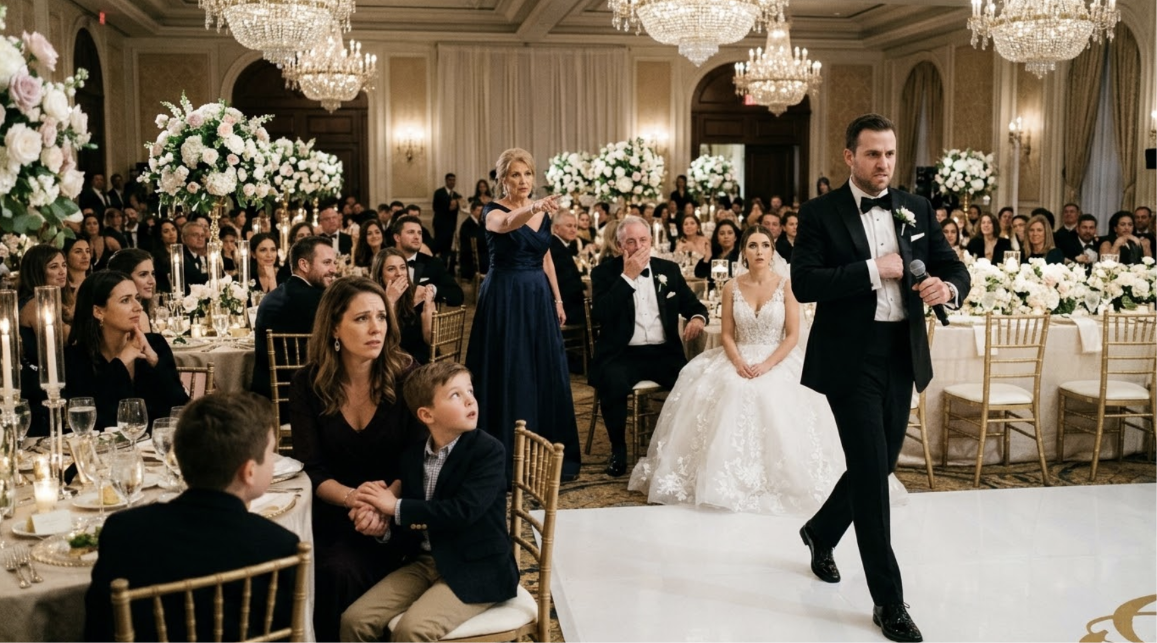
My mother once pointed at me in front of two hundred people and called me worthless.
She wanted everyone to believe that my life was a warning about what happens when a woman fails.
But she was wrong.
I wasn’t a failure.
I was a mother who kept her promises.
A nurse who cared for families when they were frightened.
A daughter who survived the disappointment of the people who were supposed to protect her.
And a woman who finally stopped asking permission to be happy.
That night, after the guests had left and Beckett was asleep, I stood in the garden beneath the little string lights.
I looked up at the sky and whispered:
“I hope you’re proud of me, Grandpa.”
The breeze moved gently through the flowers.
And for the first time in a very long time, I didn’t feel like I had to prove anything to anyone.
I was home.
I was happy.
And that was more than enough.