My Husband Handed Me a Halloween Mask Before His Company Christmas Party and Said, “Wear It or Stay Home.” He Had No Idea His Wife Was About to Become the Majority Owner of His Company.
PART 3
Then the board members stood. One by one, the executives followed.
Within seconds, the entire ballroom was on its feet.
I stood beneath the spotlight in my blue dress, my damaged face completely visible.
For the first time in two years, nobody was looking at me with pity.
They were looking at me because I mattered.
And I wasn’t going to apologize for it. But Kenton wasn’t clapping.
He was staring at Augustus as if the chairman had just announced that the world was ending.
“That’s impossible,” he finally said.
His voice wasn’t loud, but the people closest to us heard him.
Augustus raised an eyebrow.
“Is something troubling you, Mr. Whitmore?”
Kenton swallowed.
“Whitmore?” He looked at me. “You mean… Corinna?”
Augustus nodded.
“Yes. Your wife.”
Darcie, who had been sitting at Kenton’s table only moments earlier, slowly removed her hand from the back of his chair.
I noticed it.
So did Kenton.
But I wasn’t interested in Darcie.
I was interested in the man who had given me a Halloween mask.
“Augustus,” I said quietly, “would you mind if I said a few words?”
He smiled.
“Of course. The floor is yours.”
He offered me his arm, and we walked toward the stage.
My left leg still became tired if I walked too quickly. My balance wasn’t perfect. My speech sometimes sounded different when I was nervous.
But I walked.
Every step reminded me of the woman who had learned to stand again after a stroke.
Every step reminded me of the mother who had carried her baby through hospital corridors while half her body refused to cooperate.
And every step reminded me that I had survived something much worse than a room full of judgmental people.
When I reached the microphone, I looked out at the crowd.
Then I found Kenton.
He was standing alone now.
His face was pale.
“Good evening,” I began.
My voice trembled slightly.
I took a breath and continued.
“First, thank you for welcoming me. Some of you may already know who my father was. His name was Edward Whitmore. He founded this company with two trucks, a borrowed warehouse, and a belief that a business should be built on trust.”
A few older executives nodded.
“My father used to tell me that a company’s reputation wasn’t measured by the size of its offices or the price of its executives’ cars. It was measured by how it treated people when nobody important was watching.”
I paused.
“After he died, I stepped away from the company. I wasn’t ready to take his place. I was grieving, and I believed the business was in capable hands.”
I looked at Augustus.
“He respected my decision. He protected my father’s legacy while I learned to live my own life.”
Then I turned back to the audience.
“But two years ago, something happened that changed everything.”
The room became quiet.
“Three days after giving birth to my son, I suffered a stroke. I nearly died. I spent months learning how to do things that most people never think about. Walking. Eating. Speaking. Holding a spoon. Smiling.”
My voice caught on that last word.
I waited.
“I lost movement on the left side of my face. I still have difficulties. I still have days when I look in the mirror and miss the woman I used to be.”
Nobody moved.
“But I am still that woman. I am also a mother, a daughter, a friend, and a person who deserves to be treated with dignity.”
I looked directly at Kenton.
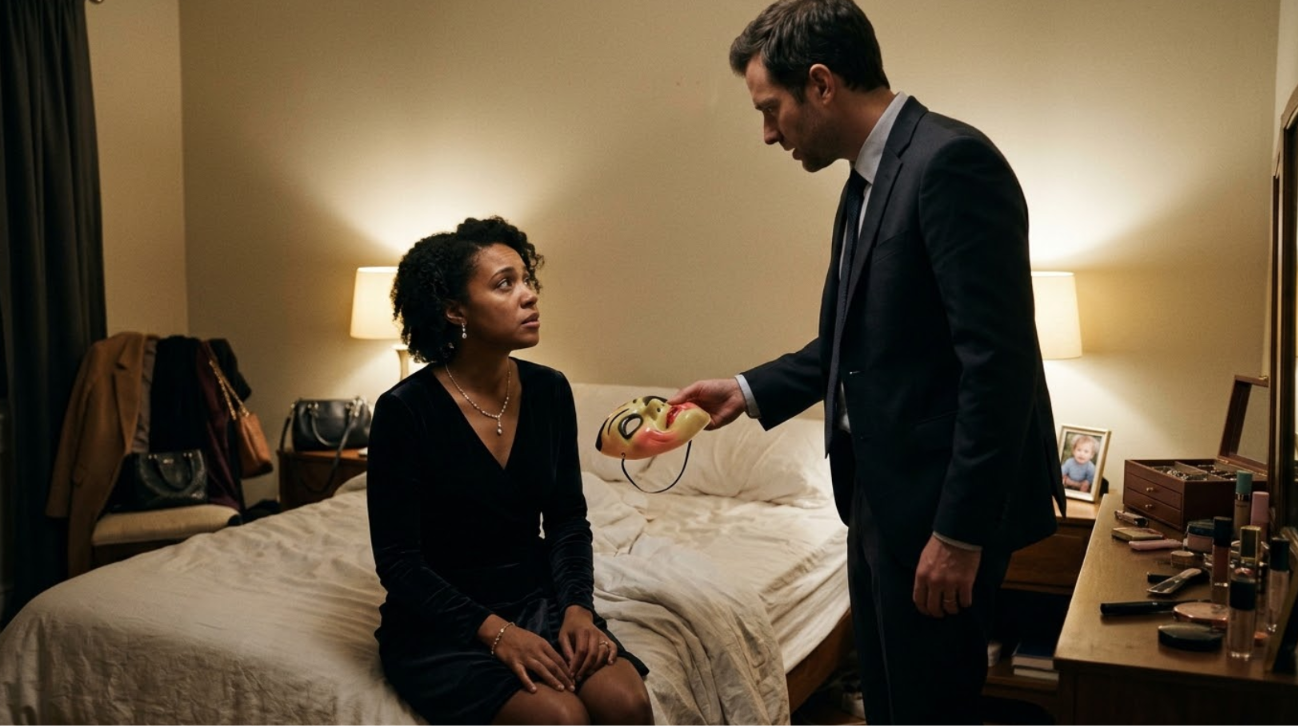
“Tonight, someone handed me a mask and told me that nobody needed to see my face.”
A murmur moved through the ballroom.
“I was told that my appearance might embarrass someone else’s career. That I should either cover my face or stay home.”
Kenton’s jaw tightened.
“Corinna,” he whispered from the crowd.
I continued.
“I want everyone here to understand something. There is nothing shameful about a face that has survived a stroke. There is nothing embarrassing about a body that has fought to stay alive.”
My eyes began to fill with tears.
“And there is nothing wrong with being different from the person you were before.”
The applause began again.
This time, it was louder.
But I wasn’t finished.
“My father built this company believing that people should be judged by their character, not by their appearance. I intend to protect that belief.”
I stepped back from the microphone.
Augustus returned to the stage and placed a hand on my shoulder.
“Your father would be very proud.”
I nodded.
I knew he would be.
But the evening was far from over.
Because Kenton was about to discover that the consequences of his behavior went far beyond one embarrassing moment at a Christmas party.
About twenty minutes later, I was standing near the windows overlooking Charleston Harbor.
The Christmas lights reflected against the dark water. The ballroom had returned to its usual noise, but people kept approaching me.
Some introduced themselves.
Others told me stories about my father.
A retired warehouse manager named Thomas shook my hand and said, “Your dad once paid for my daughter’s surgery when I couldn’t afford it. He never told anyone.”
I smiled.
Only the right side of my mouth moved.
But Thomas smiled back as though he hadn’t noticed.
That small moment meant more to me than all the applause.
“Corinna.”
I turned.
Kenton was standing behind me.
He had loosened his tie. His cheeks were flushed.
“Can we talk?”
I looked around.
“About what?”
“Not here.”
“Then we have nothing to discuss.”
His eyes widened.
“You’re really going to do this? You’re going to humiliate me in front of everyone?”
I almost laughed.
“Humiliate you?”
“You made me look like an idiot!”
I studied his face.
For two years, I had wondered what had happened to the man I married.
The man who used to hold my hand while we walked along the beach.
The man who cried when our son was born.
The man who once told me that he would love me no matter what happened.
I had spent countless nights trying to understand when he stopped seeing me as his wife.
But standing there, listening to him complain about his reputation, I finally understood.
He hadn’t been worried about losing me.
He had been worried about being seen with me.
“Kenton, I didn’t make you look like anything.”
He stepped closer.
“Listen. You misunderstood what I was trying to do.”
I glanced toward the ballroom.
“Did I misunderstand the mask?”
“It was a joke.”
“A joke?”
“Yes. A stupid joke. I was under pressure. You know how important tonight was.”
I nodded slowly.
“Then explain something to me.”
“What?”
“If the mask was a joke, why did you tell me Darcie could take my place at your table?”
His mouth opened.
Nothing came out.
I continued.
“And why did you say you weren’t walking into that room with a wife who looked like me?”
He looked down.
“Corinna, I was trying to protect my career.”
“From my face?”
He rubbed his forehead.
“You’re twisting everything.”
“No. I’m finally hearing you clearly.”
He looked toward the stage, where several board members were speaking with Augustus.
Then he lowered his voice.
“Okay. I know you’re upset. But we need to think about our family.”
“Our family?”
“Yes. Nico. Our home. Our future.”
I felt something tighten in my chest.
For two years, I had put up with his excuses because I wanted Nico to grow up in a home with both parents.
I had convinced myself that marriage meant patience.
That love meant understanding.
That if I worked hard enough to recover, Kenton might look at me the way he used to.
But love was never supposed to require me to hide my face.
“I have always thought about our family,” I said. “That’s why I stayed.”
His expression softened slightly.
“Then let’s go home. We can talk about this privately. I’ll apologize. I’ll do whatever you want.”
I looked at him.
“Would you have apologized if I hadn’t been introduced as the majority owner?”
He didn’t answer.
I didn’t need him to.
At 10:30 p.m., Augustus asked me to join a private meeting in the hotel’s conference room.
Several board members were already waiting.
There was a folder on the table with my name printed across the front.
I sat down.
“What’s this?” I asked.
Augustus opened the folder.
“Your father wanted you to have a complete understanding of the company before the trust transferred control. We’ve been preparing the transition for months.”
He passed me several documents.
The first contained the company’s ownership structure.
The second showed financial reports.
The third was an organizational chart.
I recognized several names.
One of them was Kenton Whitmore.
“He’s been with the company for six years,” Augustus explained. “He’s talented in certain areas, but his performance has been inconsistent.”
I looked at the figures.
“His division missed its annual targets?”
“Three consecutive quarters.”
“Why wasn’t I told?”
Augustus folded his hands.
“Because your father wanted you to make your own decisions when you were ready. He didn’t want you to feel pressured to intervene in the company while you were recovering.”
I looked at the next page.
There were several notes about employee complaints.
Some involved inappropriate treatment of junior employees.
Others concerned questionable sales reporting.
I frowned.
“Has this been investigated?”
“An internal review is underway.”
I looked at Augustus.
“Is Kenton involved?”
He hesitated.
“We have reason to believe he may have authorized certain changes to the sales figures.”
I read the report again.
“How serious?”
“Serious enough that the board requested a formal audit.”
I leaned back.
I had known Kenton could be selfish.
I had known he could be cruel.
But I had never imagined he might be dishonest at work.
“Does he know about the investigation?”
“Not yet.”
I closed the folder.
“Then don’t make any decisions tonight. I want the full report, every supporting document, and an independent review.”
Augustus nodded.
“Your father would have said exactly the same thing.”
I smiled faintly.
“Then I suppose I learned something from him.”
One of the board members, a woman named Margaret Ellis, leaned forward.
“There’s another matter, Corinna.”
“What is it?”
“Your husband has been telling people for months that you are unable to manage your personal affairs.”
I stared at her.
“What?”
“He mentioned that your stroke left you mentally incapable of handling financial decisions. He suggested that someone should manage your inheritance until you were fully recovered.”
I felt my fingers tighten around the folder.
“My stroke affected my facial muscles. It did not affect my mind.”
“I know,” Margaret said gently. “We know that now.”
I looked at Augustus.
“Did he ever try to access the trust?”
Augustus didn’t answer immediately.
Then he opened another document.
“Three months ago, someone contacted the trust’s legal department requesting information about the transfer date and the possibility of appointing an alternate beneficiary.”
“Who?”
He turned the paper toward me.
The request had been submitted under Kenton’s name.
For several seconds, I couldn’t speak.
My husband had been waiting for my father’s inheritance.
And apparently, he had been planning what to do with it.
I didn’t go home with Kenton that night.
Augustus arranged for a car to take me back to my neighbor’s house, where Nico was sleeping.
When I walked through the door, my little boy was curled up on the couch with his stuffed dinosaur.
My neighbor, Mrs. Patterson, stood up.
“Everything okay, sweetheart?”
I looked at Nico.
“Yes,” I whispered. “I think it will be.”
I picked him up carefully and carried him home.
The next morning, Kenton arrived at 8:15.
He was holding a bouquet of white roses.
I opened the door but didn’t invite him inside.
“Can we talk?” he asked.
“Nico is eating breakfast.”
“I brought flowers.”
I glanced at the bouquet.
“For whom?”
He looked confused.
“For you.”
I almost smiled.
“That’s interesting. You didn’t bring me flowers when I spent three months in rehabilitation.”
He lowered his eyes.
“Corinna, I know I made a mistake.”
“You made several.”
“I was scared.”
“Of what?”
He took a breath.
“Everything changed after your stroke. I didn’t know how to handle it. I was working constantly. I had pressure at the office. I was worried about money. I didn’t know how to be a husband anymore.”
I listened.
Some part of me still wanted to believe there was a reasonable explanation.
But then he said something that destroyed whatever sympathy I had left.