PART4
“Oh.”
“And I love you very much.”
“I love you too.”
After we hung up, I sat quietly for a while.
I wasn’t going to punish my grandchildren for their parents’ choices.
But I also wasn’t going to let anyone use my love for them as a way to control me.
On Saturday, I arrived at the soccer field with a bag of orange slices and two bottles of water.
Oliver spotted me immediately.
He ran across the grass and wrapped his arms around my waist.
“Grandma!”
I hugged him tightly.
Stella came over a moment later.
She was six and still had the habit of holding my hand whenever she wanted to tell me something important.
“Grandma, can you come to our house next Sunday?”
“I’d love to see you.”
“Mom said you don’t want to help us anymore.”
I looked down at her.
“Did she say that?”
Stella nodded.
I knelt so we were eye to eye.
“Sweetheart, I will always love you. That will never change. But sometimes adults need to make their own decisions about money.”
She considered that for a moment.
“Can you still make pancakes?”
I laughed.
“That is something I will never stop doing.”
She smiled and ran back toward the field.
From the opposite side of the bleachers, I noticed Monica watching me.
She wasn’t smiling.
Jeffrey stood beside her with his hands in his pockets.
Neither approached me until after the game.
Then Jeffrey walked over.
“Mom, can we talk?”
I looked at the children.
“Not here.”
“Fine. Tomorrow?”
“Call me first.”
He looked surprised.
“Why?”
“Because I don’t want unexpected visits anymore.”
He nodded reluctantly.
As he turned away, Monica said something under her breath.
I didn’t hear the words.
But I saw her expression.
And I knew the conversation wasn’t over.
The following Sunday, Jeffrey called at nine in the morning.
His voice was different.
Less demanding.
Almost careful.
“Mom, I think we need to sit down and talk about what’s happening.”
I poured myself a cup of coffee.
“All right.”
“Can Monica and I come over this afternoon?”
I considered it.
“Yes. Three o’clock.”
“Thank you.”
“And Jeffrey?”
“Yes?”
“I want us to have an honest conversation. No shouting, no demands, and no bringing the children into it.”
He was quiet.
“Okay.”
At three, they arrived.
This time, they didn’t try their keys.
Jeffrey rang the doorbell.
I opened the door and invited them into the living room.
The coffee table had three cups, a small plate of cookies, and a folder containing copies of the account statements.
Jeffrey looked at the folder.
“What’s that?”
“Something I think we need to discuss.”
Monica sat down without saying anything.
Jeffrey remained standing.
“Mom, we understand you’re upset. But I think we’ve all made mistakes.”
I nodded.
“That’s possible.”
He looked relieved.
“We don’t want this to damage the family.”
“Neither do I.”
“Then can we put the card back the way it was?”
I looked at him.
“No.”
His expression fell.
“Mom—”
“Jeffrey, before we discuss anything else, I want you to look at these statements.”
I opened the folder.
I had highlighted several transactions.
Restaurants.
Online purchases.
Clothing stores.
A weekend hotel stay.
And one particularly large charge from a furniture showroom.
I placed the first statement in front of him.
“Do you remember this?”
He glanced down.
“That’s from the card.”
“Yes. Four hundred and eighty-six dollars at a restaurant.”
“We had dinner with friends.”
“On my emergency card.”
He didn’t answer.
I placed another statement beside it.
“Three hundred and twelve dollars at a clothing store.”
Monica shifted in her chair.
“Those were things for the children.”
“Some of them may have been. But this was a personal shopping charge, and I never agreed to pay for it.”
Monica crossed her arms.
“Are you going to question every single purchase?”
“No. I’m going to stop paying for purchases I never agreed to.”
Jeffrey finally sat down.
“How much are you saying we owe you?”
I looked at the highlighted pages.
“That’s something I want to calculate properly. But there is another issue.”
I placed Daniel’s email summary on the table.
Jeffrey’s eyes moved across the page.
Then his face changed.
He looked up at me.
“Who gave you this?”
“Daniel.”
“Why is he discussing my phone call with you?”
“Because the account belongs to me.”
Jeffrey leaned back.
I watched him carefully.
“Mom, I was just asking about options.”
“You asked to become a joint owner.”
“I was trying to make things easier.”
“For whom?”
He didn’t answer.
Monica suddenly spoke.
“Jeff was trying to help us get a house.”
I turned toward her.
“With my money?”
She looked irritated.
“We weren’t asking you to buy us a house.”
“Then why did you want access to the account?”
“Because we thought you might help with the down payment.”
I stared at her.
“Did you discuss that with me?”
She looked away.
Jeffrey rubbed his face.
“We were going to tell you.”
“When?”
“Eventually.”
I took a breath.
“Jeffrey, I need you to understand something. Your father and I spent forty years building a life. We saved money. We made sacrifices. We paid our mortgage. We raised you. We planned for retirement.”
I paused.
“When your father died, I lost my husband. I did not suddenly become a family bank.”
His eyes lowered.
I continued.
“I have helped you because I love you. But I am sixty-eight years old. I should not have to wonder whether I can afford my own retirement because my son expects me to finance his lifestyle.”
Monica shook her head.
“Nobody is asking you to give up your retirement.”
I looked at her.
“Then stop asking me to spend it.”
Silence filled the room.
And then Jeffrey said something that made my heart sink.
“Well, if Dad were here, he wouldn’t let you treat us this way.”
I looked at my son’s face.
For a moment, I could almost hear Bruce’s voice telling me not to argue when emotions were high.
But I wasn’t going to let Jeffrey use his father’s memory as a weapon.
“You’re right about one thing,” I said quietly. “Your father would want this family to stay together.”
Jeffrey nodded.
“But he would also want you to respect me.”
He looked away.
“And he would never have wanted me to spend my remaining years being afraid to say no to my own child.”
Neither of them spoke.
I closed the folder.
“We’re going to do things differently from now on.”
Jeffrey looked at me.
“What does that mean?”
“It means there will be no more shared credit cards. No more automatic financial assistance. No more unplanned withdrawals. And no more access to my house without permission.”
Monica stood up.
“So you’re cutting us off?”
“No. I’m ending a financial arrangement that has become unhealthy.”
“Same thing,” she muttered.
I remained seated.
“You are welcome to visit. You are welcome to bring the children. You are welcome to call me because you miss me. But if you call only when you need money, I will not answer every request with a check.”
Jeffrey stood.
He looked hurt.
But for the first time, I didn’t rush to comfort him.
He walked toward the door.
Monica followed.
At the entrance, he stopped.
“Mom?”
“Yes?”
“Are you really happy doing this?”
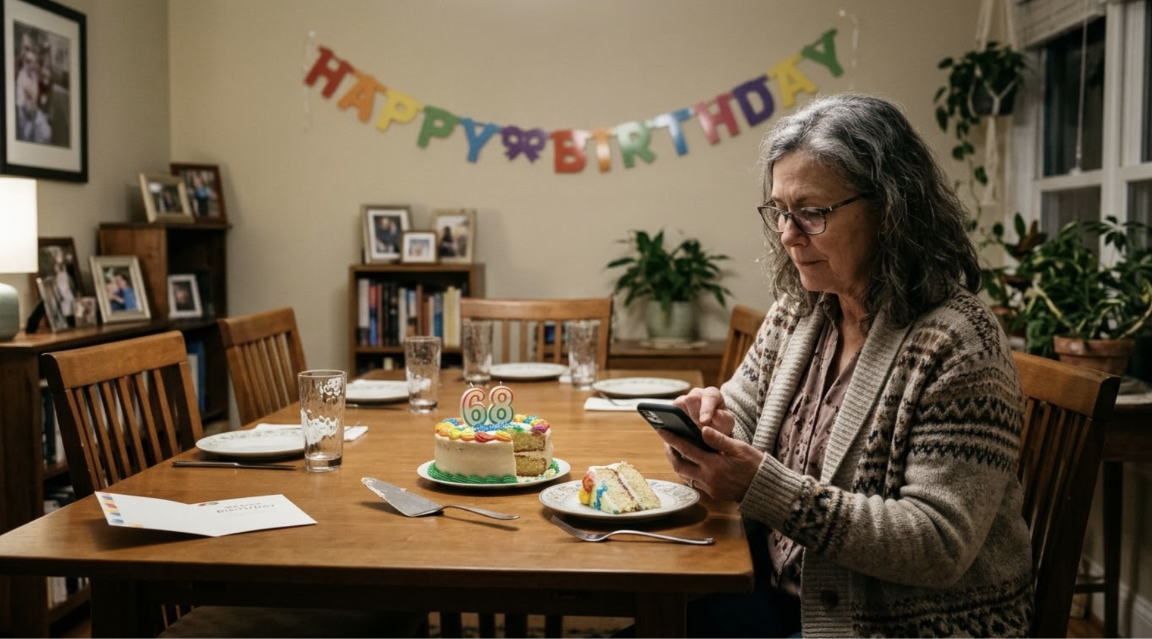
I thought about the empty birthday table.
The cold roast.
The untouched cake.
The years I had spent trying to make myself useful enough that nobody would forget me.
Then I thought about Margaret’s banana bread, my Saturday morning at the soccer field, and the trip I had been considering for months but kept postponing because someone might need something.
I looked at my son.
“I’m learning to be happy without needing everyone to approve of me.”
He nodded slowly.
Then he left.
I closed the door.
For the first time in three years, I didn’t feel guilty about the silence that followed.
But I knew there was still one more conversation waiting for us.
Because the following morning, Daniel called again.
And what he told me about the money market account was something I hadn’t expected.
“There’s one more thing you should know,” he said.
“What is it?”
“Your son wasn’t the only person who contacted our office about that money.”
I sat upright.
“What do you mean?”
Daniel paused.
“Someone called two weeks ago claiming to be acting on your behalf. They wanted to know whether your account could be used as collateral for a loan.”
My coffee cup stopped halfway to my mouth.
“Who?”
Daniel lowered his voice.
“The caller identified herself as Monica.”
I felt the room become very quiet.
“Did you approve anything?”
“No. We refused to discuss your private financial information with her.”
I stared at Bruce’s old photograph on the bookshelf.
Then I asked the question that had suddenly become much more important than anything else.
“Daniel, did she mention how much money she wanted to borrow?”
He checked his notes.
“Yes. She asked about a loan of approximately eighty-five thousand dollars.”
I slowly put down my coffee.
Eighty-five thousand dollars.
That was not a restaurant bill.
That was not an emergency.
That was not a misunderstanding.
And suddenly, I understood that changing the locks and freezing the credit card might have been only the beginning.
Because somebody in my family had been planning something much bigger than I had ever imagined.
For several minutes after Daniel finished speaking, I couldn’t say anything.
Eighty-five thousand dollars.
Monica had called my financial adviser and asked whether my money could be used as collateral for a loan.
Without my permission.
Without telling me.
And two weeks before my birthday, when she was apparently already planning an evening out at Bellini’s.
“Daniel,” I finally said, “I need you to tell me exactly what happened.”
He explained that a woman identifying herself as Monica had called the office and asked about the possibility of using my money market account to secure a personal loan.
She had apparently been told that the account was in my name and that no changes could be made without my authorization.
“Did she say what the loan was for?”
“She mentioned a property investment.”
I closed my eyes.
“Did she provide any documents?”
“No. She asked what paperwork would be required and whether you would need to attend the bank in person.”
I felt a chill run through me.
“Daniel, I want every account protected. No third-party access, no telephone changes, and no transfers without direct verification with me.”
“We can arrange that.”
“And I want a meeting with the estate attorney.”
“Of course.”
After the call, I walked into Bruce’s study.
I sat in his chair and looked around the room.
His reading glasses were still in the little wooden tray beside his desk. His favorite pen was in the drawer. A photograph of us standing beside our first house was still hanging above the filing cabinet.
I remembered the day we bought that house.
We were twenty-two and twenty-four.
We had almost nothing.
Bruce had worked overtime for months to save the down payment. I had taken extra shifts at the accounting office and packed sandwiches instead of buying lunch.
We had built everything slowly.
The house.
The savings.
The retirement accounts.
The life insurance.
And eventually, the family we had always wanted.
Now, three years after Bruce’s death, I was sitting alone trying to protect the very things we had spent our lives building.
I wiped my eyes.
Then I picked up the phone and called Jeffrey.
He answered after the fourth ring.
“Mom?”
“Did you know Monica contacted Daniel about an eighty-five-thousand-dollar loan?”
Silence.
Then I heard him breathe out.
“Mom, I can explain.”
I closed my eyes.
“Then explain.”
“It wasn’t what you think.”
“Tell me what it was.”
“We found a house we liked. It needed some work, but it was in a good neighborhood. Monica thought we could buy it, renovate it, and eventually sell our current place.”
“And where did the eighty-five thousand dollars come from?”
He hesitated.
“We needed a down payment.”
“From my money?”
“We thought you might help.”
“Did you ask me?”
“We were going to.”
“When?”
“Mom, please. It was just an idea.”
“Then why did Monica call my financial adviser?”
Another silence.
Finally, Jeffrey said, “She was trying to find out whether it was possible.”
“She was trying to find out whether she could borrow against my money without telling me.”
“She wasn’t going to do anything without your permission.”
“Then why didn’t she call me?”
He had no answer.
I lowered my voice.
“Jeffrey, I am not going to argue with you. But I need you to understand that what happened has changed the way I see things.”
“You’re making this sound worse than it was.”
“No. I’m finally looking at it without making excuses.”
I ended the call.
For the first time, I didn’t feel the need to call him back.
The next morning, I met with Daniel and an estate attorney named Susan Whitmore.
Susan was a woman in her early sixties with silver hair, a calm voice, and the kind of expression that made it difficult to hide anything.
She listened while I explained everything.
The birthday dinner.
The credit card.
The shared money market account.
The attempted loan.
The unexpected requests for money.
When I finished, she folded her hands on the desk.
“Mrs. Avery, I want to ask you something important.”
“Of course.”
“Do you believe your son or daughter-in-law has access to any of your financial documents, passwords, or identification information?”
I thought carefully.
“Jeffrey knows where I keep some of the paperwork. He also knows my date of birth and has helped me with online banking in the past.”


One Comment on “PART4: My Son Skipped My 68th Birthday for Dinner With His Wife—So I Froze Their Credit Card. What Happened Next Changed Our Family Forever”
Comments are closed.