PART5
“Does he know your passwords?”
“He used to know one of them. I changed it last year.”
“Good. We’ll review everything.”
She made a list.
We discussed the credit card account, bank accounts, beneficiaries, estate documents, and the importance of keeping my financial arrangements separate.
Then Susan asked about my grandchildren.
I told her I loved Oliver and Stella more than anything.
“I don’t want them to suffer because their parents have made poor financial decisions,” I explained. “I want to leave them something meaningful. But I don’t want anyone using that money before they’re old enough to understand what it means.”
Susan nodded.
“Then we can discuss establishing a properly structured trust for them. You can decide the conditions, the trustee, and the age at which they receive distributions.”
I liked that idea.
I also decided to review my will.
Not because I wanted to punish Jeffrey.
But because I wanted my wishes to be clear.
Bruce and I had always believed that our children should inherit what we left behind.
We had never discussed what should happen if our son began treating our savings as though they were already his.
Susan explained that I could provide for my grandchildren while maintaining control of my own assets during my lifetime.
By the end of the meeting, we had a plan.
I would retain control of my money.
The old credit card arrangement would remain closed.
The money market account would be secured.
My grandchildren’s future would be protected through an appropriate trust.
And no one would be able to make financial decisions on my behalf without the proper legal authority.
When I walked out of Susan’s office, the sky was clear.
I felt lighter.
Not because the problem had disappeared.
But because I had finally stopped pretending it wasn’t there.
Two weeks later, something happened that I hadn’t expected.
I received a handwritten letter from Jeffrey.
Not a text.
Not an email.
An actual letter.
The envelope was addressed in his handwriting.
I sat at the kitchen table and opened it carefully.
Mom,
I know you’re angry with me. I know I haven’t handled things well.
But I want you to understand that Monica and I have been under a lot of pressure.
The house needs repairs. The kids are getting older. Our expenses keep increasing. I thought if we could get another property, we could improve our financial situation.
I didn’t think you would mind helping because you’ve always helped us before.
I know that sounds selfish.
I’m sorry.
I miss the way things used to be.
Love, Jeffrey.
I read it twice.
There was no mention of the eighty-five-thousand-dollar loan.
No mention of Monica contacting Daniel.
No mention of the money they had spent on the credit card.
But there was an apology.
And I wanted to believe it was genuine.
I folded the letter and placed it in the drawer beside Bruce’s old notebook.
Then I decided to wait before responding.
Sometimes, an apology needed time to prove itself.
The following Sunday, Margaret and I went to the botanical gardens.
We walked beneath the flowering trees, stopped for lunch, and spent nearly an hour looking at a display of roses.
At one point, Margaret asked whether I had heard from Jeffrey.
I told her about the letter.
“Are you going to forgive him?” she asked.
I looked at the flowers.
“I don’t know.”
“That’s fair.”
“I love him, Margaret. I always will. But I don’t know how to go back to the way things were.”
She smiled gently.
“Perhaps you aren’t supposed to go back.”
I looked at her.
“Perhaps you’re supposed to build something different.”
I thought about that for the rest of the afternoon.
And she was right.
I didn’t want the old arrangement anymore.
I wanted a family relationship that didn’t depend on my credit card.
I wanted phone calls that didn’t begin with requests.
I wanted invitations that weren’t followed by financial expectations.
Most of all, I wanted to be able to say no without wondering whether I would lose my son.
Three weeks later, Jeffrey called.
“Mom, can we come over?”
“Of course. What time?”
“Saturday afternoon?”
“That works.”
He arrived with Monica and the children.
Oliver ran through the front door as soon as I opened it.
“Grandma!”
He hugged me so tightly that I almost lost my balance.
Stella followed, carrying a drawing.
“I made this for you.”
It was a picture of five people standing beneath a large yellow sun.
There was a house in the background and a cake on the table.
At the top, in uneven letters, she had written:
I LOVE GRANDMA.
I hugged her.
“Thank you, sweetheart. I’m putting this on the refrigerator.”
For a little while, everything felt normal.
The children played in the living room while Jeffrey and Monica sat with me at the kitchen table.
Monica looked uncomfortable.
Jeffrey cleared his throat.
“Mom, we wanted to talk about something.”
I placed my coffee cup down.
“All right.”
He looked at Monica.
Then back at me.
“We’ve decided not to pursue the other house.”
I nodded.
“That’s probably wise.”
“We realized we were trying to take on too much.”
Monica looked down.
“And I want to apologize,” she said.
I waited.
She took a breath.
“I shouldn’t have used your credit card for personal purchases. And I shouldn’t have contacted Daniel without telling you.”
It wasn’t a perfect apology.
But it was a start.
“Thank you for saying that,” I replied.
She nodded.
Jeffrey looked at me.
“We also wanted to ask whether we could start over.”
I studied his face.
“What does starting over mean to you?”
He thought for a moment.
“Maybe Sunday dinners again. The kids miss them.”
I smiled slightly.
“I miss them too.”
“Could we come next Sunday?”
“Yes. But I want to make one thing clear.”
Both of them looked at me.
“I will happily cook dinner for my grandchildren. I will happily spend time with you. But there will be no more financial arrangements like before.”
Jeffrey nodded.
“I understand.”
“And if you need help with something, you can ask. I may or may not be able to help, but I won’t be pressured.”
Monica nodded too.
“That’s fair.”
I hoped they meant it.
But I also understood that trust wasn’t restored by one conversation.
It was rebuilt through actions.
Over the next several months, things slowly changed.
Jeffrey stopped asking for money.
Monica stopped sending me links to expensive items she thought I should buy.
They began making their own financial arrangements.
Sometimes they still struggled.
Sometimes Jeffrey mentioned that the car needed repairs or that the children had school expenses.
But I no longer automatically reached for my checkbook.
Instead, I listened.
Sometimes I offered advice.
Sometimes I simply wished them luck.
And gradually, I began noticing something important.
My son was capable of managing his own life.
He had simply become accustomed to having me manage the difficult parts.
One afternoon, Jeffrey called to tell me he had received a promotion.
“That’s wonderful!” I said.
“Thanks, Mom.”
There was a pause.
Then he added, “I wanted to tell you before I told anyone else.”
I smiled.
“That means a lot.”
“Maybe we can celebrate sometime.”
“I’d like that.”
And for once, I didn’t wonder how much the celebration would cost me.
My sixty-ninth birthday arrived the following year.
This time, I didn’t spend the entire morning preparing a dinner for people who might not come.
Margaret and I went shopping.
I bought myself a beautiful blue dress.
Then we stopped at a bakery and ordered a small coconut cake.
I invited Jeffrey, Monica, Oliver, and Stella.
I also invited Margaret and two old friends from the neighborhood.
At six o’clock, everyone was there.
The table was set with ordinary plates.
No expensive china.
No elaborate meal.
Just roast chicken, vegetables, salad, and a cake with sixty-nine candles.
Oliver helped me arrange the flowers.
Stella insisted on placing the napkins.
Jeffrey brought a bottle of wine.
Monica carried a small gift bag.
When dinner was over, everyone gathered around the cake.
Jeffrey stood beside me.
“Mom, before we sing, I want to say something.”
I looked at him.
He seemed nervous.
“Last year, I let you down. I thought you would always be there to fix things, and I forgot that you needed someone to show up for you, too.”
The room became quiet.
He continued.
“I’m sorry I made you feel like your value was connected to what you could give us. You’re my mother, and I should have treated you with more respect.”
My eyes filled.
He reached for my hand.
“I love you, Mom.”
I squeezed his fingers.
“I love you too.”
Then everyone began singing.
Their voices weren’t perfect.
Oliver sang too loudly.
Stella forgot half the words and made up the rest.
Margaret laughed so hard that she had to sit down.
But I didn’t care.
When the song ended, I closed my eyes.
Last year, I had wished that my family would remember me.
This year, I wished for something different.
I wished that I would never again forget myself.
Then I blew out the candles.
Later that evening, after everyone had gone home, I sat on the back porch with a small glass of Merlot.
My phone buzzed.
It was a message from Jeffrey.
Thank you for having us tonight, Mom. We had a wonderful time. I love you.
I smiled.
Then I opened the photograph Margaret had taken of us around the birthday cake.
Everyone was smiling.
For the first time in a long while, I didn’t look at the picture and wonder whether the happiness was real.
I simply enjoyed it.
A few days later, I visited Bruce’s grave.
I brought fresh flowers and stood quietly beside his headstone.
“Well, Bruce,” I whispered, “I think I’m finally learning.”
The wind moved gently through the trees.
I told him about the birthday dinner, about the children, and about how Jeffrey was slowly learning to stand on his own feet.
Then I placed my hand against the cold stone.
“I wish you could have been here.”
I stood there for another minute before turning to leave.
On the way home, I stopped at the bank.
Not because I needed to transfer money.
Not because someone had asked for help.
I simply wanted to review my accounts and make sure everything was exactly where I wanted it.
The trust for Oliver and Stella was in place.
My retirement savings were protected.
My accounts were secure.
And my future was no longer something I had to negotiate with anyone.
There was one final thing I did that month.
I booked a trip.
A ten-day trip to the coast with Margaret.
We had talked about doing it for years, but I had always found a reason to postpone it.
There was always a school pickup.
A family dinner.
A bill.
An emergency that somehow became my responsibility.
This time, I booked the hotel, paid the deposit, and put the confirmation in my calendar.
When Jeffrey called and asked whether I could watch the children that weekend, I told him I was going away.
“Oh. Where?”
“To the coast with Margaret.”
“That’s nice. When will you be back?”
“Ten days.”
There was a pause.
“Okay, Mom. Have fun.”
And he meant it.
I realized then that something had changed.
I was no longer afraid that having my own life would make me a bad mother.
Because a mother could love her children without financing every decision they made.
A grandmother could adore her grandchildren without giving their parents unlimited access to her savings.
And a widow could begin living again without feeling guilty for enjoying the years she still had.
On the morning of our trip, I stood in the driveway with my suitcase.
The same driveway where I had stood on my sixty-eighth birthday, waiting for cars that never arrived.
I looked back at the house.
The windows were clean.
The garden was blooming.
The front door had new locks.
And inside, on the refrigerator, Stella’s drawing was still hanging beneath a little magnet shaped like a heart.
I smiled.
Then I got into Margaret’s car.
As we pulled away, my phone buzzed one last time.
It was a message from Jeffrey.
Have a wonderful trip, Mom. We’ll see you when you get back. Love you.
I read it and smiled.
Then I put the phone away.
The road stretched ahead of us, bright beneath the morning sun.
For years, I had believed that being a good mother meant always keeping a place at my table, always answering the phone, always opening my wallet, and always saying yes.
But I had learned something important.
Love should never require you to disappear.
I could love my son and still protect my money.
I could forgive my daughter-in-law and still remember what happened.
I could spoil my grandchildren without allowing anyone to use them as a reason to control me.
And I could celebrate another birthday without waiting for someone else’s permission to feel happy.
Bruce used to tell me that the best years of our lives weren’t necessarily behind us.
I finally understood what he meant.
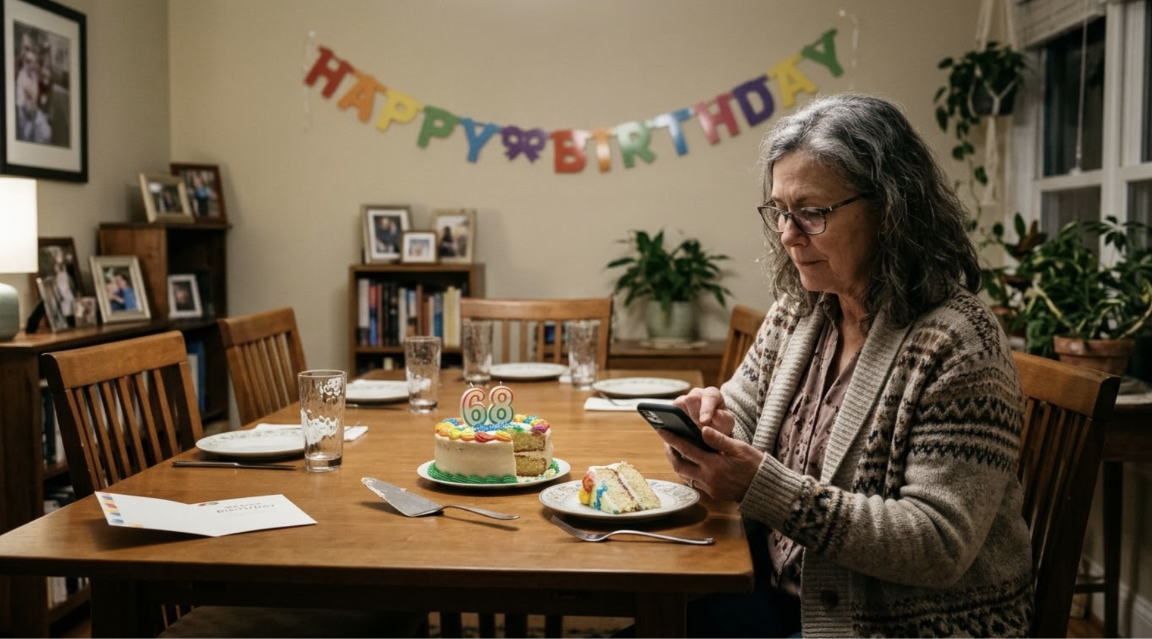
My sixty-eighth birthday had begun with an empty driveway, a cold dinner, and a message telling me not to wait.
But it had also been the day I stopped waiting for other people to decide whether I mattered.
And that turned out to be the best birthday present I could have given myself.



One Comment on “PART5: My Son Skipped My 68th Birthday for Dinner With His Wife—So I Froze Their Credit Card. What Happened Next Changed Our Family Forever”
Comments are closed.