“Duchess of Sussex” is the phrase Meghan repeats again and again.It isn’t just habit—it’s a strategy of public “brand imprinting,” deployed just as Prince William is preparing to take decisive steps toward stripping the Sussex title. Recent quiet but forceful moves from William gradually tightening royal authority in accordance with long-standing tradition. And those actions are the very reason Meghan has reacted with such intensity—doubling down on title usage, reinforcing imagery, and ensuring the Duchess of Sussex name is spoken at every appearance. What fascinates observers now is not only Meghan’s determination to hold onto her title… but what William is believed to be doing behind the scenes— strict measures enough to leave Meghan feeling she may be standing at the final threshold.
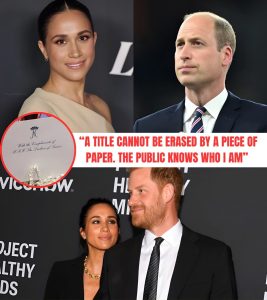
Meghan Markle’s connection to the Sussex title has become more than a formality. In recent months, it has evolved into a message—calculated, deliberate, and increasingly visible. Whether she is stepping into a quiet meeting in Los Angeles or greeting a journalist at her Montecito home, the introduction is the same, unmistakable and unwavering: The Duchess of Sussex. The repeated use of the title has sparked a surge of speculation from royal commentators, many claiming that this is not simply Meghan asserting her identity, but actively reinforcing it in anticipation of a possible move by Prince William to remove it.
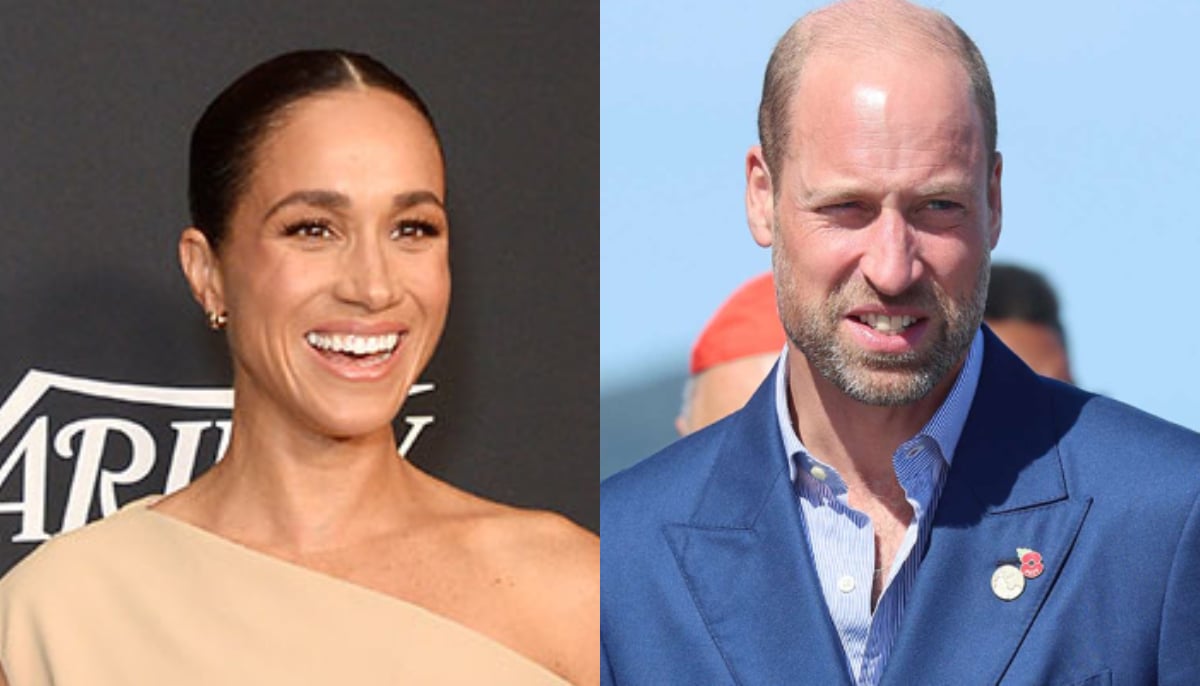
According to several publications that follow the inner workings of the monarchy, William is said to be navigating a highly sensitive decision. Stripping a royal title is not a routine event; it requires legal, political, and symbolic groundwork. Yet in the wake of recent royal tensions—and particularly after the precedent set with the former Prince Andrew—sources suggest that conversations behind palace walls have shifted from theoretical to tactical. The idea is no longer distant. It is, reportedly, being prepared.
:max_bytes(150000):strip_icc():focal(999x0:1001x2)/Meghan-markle-Prince-Harry-111925-6fe0b8bb198f42a8a9ee56df8d867778.jpg)
For Meghan, the timing appears far from coincidental. Observers point to the now-viral anecdote from her Harper’s Bazaar profile, where her manager formally announced her as the Duchess of Sussex despite being the only other person in the room. A similar formality took place during her visit to the La Brea Tar Pits, where staff were instructed to use the full title. To some, these repetitions are mere ceremony. To others, they are signals—an intentional, public reaffirmation meant to precede any attempt at removing the name she has built her global platform around.
:max_bytes(150000):strip_icc():focal(749x0:751x2)/Meghan-Markle-Fortune-Most-Powerful-Women-Summit-As-Ever-Holidays-111525-46766544c7bc40b59fcadabb06d2d949.jpg)
A former royal aide, speaking anonymously, described the situation with a mix of resignation and intrigue. “Titles operate on two levels,” she explained. “There’s the legal reality, and then there is the public perception. If a title becomes strongly associated with a person in the public consciousness, removing it becomes much more complicated. People don’t unlearn what they’ve already internalized.” She added, after a brief pause, “Meghan understands this better than many realize.”
Supporters of Meghan argue that she has every right to use her title and that labeling her behavior as “strategic” is yet another attempt to control her narrative. They point out that Meghan has continued to be referred to as the Duchess of Sussex in American media, in charity work, and in public appearances, and that nothing she has done violates royal protocol as it currently stands. Critics, however, interpret her behavior differently, framing it as a pre-emptive move to create a public record that would make a future title removal look punitive, even politically motivated.
A British commentator who has covered the Royal Family for two decades offered an even sharper assessment. “When Meghan repeats that title, she’s not just speaking to her fans,” he said. “She’s speaking to the monarchy. She’s saying: ‘This is who I am, this is who you named me, and I dare you to try to take it back.’ And the palace is well aware of the message.”

Underlying the tension is the shadow cast by Prince Andrew’s case. After the re-examination of his ties to Jeffrey Epstein, Andrew was stripped of all remaining titles. He now goes by Andrew Mountbatten-Windsor, a symbolic and public severing that did not go unnoticed. His removal set a precedent—one that, according to insiders, sparked genuine concern for Harry and Meghan. Those familiar with palace thinking say that William, unlike his father, has little tolerance for prolonged institutional strain and is more inclined to act decisively where he believes tradition or stability is at stake.
But what exactly has William begun doing behind the scenes? That is where the atmosphere around the palace becomes thick with rumor. Some say he has started consolidating legal pathways, consulting constitutional advisors on the technicalities of dukedom removal. Others suggest he has already taken smaller steps—quiet reassignments, internal restructuring, and private briefings intended to prepare senior aides for the possibility of title revision. None of this has been confirmed. All of it has been discussed.
A London political analyst offered a pointed observation while nursing a cup of tea near Westminster. “William works differently from his father. Charles tolerated dysfunction for years. William sees it as erosion. If he believes the Sussex title is being used in a way that harms the institution, he will move faster than people expect.” He smiled ruefully, adding, “And Meghan knows that. She’s smart enough to feel the temperature shift.”
This dynamic—Meghan’s public reinforcement and William’s rumored tightening of royal authority—has created a quiet standoff, one fought not through public statements but through symbolism, visibility, and timing. The battle lines, if they can be called that, are not drawn in words but in actions: who announces the title, who acknowledges it, who challenges it, and who has the power to erase it.
For now, the Duchess of Sussex continues to speak her title into every room she enters. Whether it is self-branding, self-protection, or simply self-assertion, it has become the centerpiece of her public identity. And while her supporters see strength in her insistence, critics see fear—fear of what may be coming, and fear of a loss that would reach far beyond a name on paper.
In the end, the truth of what William is preparing remains behind palace walls. But each new gesture from Meghan suggests she feels the pressure building. And each quiet move attributed to William suggests that something significant may be underway.
The public, for now, is left watching the space between them—wondering which will come first: a royal decision, or a royal confrontation.