Princess Charlotte’s Whisper for Diana Reduces Red Roses to Tears in Unscripted Royal Moment.
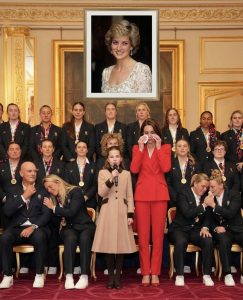
During a private reception at Windsor Castle on January 15, 2026, the England women’s rugby team, the Red Roses, experienced an unforgettable and deeply moving encounter with Princess Charlotte that left even the toughest athletes in tears. The moment was entirely unscripted, unplanned, and captured only in the memories of those present—no cameras, no official photographs, just a quiet exchange between a 10-year-old princess and the World Cup champions.
The Red Roses had been invited to Windsor to celebrate their historic Rugby World Cup victory in September 2025—their first since 2014—following a triumphant campaign that captivated the nation. Princess Catherine, as patron of the Rugby Football Union, hosted the team personally, joined by her husband Prince William and their three children: Prince George, Princess Charlotte, and Prince Louis. The family had spent the afternoon engaging with the players—watching curling demos, trying their hand at the sport, and sharing laughs over family rugby games at home.
Toward the end of the visit, as the group prepared to depart, Princess Charlotte approached a small cluster of Red Roses players who were standing near a display of memorabilia. Among the items was a framed photograph of Princess Diana wearing an England rugby shirt during a 1990s visit to Twickenham. Diana had been a passionate supporter of women’s sport and rugby in particular, often attending matches and championing female athletes long before it was common.
Charlotte, who had been quietly observing the celebrations all afternoon, walked up to the players holding the photo. Without fanfare or announcement, she leaned in close to one of the senior players—later identified as captain Marlie Packer—and whispered something only she and Packer could hear. Packer’s expression changed instantly: her eyes filled, she covered her mouth, and tears began to fall. Within seconds, the emotion spread through the nearby players. Several dropped to one knee or embraced each other as quiet sobs broke the room’s earlier laughter.
Catherine, noticing the shift, walked over immediately, placing a gentle hand on Charlotte’s shoulder. William followed, his face softening with pride and tenderness. No one spoke for several long moments. When the tears subsided, Packer later shared with close friends what Charlotte had whispered: “My granny would have loved you. Thank you for playing like she believed women could.” The reference was unmistakable—Diana, Charlotte’s grandmother, had long been an advocate for breaking barriers in sport and empowering women.
The gesture carried profound weight. Diana’s legacy as a trailblazer for women’s rights, mental health, and equality had always resonated with younger royals, particularly Charlotte, who has grown up hearing stories of her grandmother’s compassion and courage. For the Red Roses—many of whom had idolized Diana’s support for women’s rugby in the 1990s—the whisper felt like a direct bridge between past and present. It was as though Diana herself had reached across time to honor their achievement.
The team was deeply affected. Packer, visibly emotional in private conversations afterward, said the moment “hit harder than any trophy presentation.” Other players described feeling “seen in a way we never expected,” not just as athletes but as part of a larger story of progress Diana had helped begin. Several admitted crying openly—something rare for professional athletes accustomed to composure under pressure.
Catherine later spoke privately to team staff about the incident, explaining that Charlotte had been carrying the photograph in her pocket all day, waiting for the right moment. “She didn’t plan to make a speech or draw attention,” Catherine reportedly said. “She just wanted them to know her grandmother would have been proud.” The princess emphasized that the children are encouraged to express gratitude in their own way, and Charlotte’s quiet approach reflected her thoughtful, introspective nature.
The story remained private for several days until one of the players shared it anonymously with a trusted journalist, asking only that the focus remain on the emotion rather than sensationalizing the child. When the account emerged, it spread rapidly across social media and news outlets. Fans and commentators praised Charlotte’s sensitivity and the Red Roses’ vulnerability, calling it “one of the most touching royal moments in years.” Many drew parallels to Diana’s own emotional openness, noting how her legacy lives on through small, human gestures.
The Red Roses themselves responded with gratitude. In a team statement released later, they wrote: “Princess Charlotte gave us a moment we will carry forever. Her whisper reminded us why we play—not just for wins, but for the people who believed in us before anyone else did. Thank you to the Wales family for welcoming us with such warmth.”
The incident also highlighted Catherine’s parenting philosophy: allowing her children to engage authentically with the public and express themselves without pressure to perform. Charlotte’s action was spontaneous, unprompted, and deeply personal—qualities that resonated far beyond the castle walls.
In a year marked by royal duties, family milestones, and continued recovery from health challenges, this quiet moment stood out for its simplicity and sincerity. A child’s whisper bridged generations, honored a princess long gone, and reminded a group of world-class athletes that their victories echo in hearts they may never meet. The Red Roses left Windsor not just as champions, but as part of something larger—a living legacy of courage, kindness, and quiet gratitude that Diana would have recognized instantly. And in that fleeting, tearful exchange, Princess Charlotte proved that sometimes the most powerful words are the ones spoken softly, meant only for a few.