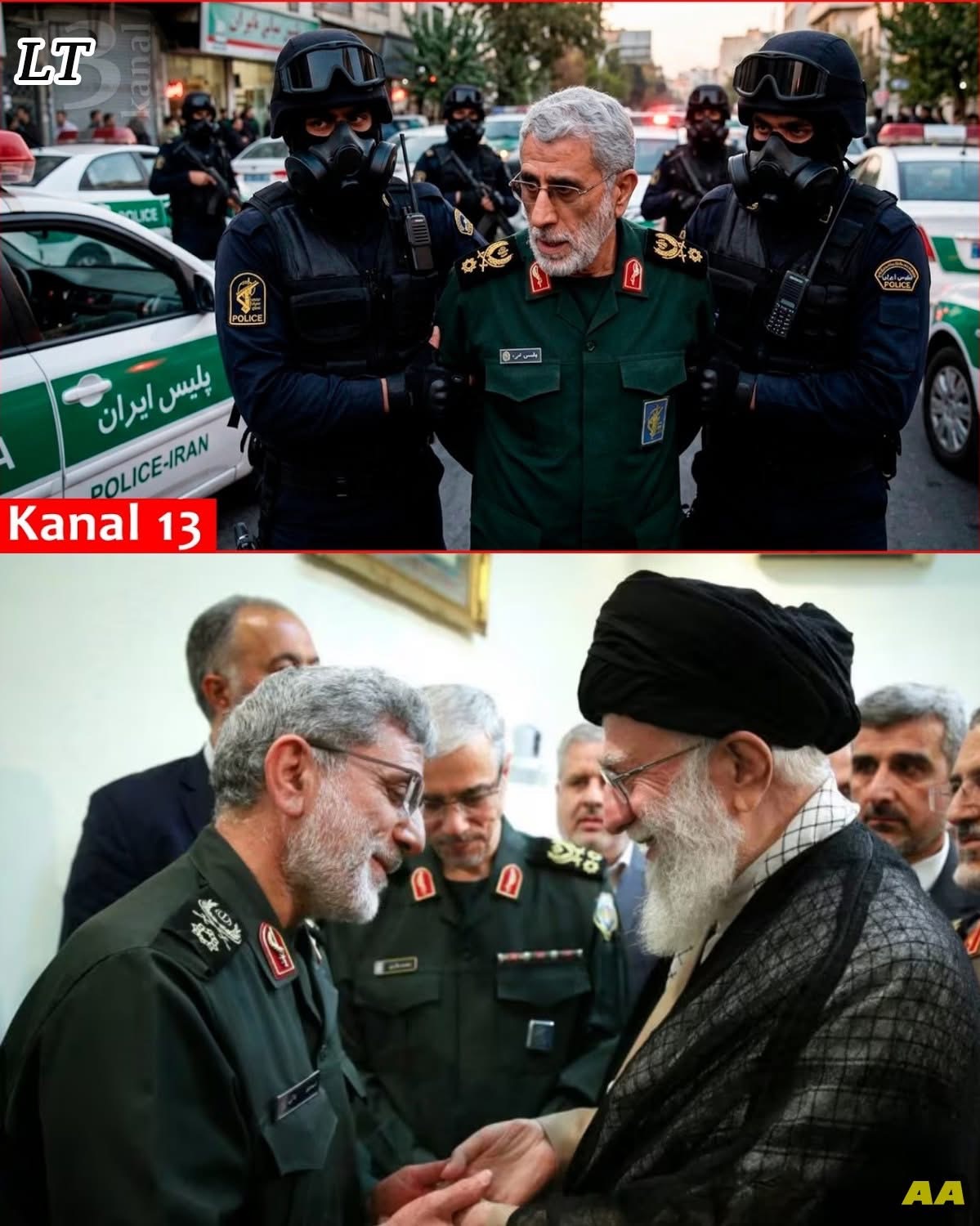
 Mystery Inside the IRGC: Reports Claim Quds Force Chief Questioned Over Alleged Mossad Links
The political and military circles of Iran have been shaken by dramatic and controversial reports suggesting that Esmail Qaani, the commander of the Quds Force of the Islamic Revolutionary Guard Corps, may have been detained by Iranian authorities themselves amid suspicions of potential intelligence leaks and alleged links to Israel’s intelligence service, Mossad.
While the information remains unconfirmed by official government channels, the rumors have rapidly spread across regional media, social networks, and security analysis platforms, fueling intense speculation about what might be unfolding behind the closed doors of Iran’s powerful military establishment.
Esmail Qaani is one of the most influential military figures in Iran’s current leadership structure.
As commander of the Quds Force, he oversees the external operations branch of the Islamic Revolutionary Guard Corps, the elite military organization responsible for many of Iran’s strategic activities beyond its borders.
The Quds Force has long been considered one of the most sensitive and powerful arms of Iran’s military network, coordinating relationships with allied groups and managing operations across several regions.
Reports circulating online claim that Iranian authorities may have taken Qaani into custody for questioning following suspicions raised within internal security circles.
According to these claims, some members within the IRGC have expressed concerns about possible information leaks that could have contributed to recent strikes targeting high-level Iranian officials.
The situation is further complicated by the context in which these rumors emerged.
Over the past months, Iran has experienced several high-profile security incidents, including deadly attacks that eliminated senior figures associated with the country’s leadership and military command.
These developments have intensified internal concerns about infiltration, intelligence leaks, and the possibility that sensitive operational information may have been compromised.
One of the most widely circulated claims relates to a series of events in which Qaani reportedly escaped dangerous situations shortly before deadly attacks occurred nearby.
According to various unofficial sources, the Iranian general had left several locations shortly before they were struck by devastating military operations.
These incidents have led to growing speculation among observers who question whether his repeated survival was the result of coincidence, instinct, or access to sensitive intelligence.
One such reported incident allegedly occurred in Beirut in September 2024.
According to claims circulating online, Qaani had reportedly left a confidential meeting involving Hezbollah leadership moments before a bunker was destroyed in a strike that reportedly killed several senior figures associated with the group, including Hassan Nasrallah and other top commanders.
While these details remain widely debated and unverified, the story has become part of the larger narrative fueling speculation about the general’s unusual pattern of survival.
Another incident reportedly took place in June 2025 when Qaani allegedly departed from an IRGC headquarters building shortly before a targeted strike hit the location.
Reports suggest the attack occurred shortly after he left the area, again raising questions among observers who noted the timing.
The latest episode reportedly occurred near the residence of Iran’s Supreme Leader, Ayatollah Ali Khamenei.
According to circulating reports, Qaani had been seen in the presence of the Supreme Leader not long before another deadly strike reportedly targeted senior officials.
Once again, he was said to have escaped unharmed while others were killed.
These repeated incidents have become a focal point of speculation among analysts and commentators who have begun asking difficult questions about the pattern.
Some observers argue that surviving multiple targeted attacks could simply be the result of coincidence or strong situational awareness.
Others suggest that the pattern appears too unusual to ignore.
One theory circulating among analysts suggests that Qaani may have had access to information warning him of imminent danger, allowing him to leave locations before they were attacked.
Another theory, far more controversial, proposes that information about meeting locations or movements might have somehow reached hostile intelligence services.
These claims remain speculative and have not been confirmed by independent sources.
However, they have fueled intense debate within political and security circles both inside and outside the region.
Amid the growing speculation, accusations reportedly began appearing on social media claiming that Qaani could be linked to Israeli intelligence operations.
Some commentators suggested that the pattern of his escapes raised questions about whether he might have been providing information that allowed external forces to carry out precise strikes.
However, such accusations have been strongly denied.
According to reports, Israeli intelligence agency Mossad issued a statement rejecting claims that Qaani was working with them.
The statement reportedly dismissed the rumors and denied months of speculation suggesting that the Iranian commander had defected or cooperated with Israeli intelligence.
Despite the denial, the controversy surrounding Qaani continues to grow.
The fact that such rumors have circulated at all highlights the atmosphere of uncertainty currently surrounding Iran’s internal security landscape.
Esmail Qaani assumed leadership of the Quds Force in January 2020 following the death of his predecessor, Qasem Soleimani.
Soleimani was killed in a United States drone strike near Baghdad International Airport, an event that dramatically reshaped the balance of power within Iran’s military command.
At the time of Soleimani’s death, Qaani was widely seen as his natural successor.
Having served as Soleimani’s deputy for years, he was deeply familiar with the structure and operations of the Quds Force.
His appointment was intended to ensure continuity within the organization during a period of intense geopolitical pressure.
However, stepping into the role left by Soleimani also meant inheriting enormous responsibility.
Soleimani had been a highly visible and charismatic figure whose influence extended across multiple regions.
Qaani, by contrast, maintained a lower public profile while continuing to oversee the Quds Force’s strategic operations.
Since assuming command, Qaani has remained closely involved in Iran’s regional activities and security planning.
His position places him at the center of many of the country’s most sensitive decisions regarding foreign operations and military coordination.
For this reason, reports suggesting that he may have been detained or questioned by his own country’s authorities have captured global attention.
If confirmed, such a development would represent one of the most dramatic internal investigations within the IRGC in recent years.
At the moment, however, the situation remains unclear.
Iranian authorities have not issued an official confirmation regarding Qaani’s alleged detention or questioning.
Without official statements or independently verified evidence, many details surrounding the story remain uncertain.
Security analysts emphasize that internal investigations within military organizations are not uncommon, especially during periods of heightened tension.
When major security breaches or intelligence leaks are suspected, internal reviews are often conducted to identify potential vulnerabilities.
In highly sensitive institutions such as the IRGC, such investigations are typically conducted with strict confidentiality.
Information rarely becomes public until authorities decide to release official statements.
For now, the absence of confirmed details has allowed speculation to spread rapidly across online platforms.
Each new rumor or unverified report adds another layer to an already complex story.
Observers across the Middle East and beyond are watching closely for any indication of what might come next.
If the reports prove inaccurate, the story may eventually fade as another example of misinformation spreading during a tense geopolitical moment.
If the claims are confirmed, however, the implications could be significant for Iran’s internal security dynamics and regional strategy.
The mystery surrounding Esmail Qaani’s situation highlights the fragile and often secretive nature of power within military structures.
In environments where intelligence, secrecy, and strategic operations intersect, rumors can quickly transform into international headlines.
Whether the reports ultimately prove true or false, the controversy has already raised questions about internal trust, security vulnerabilities, and the pressures facing Iran’s military leadership during a period of intense regional tension.
For now, one of Iran’s most powerful generals has become the center of a story filled with uncertainty, speculation, and unanswered questions.
And until official clarification emerges, the world will continue watching closely for signs of what may truly be happening behind the guarded walls of Iran’s most powerful military institution.