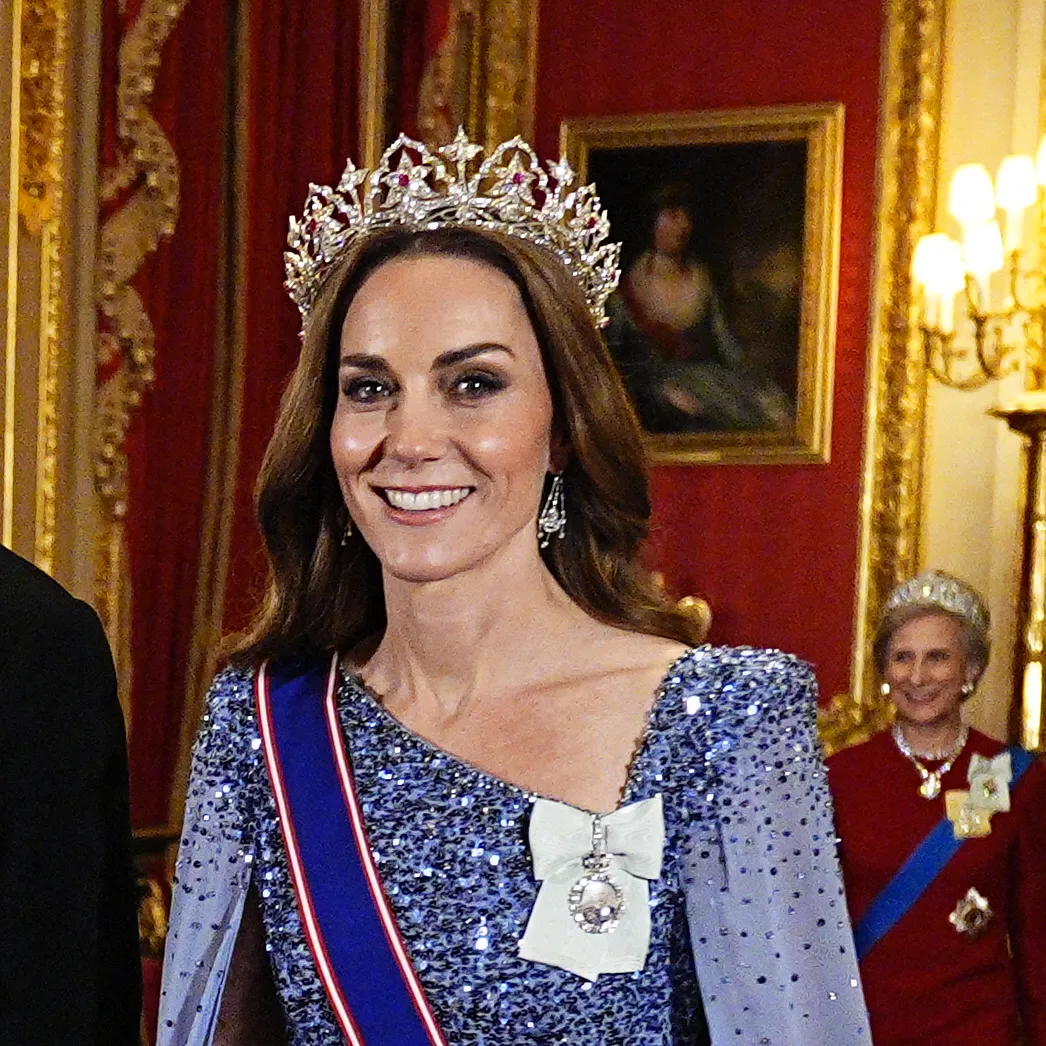
Did you notice Kate’s crown that night. Not the diamonds themselves, but the way it rested, slightly tilted, as though history had gently exhaled and settled.
In royal life, nothing is accidental. Every fabric choice, every jewel, every movement is studied, weighed, and approved long before a camera ever flashes.
That is why the tilt mattered. It was not a mistake. It was a message, delivered without a single word being spoken.
Kate entered the state banquet calm and luminous, wearing blue like quiet confidence, carrying herself with the ease of someone who knows where she belongs.
The crown she wore was not simply decorative. It was an heirloom bound by tradition, reserved for queens and the wives of future kings.
Kate qualified not because of ambition, but because of destiny. Her place is not borrowed. It is written into the monarchy’s future.
Camilla, despite her title, never qualified for this piece. Her role, though legitimate, ends with her. Kate’s role continues forward.
That distinction matters deeply in royal circles, where lineage and continuity outweigh ceremony and pageantry every time.
When Kate wears a crown, she does not borrow the past. She bridges it to what comes next.
The tilt itself was subtle, almost intimate, softening the formality that crowns usually demand. It felt human. Approachable. Confident without arrogance.
Where tradition often demands rigidity, Kate introduced grace. She honored the past while allowing it to breathe in the present.
Camilla’s style has long leaned toward rigid tradition, wearing jewels as they have always been worn, unmoving and firmly anchored in old expectations.
Kate’s choice suggested something else entirely. That tradition survives not by freezing time, but by understanding when to gently evolve.
There was also a deeper message, one that resonated strongly with those who understand legacy rather than spotlight.
Kate is not only the future queen. She is the mother of the next generation, including a daughter who may one day wear a crown herself.
The jewels Kate wears are not ending with her. They are being prepared, consciously or not, to pass forward.

Camilla wears jewels that will return to the vault. Kate wears jewels that remain part of a living line.
That difference is quiet, but profound. It speaks to permanence rather than possession.
Queen Elizabeth understood this better than anyone. She valued restraint, patience, and an instinct for duty over personal expression.
Kate learned those lessons carefully, not through speeches, but through years of observation and quiet discipline.
The former queen trusted Kate not because she sought attention, but because she never did.
That night, the crown did not dominate Kate. Kate carried it effortlessly, as though it had always known her.
There was no need for explanation. Royal language is symbolic, and Kate speaks it fluently.
Older generations watching understood something instinctively. This was not about rivalry or triumph.

It was about assurance. About stability. About knowing the institution would endure beyond any single reign.
In an age of constant noise, Kate’s power lies in what she does not say.
Her crown, tilted just enough, whispered confidence rather than demanded admiration.
And perhaps that is why so many people could not look away.
Because in that small, graceful angle, they saw continuity, dignity, and the quiet comfort of knowing the future was in steady hands.
A crown does not make a queen. But sometimes, it reveals one.