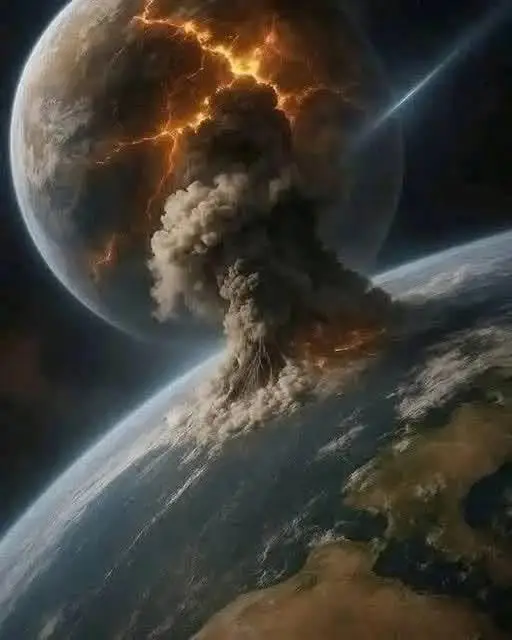
It usually starts with a bold headline.
A sentence that feels urgent, almost cinematic—suggesting that something massive is about to change, something beyond everyday experience. The kind of claim that makes people pause mid-scroll, read twice, and wonder if they’ve missed something important.
Recently, one such claim began circulating again—suggesting that the Earth is about to undergo a dramatic shift. The wording varies, but the tone remains the same: imminent, mysterious, and difficult to ignore.
The Power of a Simple Phrase
There’s something about statements involving the Earth itself that captures attention immediately.
After all, it’s not just another topic—it’s everything. When a headline hints that the planet might “begin” doing something unusual, it taps into a deep, almost instinctive curiosity.
But that same simplicity can also be misleading.
Without context, scientific language can be reshaped into something that feels more dramatic than it really is. A slow, measurable process becomes an “event.” A long-term trend becomes something that sounds immediate.
How These Claims Take Shape
In many cases, viral stories like this are rooted in real scientific observations—but presented without the nuance that gives them meaning.
For example, Earth is constantly changing.
- Its rotation is not perfectly constant
- Its magnetic field shifts gradually over time
- Its climate evolves through complex natural and human-influenced processes
These are well-documented facts. But they unfold over years, decades, or even centuries—not overnight.
When those ideas are compressed into short, dramatic statements, they can lose their scale. What is gradual becomes urgent. What is expected becomes alarming.
Why People Pay Attention
It’s not just about the claim itself—it’s about how it’s delivered.
Short, emotionally charged headlines are designed to stand out. They often omit detail in favor of impact, leaving readers to fill in the gaps. And in those gaps, uncertainty grows.
For many, the reaction is immediate:
Is this real?
Should I be concerned?
Why haven’t I heard about this before?
These questions are natural. But they also highlight how quickly information can move without full context.
The Role of Scientific Context
When scientists talk about changes related to Earth, they usually do so with careful language.
Terms are precise. Timelines are clearly defined. Uncertainty is acknowledged.
This approach may feel less dramatic, but it reflects how complex systems actually behave. The planet doesn’t shift suddenly without warning—it evolves through processes that are studied, measured, and understood over time.
Removing that context can make even ordinary findings seem extraordinary.
A Pattern in Modern Information
Stories like this are not isolated.
They are part of a broader pattern where complex topics are simplified into attention-grabbing statements. While this can make information more accessible, it can also blur the line between explanation and exaggeration.
In the case of planetary science, that line is especially important.
Because when the subject is as large as Earth itself, even small misunderstandings can feel overwhelming.
Slowing Down Before Reacting
There’s value in pausing before accepting dramatic claims at face value.
Looking for the original source, checking whether scientists are actually making the same statement, and understanding the timeframe involved can change the entire perspective.
Often, what sounds immediate turns out to be gradual.
What sounds alarming turns out to be part of a known process.
A More Grounded Perspective
The Earth is dynamic, but it is not unpredictable in the way viral headlines sometimes suggest.
Its systems move, shift, and adapt—but they do so within patterns that scientists have studied for decades. That doesn’t make those changes unimportant, but it does place them in a clearer, more realistic frame.
In a digital space where speed often outweighs accuracy, taking a moment to understand that difference can make all the difference.
Because not every dramatic headline reflects a dramatic reality.