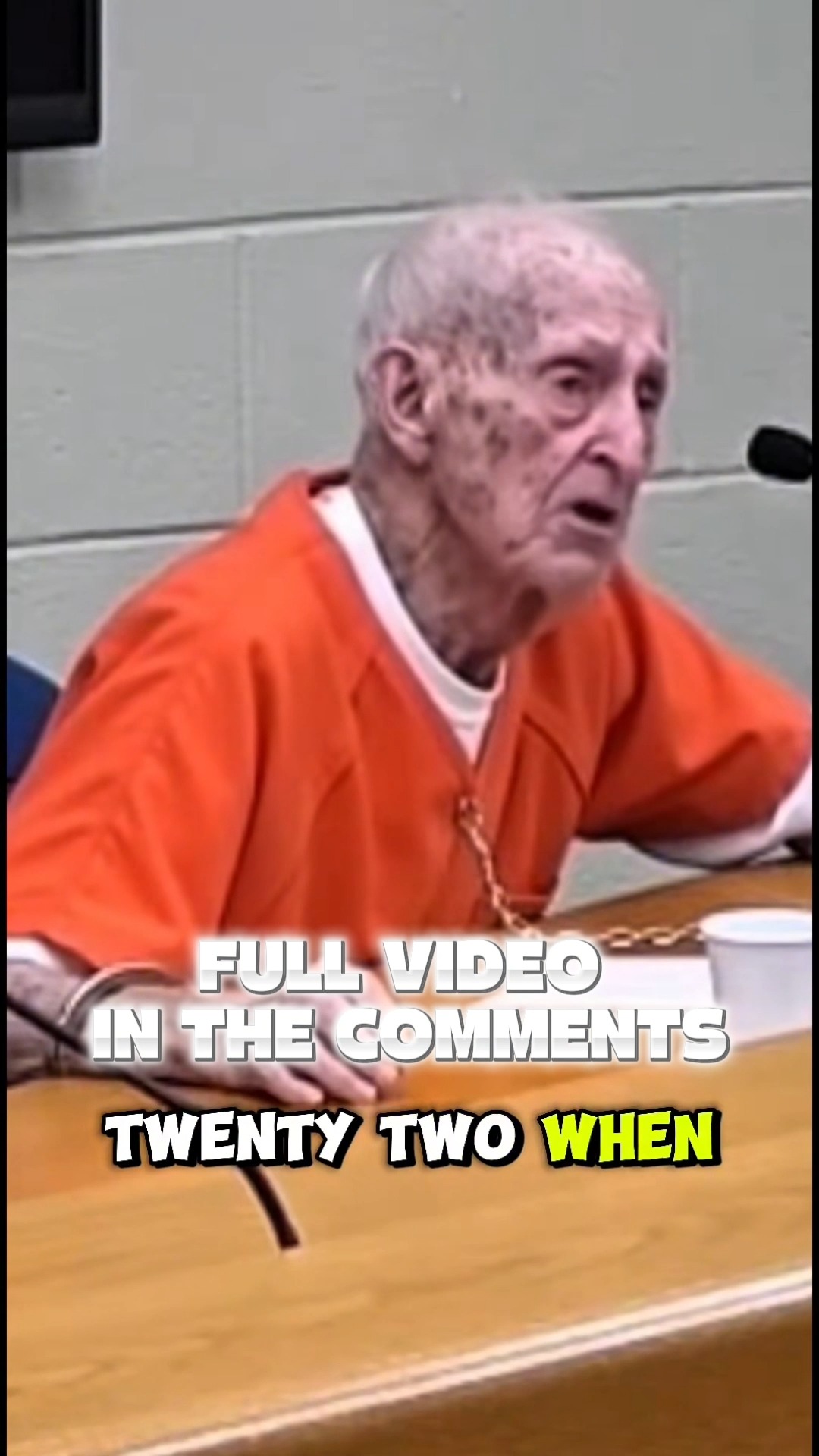
There is a particular kind of silence that falls over a courtroom when justice arrives too late. It is not the sharp silence of anticipation, nor the restless murmur of uncertainty. It is heavier, almost reverent, as though everyone present understands that what is happening cannot be undone, only acknowledged. In that moment, when an elderly man rises slowly to hear that he is finally free, the room holds its breath—not for celebration, but for something far more complicated.
For decades, this man lived inside a system that failed him. Years that should have been filled with ordinary milestones—building a career, raising a family, growing alongside friends—were instead measured in prison routines, in counted steps, in days marked by absence. Time, for him, did not flow forward with possibility; it accumulated as loss. And when the judge finally speaks the words that restore his freedom, the natural expectation is joy. Relief. Even triumph.
But what emerges instead are words that feel almost too quiet for the weight they carry: “I waited all my life to hear that.” And then, even more piercing: “You gave me freedom when I got old.”
These are not words of victory. They are words of reckoning.
Because freedom, in its truest sense, is not just the absence of chains—it is the presence of opportunity, of time, of the ability to choose one’s path while life still stretches ahead. When freedom arrives after decades have already been taken, it becomes something else entirely. It is real, yes. It matters. But it is incomplete. It cannot return youth. It cannot restore lost relationships or erase the quiet erosion of hope that often accompanies wrongful imprisonment.
The man standing there understands this better than anyone in the room. His statement is not an accusation shouted in anger, but something more devastating: a simple truth spoken without theatrics. He is free—but the life he was meant to live is gone. What remains is a fragment, a late chapter without its beginning.
And yet, there is dignity in the way these words are spoken. No dramatic outburst, no collapse under the weight of injustice—just a calm acknowledgment of what has been lost. It is this restraint that makes the moment so powerful. It forces everyone listening to confront an uncomfortable reality: justice delayed is not justice denied in a legal sense, but it is something undeniably diminished in a human one.
The courtroom, in that instant, becomes a space not of closure, but of reflection. Lawyers, judges, observers—they are all participants in a system that strives for fairness but is not immune to failure. And when such failure is revealed, there is no sentence that can truly compensate for the years taken. No apology that can fully bridge the gap between what was and what could have been.
What does freedom mean, then, when it comes at the end of a life rather than at its beginning or middle? Perhaps it becomes symbolic—a recognition of truth, a restoration of dignity, a public acknowledgment that a wrong has occurred. These things matter deeply. They are not nothing. But they exist alongside an undeniable grief.
There is also, however, a quiet resilience in that moment. The man stands. He speaks. He claims his voice in a place where it was once denied. Even after everything, he bears witness to his own story. That, too, is a form of freedom—one that cannot be measured in years alone.
And for those watching, the moment lingers. It challenges easy narratives about justice and redemption. It asks difficult questions about time, accountability, and the true cost of error. Most of all, it reminds us that behind every case, every ruling, every legal process, there is a human life—fragile, finite, and irreplaceable.
The room may have expected celebration. What it received instead was something far more profound: a quiet, unflinching truth about what it means to be free when freedom comes too late.