Trump Administration Starts New Border Wall Construction in Arizona Despite Tribal Objections
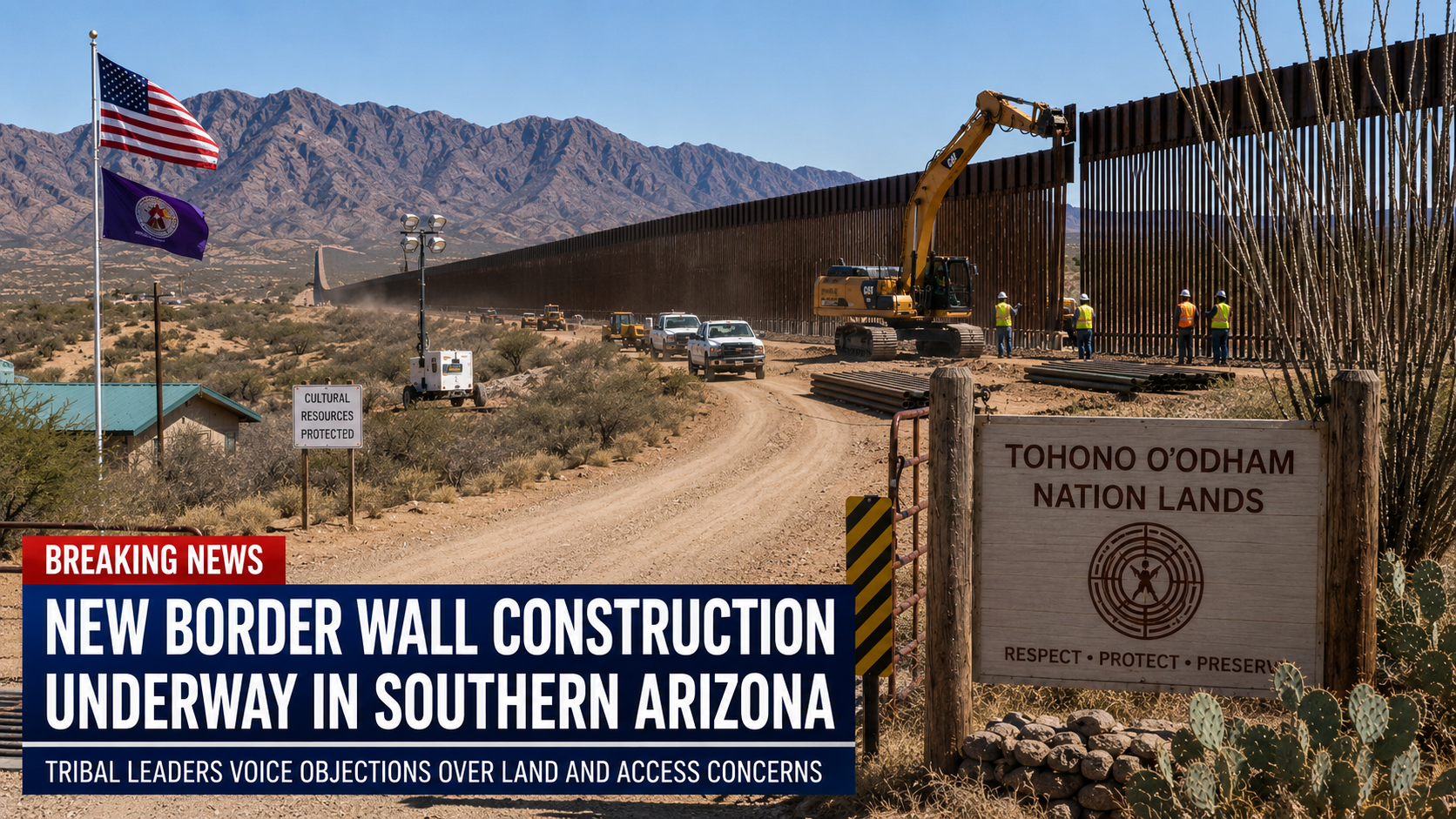
PHOENIX, Arizona — The Trump administration has begun work on a new stretch of border wall in southern Arizona, moving forward with the project despite strong objections from the Tohono O’odham Nation.
The project involves an area along the U.S.-Mexico border next to the tribe’s reservation. U.S. Customs and Border Protection says the area has been used as a dangerous smuggling route and argues that additional barriers are needed to close what the agency describes as a longstanding security gap.
Tribal leaders raise objections
The Tohono O’odham Nation, whose traditional lands extend across the U.S.-Mexico border, strongly opposes the project.
Tribal officials say federal agents and contractors entered tribal land without authorization as pre-construction work began. According to local reporting, tribal leaders said contractors accompanied by approximately 20 armed CBP agents entered the area early Tuesday and worked at several locations near the border.
The Nation maintains that even if construction itself occurs within the federal Roosevelt Reservation — a strip of federal land along the international boundary — accessing the construction area by crossing tribal property without permission constitutes trespassing.
Tribal leaders have also raised concerns about potential impacts on culturally and spiritually significant areas.
Judge previously declined to stop the project
The latest construction follows a federal court decision earlier this month.
U.S. District Judge Richard Leon declined the Tohono O’odham Nation’s request to temporarily block the administration from taking steps toward construction of approximately 62 miles of international border wall along the reservation.
That ruling allowed the administration to continue moving forward while the broader dispute remains unresolved.
Part of a much larger border initiative
The Arizona project is part of the Trump administration’s broader border-security construction effort.
AP reports that roughly $46 billion is involved in the wider effort to build 30-foot steel bollard barriers, vehicle barriers and additional border-security technology.
The administration argues that these projects are necessary to combat illegal crossings and smuggling.
But the expansion has also generated opposition from Native American tribes, environmental organizations and some landowners, who have raised concerns about property rights, environmental impacts and culturally significant sites.
What happens next?
Construction is moving forward, but the dispute is not necessarily over.
The Tohono O’odham Nation continues to challenge how contractors and federal authorities are accessing the area, and AP reports that the tribe is considering additional legal action.
That means the Arizona project could remain both a major component of the administration’s border-security agenda and the subject of continuing legal and tribal opposition.
This is a developing story. Check back for updates as additional information becomes available.