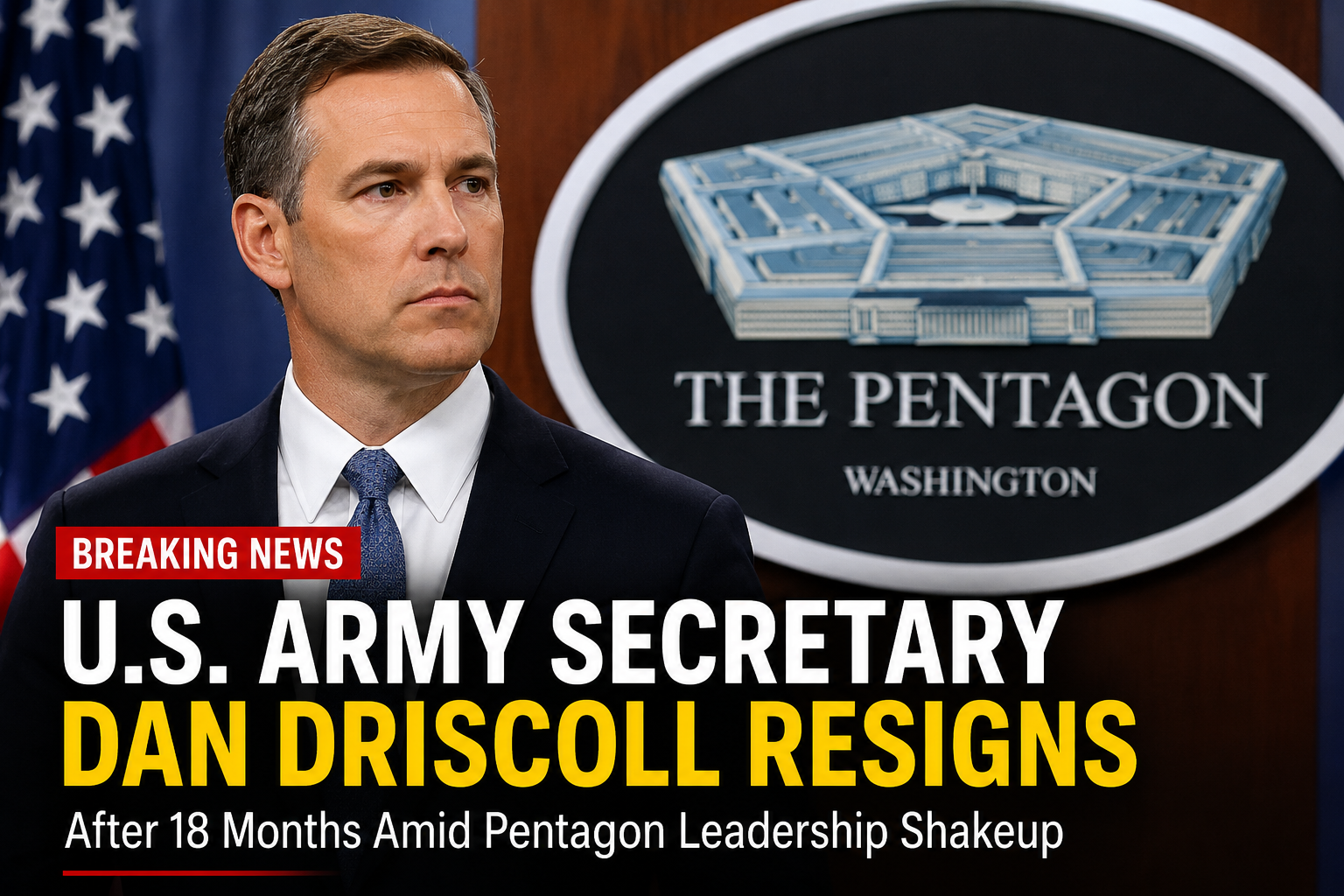
U.S. Army Secretary Dan Driscoll Resigns After 18 Months Amid Pentagon Leadership Shakeup
WASHINGTON — U.S. Army Secretary Dan Driscoll has submitted his resignation after roughly 18 months leading the Army, marking another significant leadership departure at the Pentagon during President Donald Trump’s second administration. The White House confirmed the move on Monday, August 31.
ABC News reported that President Trump accepted Driscoll’s resignation Monday evening. The White House publicly praised Driscoll’s work, pointing to his leadership during military operations, his focus on Army readiness and lethality, and his involvement in diplomatic efforts concerning Russia and Ukraine.
Why Is Dan Driscoll Leaving?
The White House did not announce an official reason for his departure. However, multiple reports describe months of friction between Driscoll and Defense Secretary Pete Hegseth.
Reuters reported that a source familiar with the matter said Driscoll had raised concerns with the administration about Army transformation and readiness, including decisions involving senior generals responsible for modernization efforts.
One particularly important development came in April, when Hegseth removed Army Chief of Staff Gen. Randy George. AP reports that Driscoll was an ally of George and later told Congress that he and his family visited George following his departure. Army commander Gen. Christopher Donahue also unexpectedly stepped down in June.
Who Is Dan Driscoll?
Driscoll was confirmed by the Senate as Army secretary in February 2025 by a 66–28 vote.
An Iraq War veteran, Driscoll served as an Army armor officer from 2007 to 2011 and deployed to Iraq from October 2009 through July 2010. Before becoming Army secretary, he worked as a technology investor and was an adviser and Yale Law School classmate of Vice President JD Vance.
During his tenure, Driscoll became closely associated with efforts to modernize the Army. He pushed for faster procurement, cheaper weapons systems, and expanded drone and counter-drone capabilities. He was also given an unusual diplomatic role when the Trump administration tapped him to participate in efforts aimed at ending the Russia-Ukraine war.
Why His Resignation Matters
Driscoll’s departure is notable because it comes during a period of substantial turnover among senior U.S. military leaders.
AP reports that several high-ranking Army and Navy officials have left or been removed, including Gen. Randy George and Navy Secretary John Phelan. The changes have prompted debate in Washington over continuity and stability in the Pentagon’s senior leadership.
The timing adds another layer of significance. Reuters reported that thousands of U.S. Army personnel are deployed in the Middle East amid the ongoing U.S.-Iran conflict.
Driscoll also received praise from lawmakers in both parties following news of his departure. Republican Rep. Steve Womack described him as a transformative leader, while Democratic Rep. Jason Crow praised his knowledge and willingness to engage on policy despite their political differences.
What Happens Next?
Driscoll’s resignation opens another important leadership position in the Army. The administration will have to determine who will lead the service going forward, while questions remain about the direction of Army modernization and programs Driscoll championed.
His departure therefore represents more than a personnel change: it comes amid broader debates over military leadership, modernization and readiness at a consequential moment for U.S. national security.