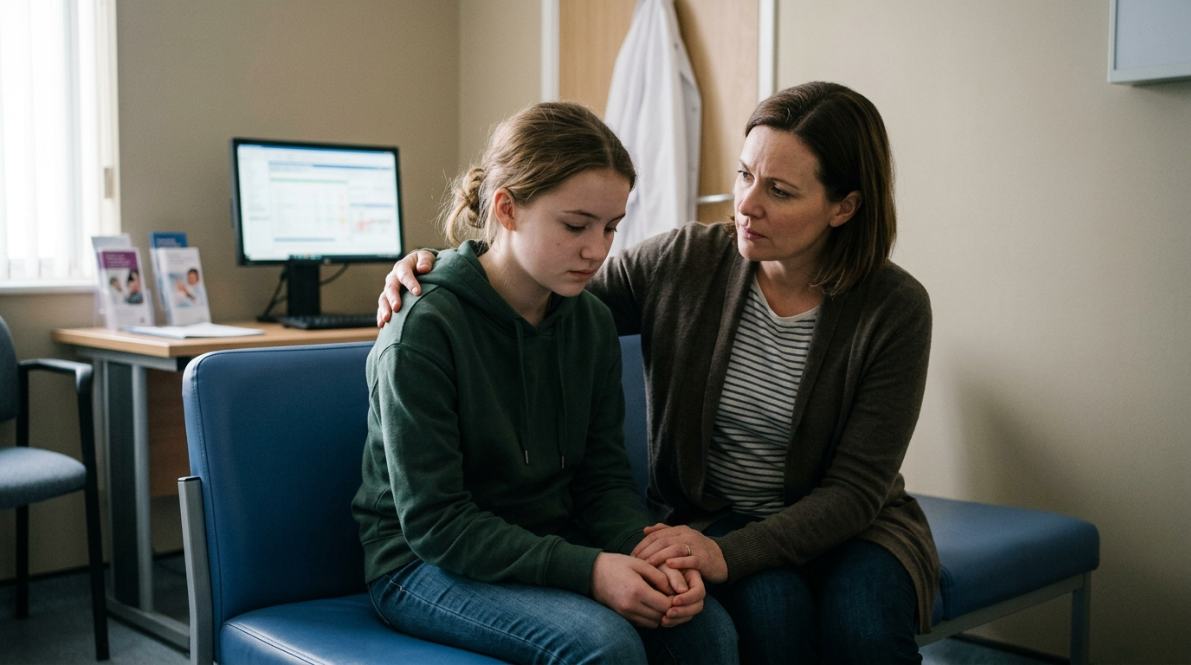
My Daughter Whispered, “I Stopped Telling Dad When It Hurts”—Then the Doctor Asked Me One Question That Changed Everything
PART 4
I didn’t sleep that night.
Neither did Emma.
I could hear her moving around upstairs long after midnight, and every time the floor creaked, I found myself staring at the ceiling.
The paper lay on the kitchen table.
Three words.
Don’t scare her.
I had read them so many times that the ink seemed burned into my mind.
At first, I had thought the words were proof that Daniel knew something serious.
Then another thought occurred to me.
Maybe they weren’t.
Maybe they were simply proof that he had been afraid.
Afraid of what the doctors would say.
Afraid of what I would do.
Afraid of admitting that he had made a mistake.
But none of those explanations made what happened acceptable.
At six in the morning, I made coffee I didn’t drink.
At six fifteen, my phone rang.
Daniel.
I watched his name glow on the screen.
I didn’t answer.
He called again.
Then again.
Finally, a message appeared.
We need to talk before you take Emma anywhere today.
I stared at it.
A second message followed.
You are making this much worse than it needs to be.
I almost laughed.
Then another message arrived.
Please don’t make decisions while you’re emotional.
I put the phone face down.
A few minutes later, Emma came downstairs.
She was pale.
“You okay?”
She nodded.
“I’m scared.”
“So am I.”
She looked surprised.
“You’re scared?”
“Yes.”
She sat at the kitchen table.
“But we’re going anyway?”
“We’re going.”
She nodded.
“And Dad isn’t coming?”
“No.”
She looked at me for a long time.
Then she reached across the table and took my hand.
“Thank you.”
Those two words nearly broke me.
Because a child shouldn’t have to thank her mother for taking her to the doctor.
That should have been ordinary.
The specialist’s office was on the fourth floor of a large medical building.
The waiting room was quiet.
Emma sat beside me, her backpack between her feet.
I had brought every document I could find.
The original hospital report.
The follow-up recommendation.
The phone records.
The notes from her school.
The list I’d made of every symptom she’d experienced during the previous several months.
The specialist entered the room carrying a tablet.
She introduced herself and sat across from us.
“I’ve reviewed the imaging from yesterday,” she said.
Emma looked at me.
I squeezed her hand.
The doctor continued.
“There is an abnormal area that we need to investigate further.”
Emma swallowed.
“What does that mean?”
“It means we need more information before we can tell you exactly what it is.”
“Is it cancer?”
The doctor paused.
“No one can answer that from this scan alone.”
Emma looked at me.
I could see the fear in her eyes.
The doctor leaned forward.
“There are several possible explanations, and many of them are treatable. But because of the location and because your symptoms have been persistent, we don’t want to wait.”
She explained the next procedure.
More imaging.
Blood work.
A biopsy if the specialists determined it was necessary.
The word biopsy made Emma go still.
I wrapped my arm around her.
“Whatever happens,” I said, “we’re doing it together.”
The doctor nodded.
Then she looked at the report from the first appointment.
“There’s something I’d like to clarify.”
I looked up.
“What?”
“This recommendation wasn’t simply for routine monitoring.”
My stomach tightened.
“What was it?”
“The radiologist had recommended additional imaging within a specific timeframe.”
“How specific?”
“Within two weeks.”
I stared at her.
Two weeks.
Daniel had waited five.
The doctor continued.
“And there was a second recommendation for a specialist consultation.”
“Was that urgent?”
“Not emergency-level urgent.”
She paused.
“But it was important.”
I nodded slowly.
“Could waiting five weeks have made a difference?”
She chose her words carefully.
“We don’t know yet.”
That answer somehow frightened me more than a definite one.
“We may never know,” she added.
I looked down.
Emma was staring at her hands.
The doctor noticed.
“Emma?”
“Yes?”
“I want you to understand something.”
Emma looked up.
“You didn’t cause this by telling anyone. You didn’t cause this by asking for help. And you did nothing wrong.”
My daughter’s eyes filled.
The doctor looked at me.
“And neither did you.”
I nodded.
But deep inside, I couldn’t stop thinking:
I should have known.
The next week became a blur of appointments.
Blood tests.
Scans.
Waiting rooms.
Phone calls.
Forms.
Questions.
More questions.
Emma handled it better than I did.
She joked with the nurses.
Complained about hospital food.
Sent pictures of her terrible gowns to her best friend.
One afternoon, while we waited for another test, she looked at me and said:
“I think you’re more scared than I am.”
I smiled.
“Probably.”
“Stop looking at me like I’m going to disappear.”
I froze.
“Do I do that?”
“All the time.”
I looked away.
She leaned against my shoulder.
“Mom.”
“Yes?”
“I’m still here.”
I closed my eyes.
“I know.”
“And I’m not planning to go anywhere.”
I hugged her.
“I know.”
But I held her a little tighter.
Meanwhile, Daniel became increasingly desperate to regain control of the situation.
He called constantly.
He sent messages.
He appeared outside the hospital once.
I refused to let him into the appointment.
He became furious.
“You can’t keep me away from my daughter.”
“I am not keeping you away.”
“You won’t even tell me what’s happening.”
“You’ve had access to her medical information for weeks.”
His face changed.
“What are you talking about?”
“You requested that the doctor’s office communicate only with you.”
“I was trying to help.”
“You also failed to tell me about the follow-up.”
“I told you, I didn’t think it was serious.”
“You weren’t qualified to decide that.”
He stepped closer.
“You’re acting like I wanted this to happen.”
“No.”
I looked at him.
“I think you wanted it not to be happening.”
He stared at me.
“And when reality didn’t match what you wanted, you ignored it.”
He said nothing.
Then he asked quietly:
“Is she very sick?”
That was the first time I saw genuine fear in his eyes.
I wanted to hate him.
But for one second, I saw the man I’d married twenty years earlier.
The man who had held our daughter the night she was born.
The man who had taught her to ride a bicycle.
The man who used to sit on the floor and build castles with her.
And I realized something painful.
People didn’t always become strangers overnight.
Sometimes they became strangers one decision at a time.
“No one knows yet,” I said.
He nodded.
“Can I see her?”
I thought about it.
“Not until she wants to see you.”
He looked down.
Then he nodded.
“Okay.”
It was the first time he didn’t argue.




One Comment on “PART4: My Daughter Whispered, “I Stopped Telling Dad When It Hurts”—Then the Doctor Asked Me One Question That Changed Everything”