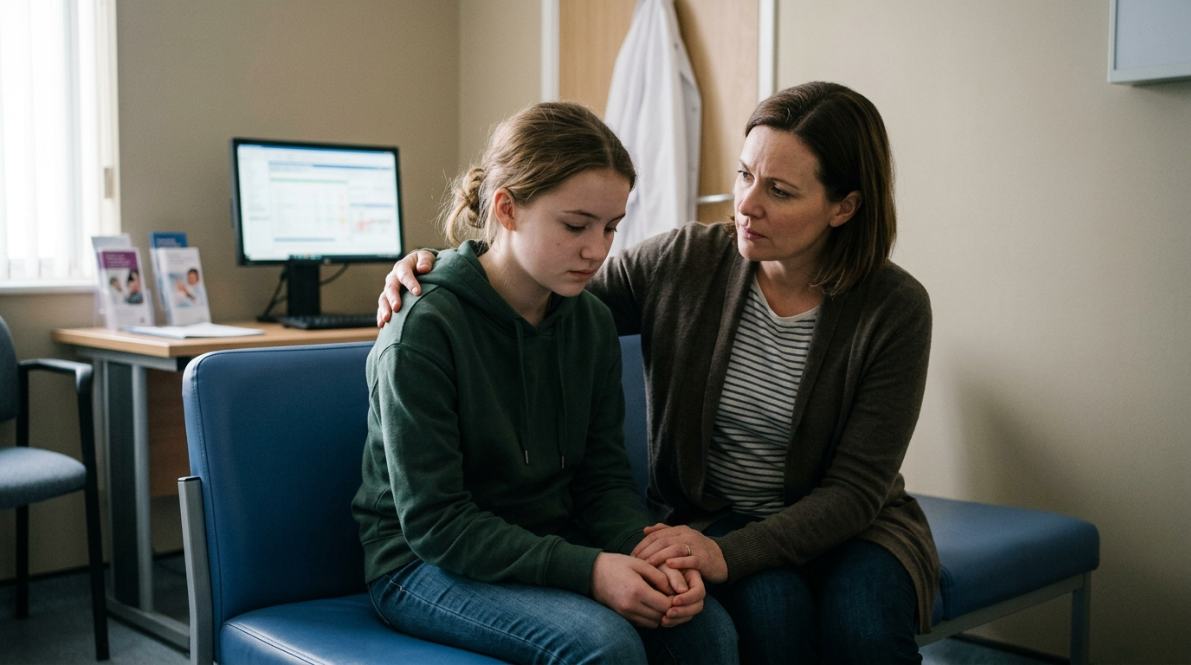
My Daughter Whispered, “I Stopped Telling Dad When It Hurts”—Then the Doctor Asked Me One Question That Changed Everything
PART 3
So I reached for her hand.
“You can tell me,” I whispered. “Whatever it is, you won’t get in trouble.”
Her fingers were cold.
“He said you had enough to worry about.”
I swallowed.
“And?”
“He said if I told you, you’d think he was a bad father.”
I stared at the floor.
There it was.
Not the pain.
Not the missed appointment.
The fear.
My daughter hadn’t been protecting her father.
She had been protecting me from the consequences of telling the truth.
“Did he say anything else?”
She hesitated.
“He said…” Her voice cracked. “He said you always make things bigger than they are.”
Something inside my chest seemed to collapse.
Because that sentence was not new.
I’d heard variations of it for years.
When our son broke his arm playing football and I insisted on taking him to urgent care, my husband had called me dramatic.
When our youngest daughter had struggled with anxiety before starting high school, he had told me I was teaching her to be afraid.
When our refrigerator stopped working and I suggested replacing it before it spoiled all our food, he’d laughed and said I was always looking for something to worry about.
And every time, I had told myself the same thing.
That’s just how he is.
I looked at my daughter.
Suddenly, I wondered how many times she had heard those words when I wasn’t around.
The doctor cleared his throat gently.
“I want to explain something before we continue,” he said. “What we’re seeing does not give us a complete diagnosis yet. We need additional testing. I don’t want either of you jumping to conclusions.”
I nodded.
“Okay.”
“But,” he continued, “the fact that she was already seen five weeks ago and the recommended follow-up didn’t happen is important.”
I looked at him.
“How important?”
He paused.
“Important enough that I’d like to understand exactly what happened between that visit and today.”
My daughter stared at her shoes.
I squeezed her hand.
“You don’t have to answer if you’re uncomfortable.”
The doctor gave me a grateful look.
“We’ll take this one step at a time.”
He explained the next steps carefully. Blood work. Additional imaging. A specialist consultation. More questions about the pain, her appetite, fatigue, and the changes we’d noticed at home.
I listened.
I wrote everything down.
Every word.
Every number.
Every instruction.
My daughter watched me.
At one point, she whispered, “Mom?”
“Yes?”
“Are you mad?”
I stopped writing.
I turned toward her.
“No.”
“Not even at Dad?”
I took a breath.
“I am angry about some things.”
Her eyes dropped.
“But I’m not angry at you.”
She nodded.
“And I’m not going to make you choose between us.”
That seemed to surprise her.
She looked at me for a long moment.
Then she said something that hurt more than anything else she’d told me.
“I thought if I told you, you’d leave him.”
I felt my eyes burn.
“What made you think that?”
She shrugged.
“Because sometimes you look sad.”
I didn’t know what to say.
So I pulled her carefully into my arms.
She cried against my shoulder.
And I let her.
For the first time in months, maybe years, she wasn’t pretending she was fine.
We stayed at the hospital for several more hours.
The tests took longer than expected.
By the time we were finished, it was after seven.
My phone had been vibrating repeatedly inside my purse.
I didn’t need to look to know who it was.
My husband.
I finally checked.
Daniel: Where are you?
Another message appeared.
Daniel: Why did you sign Emma out of school?
Then:
Daniel: Emma isn’t answering me.
Then:
Daniel: Call me now.
I stared at the screen.
My daughter was sitting beside me, exhausted, her head against the wall.
“Does he know?” she asked.
“No.”
She looked frightened.
“Don’t tell him yet.”
I turned toward her.
“Why?”
She didn’t answer.
“Emma?”
Her eyes filled again.
“He’s going to be angry.”
I felt something harden inside me.
“Why are you so sure?”
She whispered, “Because he always is when doctors disagree with him.”
I froze.
“What do you mean?”
She looked at the floor.
“Mom… he doesn’t like when people tell him something is wrong.”
That sentence stayed with me all the way home.
Daniel was standing in the kitchen when we walked through the door.
He didn’t ask whether Emma was okay.
He didn’t ask what the doctors had said.
He looked at me.
Then at her.
Then back at me.
“What happened?”
I took off my coat.
“We went to the hospital.”
His face changed.
“What?”
“She was having pain.”
“I know she was having pain.”
I looked at him.
“You knew?”
He stared at me for half a second too long.
Then he recovered.
“Of course I knew. She told me.”
“How long?”
He frowned.
“What kind of question is that?”
“How long has she been telling you?”
He sighed.
“I don’t know. A few weeks.”
“A few weeks?”
“Yes.”
“Did you take her to the doctor?”
His expression tightened.
“Yes.”
“When?”
“I don’t remember.”
“Five weeks ago?”
He went silent.
My daughter’s shoulders stiffened beside me.
I noticed.
Daniel noticed me noticing.
“She told you about that?”
I felt a chill.
“You took her five weeks ago.”
“Yes.”
“What did the doctor say?”
“Nothing serious.”
“That’s not what the chart says.”
His eyes narrowed.
“What chart?”
“The one from the hospital.”
He stepped closer.
“You went through her records?”
“She is fifteen, Daniel.”
“And?”
“And I’m her mother.”
He laughed once.
Not because anything was funny.
Because he was angry.
“You’re making this into something it isn’t.”
I stared at him.
That sentence again.
You’re making this into something it isn’t.
I heard my daughter’s breathing behind me.
I turned.
“Emma, go upstairs.”
She looked at me.
“Mom—”
“Go.”
She went.
I waited until I heard her bedroom door close.
Then I faced my husband.
“What did the doctor recommend five weeks ago?”
Daniel rubbed his forehead.
“I don’t remember.”
“You were the parent who brought her.”
“Yes.”
“So you signed the paperwork.”
“Yes.”
“You received the instructions.”
“Yes.”
“Then why didn’t she get the follow-up?”
He looked irritated.
“Because she got better.”
“She got better?”
“Yes.”
“She has been in pain for weeks.”
“She exaggerates.”
I stared at him.
He seemed to realize what he’d said.
But instead of correcting himself, he doubled down.
“She does. You know she does.”
I thought of my daughter saying, I stopped telling Dad when it hurts.
I thought of the heating pad.
The untouched dinners.
The mornings when she walked slowly down the stairs.
The way she’d stopped asking for help.
And suddenly, all the little things I’d dismissed began fitting together.
“What did the doctor say at the first appointment?”
Daniel crossed his arms.
“Something about another scan.”
“What kind?”
“I don’t know.”
“You don’t know?”
“No.”
“Did you schedule it?”
“No.”
“Why?”
“Because I didn’t think it was necessary.”
I felt my hands trembling.
“You decided that yourself?”
“I am her father.”
“That doesn’t answer my question.”
“I know my daughter.”
“No,” I said quietly. “I don’t think you do.”
His face went blank.
“What is that supposed to mean?”
“It means she was afraid to tell me because she thought you’d be angry.”
He scoffed.
“That’s ridiculous.”
“Is it?”
“Yes.”
“She said you told her I would think you were a bad father.”
He didn’t respond.
“She said you told her she was making everything worse.”
Still nothing.
Then he said something I would remember for the rest of my life.
“She shouldn’t have told you.”
I stared at him.
Not because I hadn’t heard him.
Because I had.
Every word.
He knew.
He knew she was afraid.
And instead of asking why, his first reaction was anger that she had broken his confidence.
“You’re sleeping somewhere else tonight,” I said.
He blinked.
“What?”
“You heard me.”
“Don’t be ridiculous.”
“I am not being ridiculous.”
“This is my house too.”
“Yes.”
“And you’re throwing me out because our daughter has stomach pain?”
“No.”
I looked directly into his eyes.
“I’m asking you to leave because our daughter was afraid to tell me she was sick.”
His jaw tightened.
“This is insane.”
“Maybe.”
I pointed toward the door.
“But you’re still leaving.”
He stood there for several seconds.
Then he grabbed his keys.
At the doorway, he stopped.
“You’re going to regret this.”
I didn’t answer.
He left.
The front door slammed.
And the house became completely silent.
I went upstairs.
Emma was sitting on her bed with her knees pulled to her chest.
She looked at me.
“Is Dad gone?”
“Yes.”
“Is he mad?”
“Yes.”
She nodded.
“I knew he would be.”
I sat beside her.
“Emma, I need you to understand something.”
She looked at me.
“You never have to hide pain from me to protect me.”
Her eyes filled.
“I didn’t want you to fight.”
“I know.”
“He said you already had too much going on.”
“I know.”
“He said doctors always want more tests because they make money.”
I closed my eyes for a second.
“And you believed him?”
She shrugged.
“I didn’t know what to believe.”
I pulled her close.
“You don’t have to know. That’s why adults are supposed to help.”
She cried quietly.
After a while, she whispered:
“Mom?”
“Yes?”
“There was another thing.”
I pulled back.
“What?”
She looked toward the closed bedroom door.
“Dad told me not to tell you about a phone call.”
“What phone call?”
She hesitated.
“From the doctor’s office.”
My heart began pounding.
“What did they call about?”
“I don’t know.”
“Emma.”
“He answered.”
“What did he say?”
“He told them you weren’t available.”
I stared at her.
“When was this?”
“About two weeks ago.”
I felt the room tilt.
“Are you sure?”
She nodded.
“I was in the kitchen.”
“What did you hear?”
“He said they didn’t need to call again.”
I stood up.
“Did he tell you what the call was about?”
She shook her head.
“No.”
I walked toward the window.
My hands were cold.
Two weeks ago.
A phone call.
A follow-up that had never happened.
And a husband who had apparently decided what medical information I was allowed to receive about my own child.
I looked at my reflection in the dark glass.
For the first time, I wasn’t wondering whether Daniel had made a mistake.
I was wondering what else he had hidden.
The next morning, I called the hospital.
I asked for the records from the first visit.
The receptionist transferred me to medical records.
I confirmed my identity.
Then I asked a question that made my voice shake.
“Can you tell me whether there were any notes added after the original visit?”
There was a pause.
“Yes.”
“How many?”
“Several.”
“Can I get copies?”
“Yes, but some may require authorization.”
“I am her mother.”
“I understand.”
“Please send me everything I’m legally entitled to receive.”
Another pause.
“There’s also a note indicating that the office attempted to contact the family.”
“When?”
“Two weeks ago.”
I closed my eyes.
“Can you tell me why?”
“I can’t discuss clinical details over the phone.”
“I understand.”
Then the receptionist said something unexpected.
“There is a notation that the patient’s father requested that future communications be directed to him.”
I sat completely still.
“He requested that?”
“Yes.”
“Did I authorize that?”
“I don’t see an authorization from you.”
My stomach dropped.
“Thank you,” I said.
I hung up.
Then I called the doctor’s office directly.
The nurse confirmed it.
Daniel had requested that all communication go through him because, according to his explanation, I was “overwhelmed with work and family responsibilities.”
I laughed.
Not because it was funny.
Because I suddenly didn’t know what else to do.
He hadn’t merely forgotten the follow-up.
He had put himself between me and the information.
I opened my laptop.
I began writing everything down.
Dates.
Names.
Appointments.
Symptoms.
Phone calls.
Statements.
Everything.
Because something had changed inside me.
I wasn’t trying to prove my husband was a terrible person.
I was trying to understand what had happened to my daughter.
And I wasn’t going to let anyone tell me I was imagining it.
That afternoon, the specialist called.
The appointment was scheduled for the following morning.
The specialist warned me that they still didn’t know exactly what was happening.
There were several possibilities.
Some were relatively manageable.
Others required more urgent attention.
“Bring someone with you if possible,” she advised.
“Why?”
“We may need to discuss several treatment options.”
I looked across the kitchen.
Emma was doing homework at the table.
“Okay.”
I hung up.
She looked at me.
“Is it bad?”
“I don’t know.”
She waited.
“But we’re going to find out.”
She nodded.
Then she asked:
“Can I tell you something without you getting mad?”
“Always.”
“I don’t want Dad there tomorrow.”
I sat down.
“Okay.”
“You promise?”
“I promise.”
She looked relieved.
Then she whispered:
“There’s one more thing I never told you.”
My heart sank.
“What?”
She reached into her backpack.
She pulled out a folded piece of paper.
It was old and creased.
“What is that?”
“I found it in Dad’s car.”
I unfolded it.
It was a printed medical report.
The date was five weeks earlier.
I read the first few lines.
Then the next.
My hands began shaking.
Because there was something written in the margin.
Not by the doctor.
Not by a nurse.
By someone who had apparently written a private reminder for himself.
Three words.
“Don’t scare her.”
I looked at my daughter.
“Where did you find this?”
“In the glove compartment.”
“When?”
“Last week.”
“Why didn’t you tell me?”
She looked ashamed.
“Because I was scared.”
I put the paper down.
“Emma…”
She whispered:
“Mom, I don’t think Dad was telling us everything.”
Neither did I.
And the next morning, I was going to find out exactly how much he had kept from us.