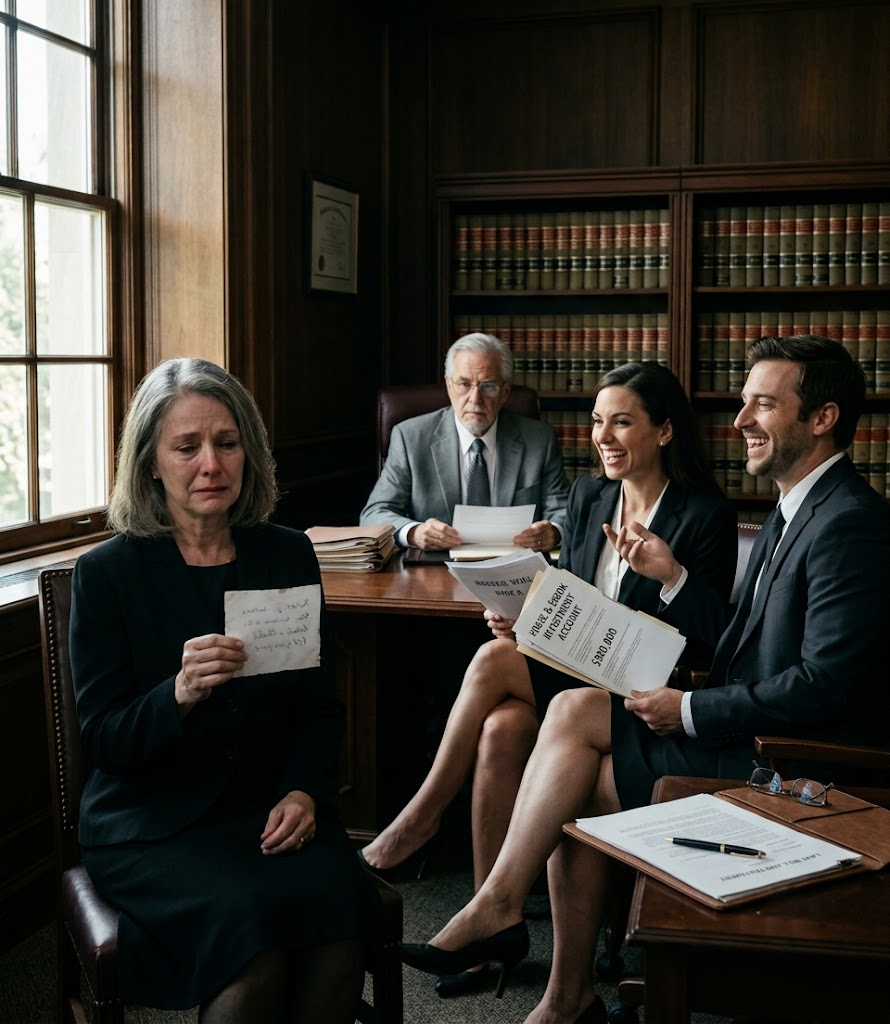
My stepchildren treated me like an outsider for all 14 years I was married to their father, and even after he died, they made sure I knew my place. They inherited his house, boat, and more than $600,000, while I got 10 acres of weeds and an abandoned trailer they openly laughed at. I walked away thinking I had gotten almost nothing. Less than three weeks later, I found out why my husband had left that “worthless” piece of land to me.
I met Walter Bennett when I was fifty-two.
By then, I had already learned not to expect life to hand me another great love.
My first marriage had ended years earlier, quietly rather than dramatically, and I had gotten used to living alone. I worked at a small medical office, tended a vegetable garden behind my house, and spent Friday nights watching old movies with a bowl of popcorn balanced on my lap.
Walter changed that.
He was sixty, recently widowed, and had the kind of dry humor that took a few minutes to notice. He never tried too hard to impress anyone. His truck was old, his shirts were usually bought on sale, and he repaired appliances long after most people would have replaced them.
We met at a community fundraiser.
He asked whether the seat beside me was taken.
Fourteen months later, we were married.
His two children, Melissa and Aaron, were adults by then.
I knew from the beginning that they weren’t happy about me.
Melissa was thirty-five and worked in real estate. Aaron was two years younger and owned a small construction business.
Neither was openly cruel at first.
They were simply cold.
At Thanksgiving, Melissa would ask Walter to join a “family photo,” then hand me the camera.
At Christmas, gifts were labeled Dad, Melissa, Aaron, and the grandchildren.
Mine would say Linda.
One year, a holiday card arrived at our house addressed to “Dad and Guest.”
Walter was furious.
I told him not to make a scene.
That became a habit.
Whenever they excluded me, I softened it.
Whenever Walter wanted to confront them, I convinced him it wasn’t worth damaging his relationship with his children.
“They lost their mother,” I reminded him.
“They’re still adjusting.”
Fourteen years is a long time to adjust.
But I kept making excuses because Walter loved them.
And because Walter loved me.
That had always seemed enough.
He never treated me like a guest.
The brick house outside Lexington had belonged to him before we married, but from the day I moved in, he called it ours.
We planted roses together.
I picked the curtains.
He built shelves in the kitchen because I complained that every cabinet was too high.
When his kidneys began failing, I drove him to dialysis three mornings a week.
On bad days, I helped him button his shirt because his hands hurt too much.
I never thought of those things as sacrifice.
That was marriage.
Walter died on a gray February morning at seventy-four.
His body had been failing for a long time, but death still felt rude when it finally arrived.
One minute, I was sitting beside his hospital bed with my hand over his.
The next, a nurse was asking whether I wanted more time with him.
Melissa took over the funeral.
I didn’t object.
I barely knew what day it was.
At the church, I discovered she had placed herself and Aaron in the front row with their spouses and children.
My seat was in the second row.
I stood in the aisle holding my purse, staring at the printed card bearing my name.
Linda Bennett.
Row Two.
A church volunteer noticed my confusion.
“I’m sorry,” she whispered. “This is the seating chart the family gave us.”
The family.
I almost laughed.
Instead, I sat where I had been told.
From the second row, I watched my husband’s children cry over the man whose medication I had measured every night, whose socks I had pulled onto swollen feet, whose forehead I had kissed before every dialysis appointment.
At the reception afterward, a distant cousin asked why I wasn’t sitting with the family.
Melissa heard her.
“There just wasn’t enough room.”
There had been an empty chair beside her.
I said nothing.
A week later, we gathered in the office of Walter’s attorney, Samuel Price, for the reading of the will.
Samuel had known Walter for almost thirty years. He was an old-fashioned attorney with silver hair, thick glasses, and shelves crowded with real books instead of decorative ones.
Melissa sat closest to his desk.
Aaron sat beside her.
I chose a chair near the window.
Samuel began with the house.
Walter left it jointly to Melissa and Aaron.
Melissa immediately relaxed.
The fishing boat went to Aaron.
Several collections, tools, and pieces of family furniture were divided between them.
Then Samuel came to Walter’s investment account.
A little over six hundred thousand dollars, split evenly between his children.
Melissa squeezed Aaron’s arm.
I looked down at my hands.
I wasn’t angry.
At least, that was what I told myself.
The house had belonged to Walter before me.
His children had grown up there.
The money had been earned over decades.
Maybe he believed it should stay with them.
Still, after fourteen years together, I had expected something.
Not millions.
Not even the house.
Just something that said he had thought about where I would go once the sixty-day occupancy period ended.
Samuel adjusted his glasses.
“To my wife, Linda Bennett, I leave the parcel located along County Road 16, consisting of approximately ten recorded acres, including all structures and rights belonging to said parcel.”
Melissa blinked.
Then she laughed.
It wasn’t loud.
That somehow made it worse.
“The trailer property?”
Aaron looked at her.
“Seriously?”
I knew the land.
Walter bought it almost thirty years earlier.
It sat forty minutes outside town along a narrow road people mostly used to reach hunting land farther north.
The property was overgrown.
A fire years earlier had damaged the old single-wide trailer so badly that Walter stopped staying there.
There was a collapsing shed, a creek along one boundary, and more weeds than grass.
Walter claimed he kept it because he liked fishing there.
In fourteen years, I saw him catch four fish.
Melissa looked at me.
“Well, Dad did always say you liked simple things.”
I met her eyes.
She smiled.
It was clear what she meant.
They had received the things with visible value.
I had received dirt.
Samuel closed the will.
“There is one additional envelope for Mrs. Bennett, but under Walter’s instructions, I am not authorized to give it to her today.”
I looked up.
“When?”