“If that land turns out to be worth nothing, Linda will still take care of it. If it turns out to be worth something, she’ll ask questions before letting somebody steal it.”
That recording ended Melissa’s strongest argument.
She eventually withdrew the challenge.
But the fights around the land continued.
A private buyer pushed the offer past four million.
Then five.
Someone connected to the project contacted Melissa directly and convinced her she could profit by helping locate old title documents.
That was when Aaron finally broke ranks.
He admitted that Melissa had been searching through Walter’s records even before the funeral.
A consultant had told her the property might become valuable.
Neither of them had known the full story when the will was read.
But within days, they’d learned enough to understand their mistake.
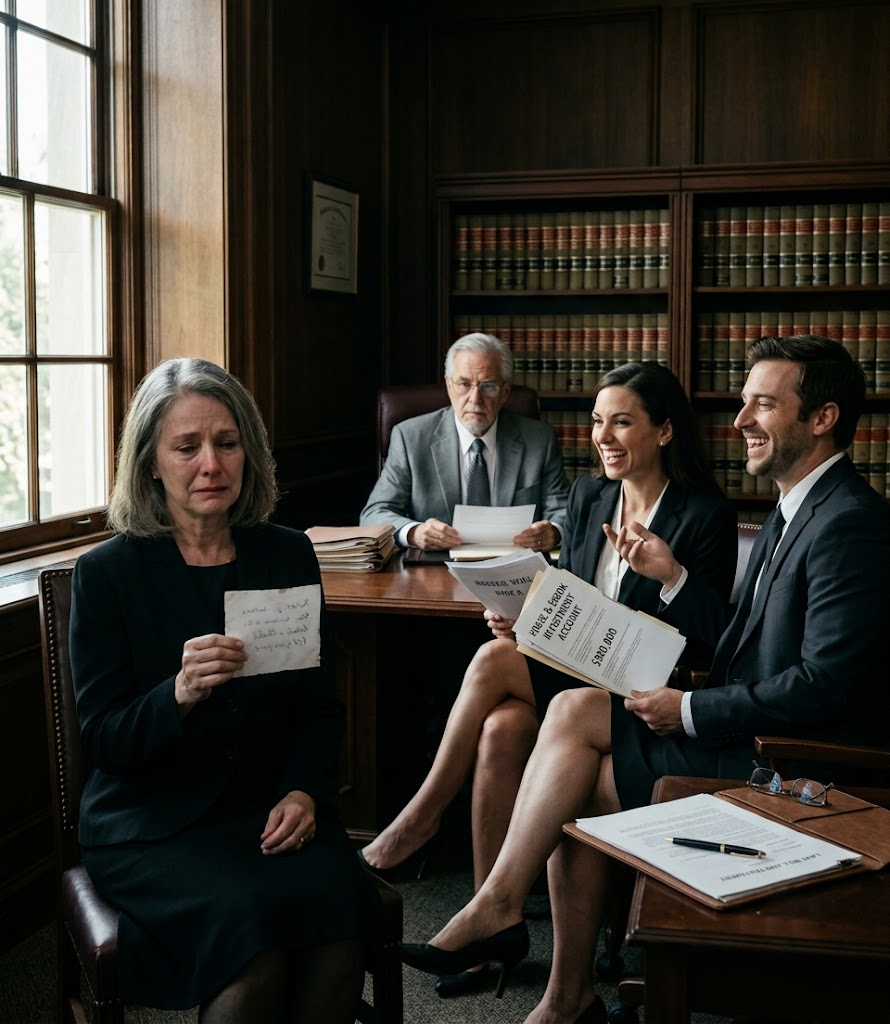
That explained the laughter in Samuel’s office.
And the sudden friendliness afterward.
Months of surveys, title work and negotiations followed.
I didn’t become an expert overnight.
I hired people who were.
That was the smartest thing I did.
Eventually, the final arrangement involved far more land than the ten acres listed in the original will.
Part of the property was sold for several million dollars.
Other sections remained under my ownership and generated annual payments for access.
I kept the creek and the northeast corner where Walter used to sit with a fishing pole and swear the fish simply weren’t hungry that day.
I also protected a share that belonged to one of Walter’s extended relatives under an old family agreement.
By the time everything was complete, the land Walter’s children had laughed at was worth more than the house, boat and investment account combined.
Melissa barely spoke to me afterward.
Aaron eventually apologized.
Not immediately.
It took almost a year.
He came to see me one afternoon at the small house I bought after moving out of Walter’s home.
We sat at my kitchen table.
“I was angry at you for a long time,” he admitted.
“I know.”
“I thought Dad changed because of you.”
“Changed how?”
“He stopped telling us about everything. Money. Investments. Property.”
“He was allowed to have privacy.”
Aaron nodded.
“I know that now.”
Then he said something I hadn’t expected.
“I think I was afraid that if he loved you, there was less of him left for us.”
For the first time, I understood him.
It didn’t excuse fourteen years of making me feel invisible.
But I understood.
“You didn’t lose your father because he married me.”
“I know.”
“He talked about you constantly.”
Aaron’s eyes filled.
“So why didn’t he tell us about the land?”
I thought about Walter’s letter.
“Maybe because he wanted to see what all of us would do without knowing its price.”
Aaron looked down.
That answer hurt him.
It had hurt me too.
Walter hadn’t left his children poor.
He hadn’t punished them.
He had given them the things they clearly valued.
The family house.
The boat.
The investments.
Then he gave me the ugly parcel nobody wanted.
If it had remained worthless, I would have kept it anyway.
That was what Walter understood.
On the first anniversary of his death, I drove out there alone.
The burned trailer had finally been removed.
A secured road serving the development ran through one section of the larger tract, but the creek looked almost exactly as it had before.
I carried Walter’s letter down to the water.
The paper had softened from being opened so many times.
Near the end, he’d written one sentence I hadn’t been able to read without crying during those first few months.
You were the only person who loved me without asking what I owned.
I sat on a flat stone beside the creek.
“You made that difficult enough,” I said aloud.
I could almost hear him laughing.
For months, people had described the story the same way.
Walter’s children got greedy.
The widow got the worthless land.
Then the widow got rich.
That version missed the point.
The money mattered, of course.
It changed my life.
It gave me security I never expected to have.
But by the time everything was settled, the millions felt less important than that first afternoon in Samuel’s office.
Melissa had looked at ten acres of weeds and seen nothing.
I had looked at them and thought only that Walter must have had a reason.
That was the difference he had counted on.
Fourteen years earlier, his children had treated me as if I had somehow entered their father’s life to take something.
I spent those years trying to prove I wanted nothing from him except the man himself.
Walter knew that.
Apparently, he had known it better than anyone.
I folded his letter and placed it back in my purse.
The sun was beginning to drop behind the trees.
Walter used to say land was the one thing nobody was making more of.
For years, I thought that explained why he kept a burned trailer, a broken shed, and weeds tall enough to hide a deer.
Only after he was gone did I understand that he hadn’t held onto that place simply because it might become valuable.
He held onto it because he had time to wait until everyone else showed him what they believed value looked like.
His children saw the house.
They saw the money.
They saw the boat.
I got the thing nobody wanted until somebody put a large number beside it.
And in the end, that strange piece of land gave me something much more useful than revenge.
It showed me that Walter had never mistaken my quietness for weakness.
He knew I would ask questions.
He knew I wouldn’t panic.
Most of all, he knew that even if those ten acres had remained nothing but weeds, a creek, and the memory of a man who was terrible at fishing, I would still have understood why they mattered to him.
For fourteen years, his children made me feel like a guest in Walter’s life.
The final thing he left me proved that I had never been one.