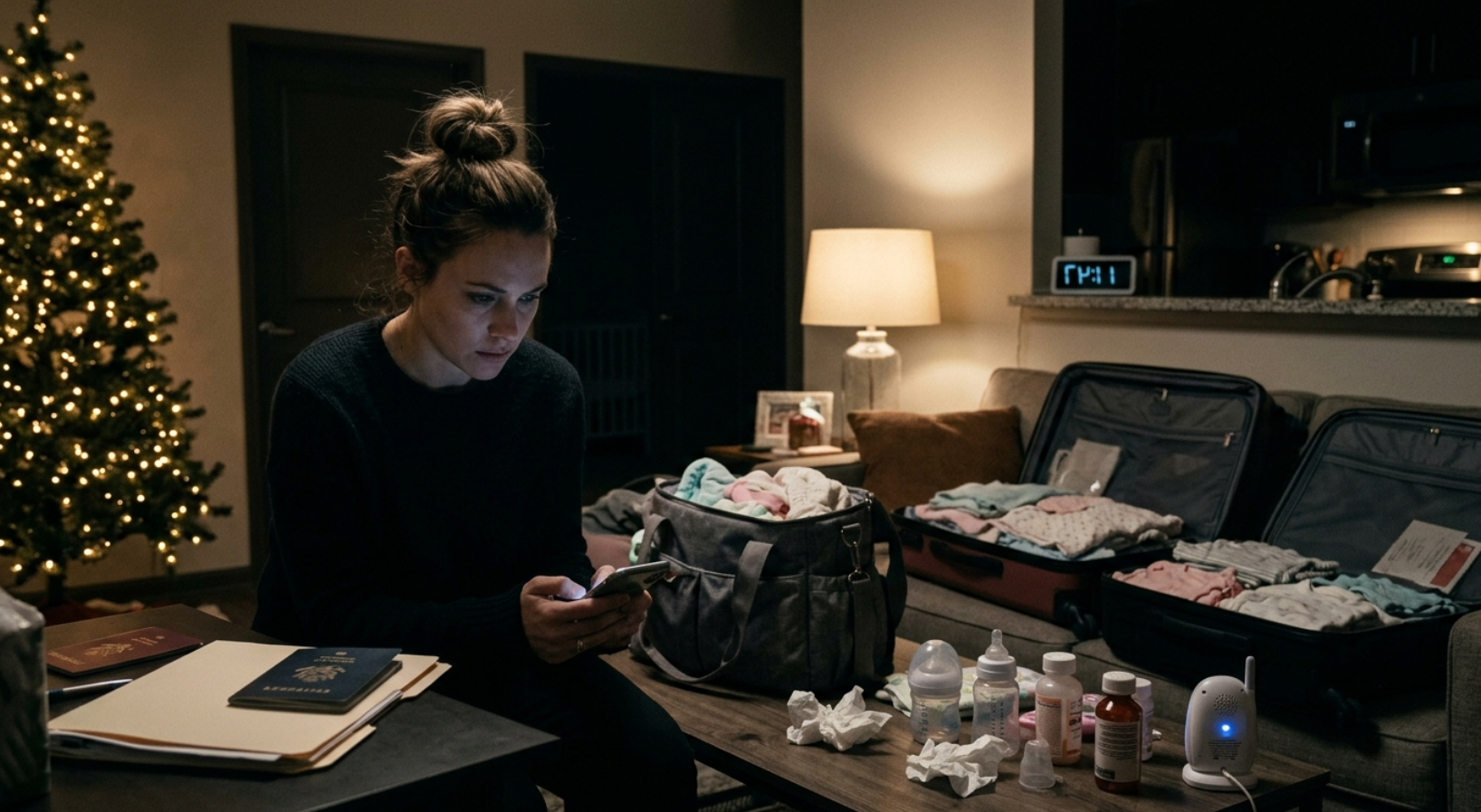
Nearly a year after that terrible Christmas Eve, I stood in a small house with a bright kitchen, a comfortable living room, and a garden just large enough for two little children to play in.
The house was not as luxurious as the apartment Cole and I had shared.
There were no expensive chandeliers.
No marble floors.
No designer furniture.
But there was something I had not felt in our old home for a very long time.
Peace.
Noah was learning to walk without holding the furniture.
Lily had developed a habit of pulling every cushion from the sofa and stacking them into a crooked tower.
My mother was in the kitchen preparing dinner.
Emily was decorating the Christmas tree with the twins.
And I was standing beside the window, watching the first winter decorations glow in the neighborhood.
I had kept the trust separate from my daily finances, followed the professional advice I received, and begun rebuilding my own financial independence.
I had also started working with the charitable fund my grandmother established.
I was not its owner, and I did not control its money. I served as an adviser, learning from its board and helping identify ways to make its support more accessible to women facing financial hardship.
The work was not glamorous.
Some days involved reviewing applications, coordinating referrals, or listening to people describe problems that had no easy solutions.
But every time someone received practical help and gained a little more freedom to make their own decisions, I thought of my grandmother.
And I thought of the woman I had been on Christmas Eve.
The woman who believed she had nowhere to go.
One afternoon, a mother arrived at the fund’s office carrying a toddler and a plastic bag filled with clothes.
She looked exhausted.
She apologized repeatedly for asking for help.
I sat beside her and listened.
When she finished, I said, “You don’t have to solve your whole life today. Let’s start with what you and your child need to be safe.”
She began to cry.
I did not tell her that everything would be easy.
I did not promise that every problem would disappear.
I simply helped her connect with the appropriate support services and make a plan for the next steps.
As she left, she turned around.
“Thank you for believing me.”
I watched her walk through the door.
Then I went into the bathroom and cried for a few minutes.
Not because I was still broken.
Because I understood, more deeply than I ever wanted to, how much it meant when someone finally listened.
That evening, I returned home and found the twins sitting beneath the Christmas tree.
Lily held a ribbon in one hand.
Noah was chewing on the corner of a gift box.
My mother laughed as she tried to rescue the wrapping paper.
And for the first time, Christmas did not remind me of betrayal.
It reminded me of everything I had survived.
My phone buzzed.
A message from Cole.
Merry Christmas. I hope the children are happy and healthy.
I looked at it for a moment.
Then I replied:
Merry Christmas. They’re doing well. I hope you are, too.
That was all.
No argument.
No accusation.
No invitation to reopen the past.
I had learned that forgiveness, if it ever came, did not require me to return to the place where I had been hurt.
It did not require me to trust someone who had broken my trust.
And it certainly did not require me to abandon the boundaries that had helped me rebuild my life.
I could wish Cole well without making him part of my future.
I could remember the good moments without denying the bad ones.
And I could love my children without pretending their parents’ marriage had been healthy.
That was enough.
Later that night, after my mother and sister had gone home, I carried the sleeping twins to their beds.
I tucked the blankets around them and kissed their foreheads.
Then I returned to the living room and took my grandmother’s photograph from the shelf.
She was smiling in the picture, one arm wrapped around my tiny body.
I traced the edge of the frame.
“You were right,” I whispered.
“Love should never cost someone their freedom.”
I placed the photograph back on the shelf.
Outside, Christmas lights shimmered in the darkness.
Inside, my children slept peacefully.
And I finally understood that the greatest victory was not that Cole had lost control of my money, that his plans had been questioned, or that his betrayal had been exposed.
My greatest victory was that I had stopped measuring my worth by whether he chose me.
I had chosen myself.
And that choice had given my children something money could never buy.
A mother who was no longer afraid.
Epilogue: The Photograph I Never Deleted
Two years later, Noah and Lily celebrated their third birthday in the garden of our little house.
There were balloons tied to the fence, a chocolate cake on the table, and enough toys scattered across the lawn to make cleaning up a full-time job.
My mother had brought too much food.
Emily had taken hundreds of photographs.
The twins were laughing so loudly that the neighbors probably knew exactly when the candles were blown out.
Cole attended for part of the celebration under the parenting arrangements we had established.
He was polite.
He helped the children open their gifts and sat with them while they ate cake.
Our conversations remained brief and focused on their needs.
We were no longer husband and wife.
But we were still their parents.
The legal and financial matters had been resolved through the appropriate processes. The protected trust remained intact, and the separate reviews had been handled by the relevant professionals. I did not need to know every detail of Cole’s life anymore.
I only needed to ensure that our children were safe, loved, and cared for.
After everyone left, I sat on the garden steps while the evening sun faded.
My phone was in my hand.
I opened an old folder and found the photograph Cole had sent at 11:47 p.m. on Christmas Eve.
For a long time, I had kept it because I feared that if I deleted it, I would somehow forget the truth.
I thought I needed the photograph to remind myself why I had left.
But I no longer needed a picture to remember the pain.
I remembered the kitchen floor.
The feverish babies.
The empty nursery.
The bruises beneath my sleeve.
And I remembered the moment I finally called Daniel and asked for help.
That moment had changed my life.
Not because a secret clause made me powerful.
Not because an inheritance made me wealthy.
But because I had finally accepted that I was allowed to protect myself.
I deleted the photograph from my personal folder after confirming that the relevant records had been preserved appropriately for the legal matters that required them.
Then I put my phone away.
I looked toward the garden, where the twins were chasing bubbles while my mother watched them.
Lily fell onto the grass and began laughing.
Noah rushed over to help her stand.
They were so small.
So innocent.
They would grow up with their own questions about why their parents did not live together.
One day, I would answer those questions honestly, in a way they could understand, without asking them to take sides.
I would tell them that adults sometimes make choices that hurt the people they love.
I would tell them that families can change shape and still provide love.
And I would teach them that nobody should have to surrender their dignity to keep someone else happy.
As the last sunlight disappeared, I carried the twins inside.
The house smelled of cake and warm milk.
Their toys were everywhere.
A pile of laundry waited in the hallway.
Tomorrow would bring ordinary responsibilities, unexpected problems, and all the imperfect moments that make up a real life.
But I was no longer afraid of ordinary life.
I had learned that peace did not mean everything was perfect.
It meant I no longer had to live in fear of someone else’s anger.
I had once believed my story would end when my marriage ended.
I was wrong.
My marriage was one chapter.
My inheritance was another.
My grandmother’s wisdom became a third.
But the most important chapter was the one I began when I finally walked away from a life that was hurting me.
I closed the children’s bedroom door and stood quietly in the hallway.
Then I smiled.
Because the woman who had left that apartment on Christmas Eve, carrying two sick babies and a handful of belongings, had not lost everything.
She had carried the most important things with her.
Her children.
Her dignity.
Her freedom.
And the chance to begin again.
Sometimes the most powerful ending is not watching the person who hurt you lose everything. It is realizing that you no longer need to watch them at all.



One Comment on “Part 10: A Different Kind of Christmas”