PART11
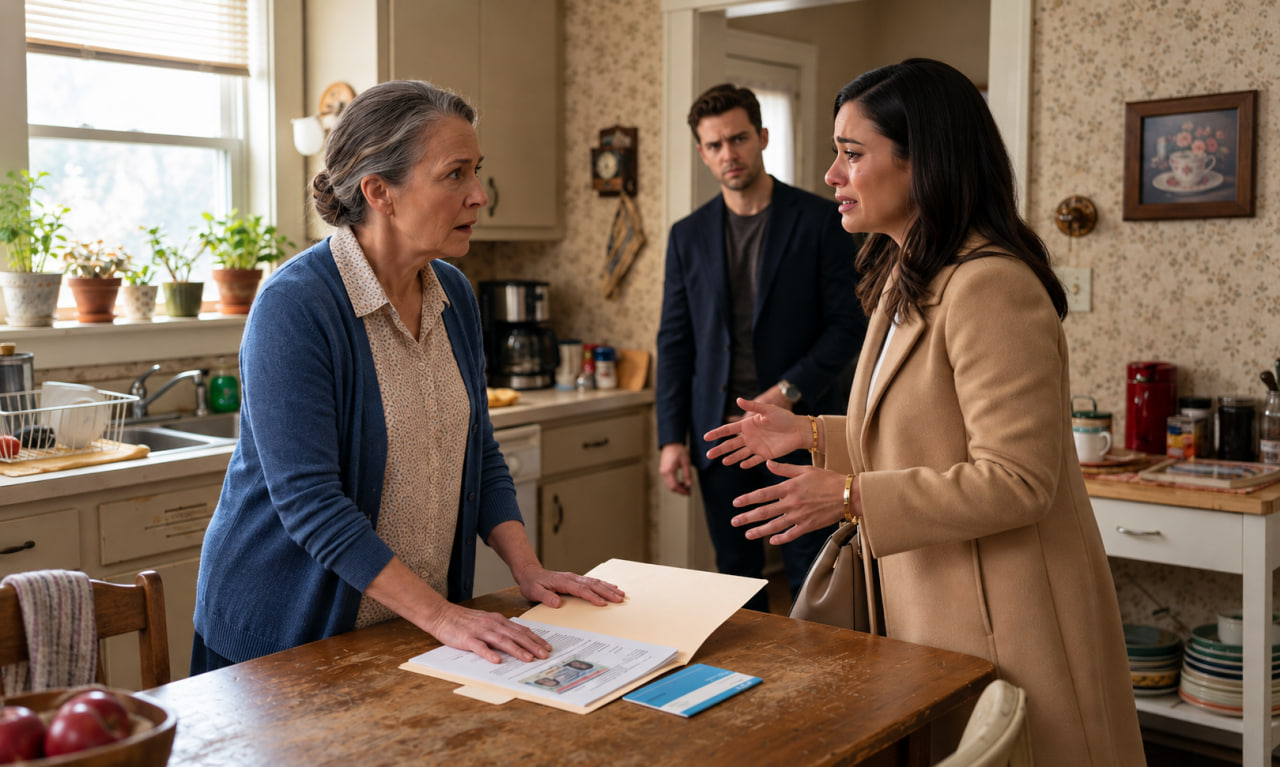
I felt tears gather in my eyes.
“No,” I said. “It can’t.”
She turned toward me.
“I wish I’d invited you.”
The words were so simple that they almost broke my heart.
Not because they could change the past.
Because she was finally acknowledging what she had done without blaming anyone else.
“I wish you had, too.”
She looked down at her hands.
“I don’t expect you to forget.”
“Good. Because I won’t.”
She nodded.
“But I hope one day you can trust me again.”
I reached over and took her hand.
“That depends on what you do from now on.”
For the first time, she didn’t ask me to promise that everything would be all right.
She simply held my hand and sat beside me.
And that was a beginning.
Several months later, the investigation reached an important stage.
The lender confirmed that the loan had been issued based on documents that were now being formally disputed. The company continued its review, and the matter involving the suspected misuse of my identity was referred to the appropriate authorities.
The attorneys also received additional records connected to the loan application and the lease renewal.
Those records strengthened the case that the documents had been submitted without my authorization, although the legal responsibility of each person involved still had to be established through the proper process.
Susan’s company was asked to provide information about the account that received the loan proceeds.
Brandon was also required to respond to questions about his communications with the lender.
For the first time, the people who had treated me as an inconvenience were being asked to explain their decisions to someone other than me.
I did not celebrate.
I didn’t feel triumphant.
I felt tired.
There is nothing glamorous about discovering that people you trusted may have used your identity. The paperwork is exhausting. The phone calls are frightening. Every new document brings another question.
But I no longer felt powerless.
I had a lawyer.
I had records.
I had the truth as far as it could be established.
And I had stopped making decisions out of fear that my daughter might be angry with me.
Eventually, Valerie made a decision of her own.
She separated from Brandon and began the legal process of ending their marriage.
She told me she couldn’t build a future with a man whose explanations changed every time someone asked for evidence.
“I don’t know what will happen to him,” she said one afternoon. “But I know I can’t keep living like this.”
I nodded.
“You don’t have to know everything about your future to take the first honest step.”
She hugged me.
This time, the embrace felt different.
There was no request hidden inside it.
No bill waiting to be paid.
No emergency that I was expected to solve.
Just a daughter who was beginning to understand the consequences of her choices.
As for Susan and Brandon, their legal and financial problems continued to unfold through the appropriate channels. I did not control the outcome, and I did not need to.
My responsibility was to protect myself and cooperate with the process.
Their responsibility was to answer for their own actions.
For the first time in decades, I understood the difference.
A year after the day Valerie told me that her wedding had already happened, I received an invitation in the mail.
It wasn’t an invitation to another wedding.
It was an invitation to Valerie’s graduation ceremony for a professional certification program she had completed while rebuilding her career.
The envelope contained a handwritten note.
Mom, I don’t know if I deserve to ask you to come. But I want you there because you’re my mother, not because I need anything from you. If you decide to come, I’ll save you a seat.
I read the note several times.
Then I placed it on the kitchen table and sat quietly for a long time.
I thought about the first graduation ceremony, years earlier.
I remembered my old dress, the aching feet, and the tears of pride I had cried while watching her receive her degree.
I remembered believing that if I gave her enough, she would always understand what it meant.
I had been wrong about that.
But perhaps I hadn’t been wrong to love her.
On the day of the ceremony, I wore a navy-blue dress I had purchased for myself. I did my hair, put on a little lipstick, and arrived early.
When Valerie saw me, she hurried across the room.
For a moment, she looked almost like the little girl who used to run into my arms after school.
Then she stopped in front of me.
“Thank you for coming, Mom.”
I smiled.
“Congratulations, sweetheart.”
She hugged me tightly.
“I saved you the best seat.”
I looked toward the front row.
There was a small card with my name on it.
Not Susan’s name.
Not Brandon’s.
Mine.
I sat down, and when Valerie walked across the stage, I clapped.
I didn’t clap because she was my daughter and therefore incapable of doing wrong.
I clapped because she had worked hard to build something of her own.
And because I hoped she was finally learning that the most important kind of success was not the kind that impressed other people.
It was the kind you could live with honestly.
After the ceremony, we went to a small restaurant.
No string quartet.
No expensive decorations.
No elaborate display.
Just the two of us, sharing a meal.
Valerie ordered a simple dinner and insisted on paying for it herself.
When the bill arrived, she placed her card on the table.
I didn’t reach for my purse.
I didn’t offer to split the cost.
I simply thanked her.
As we walked outside, she stopped beside my car.
“Mom, can I ask you something?”
“Of course.”
“Do you think we’ll ever be the way we were before?”
I considered the question.
“No,” I said gently.
Her face fell.
Then I continued.
“I hope we become something better.”
She looked at me.
“Better?”
“Yes. Before, I thought being a good mother meant making sure you never had to struggle. I thought loving you meant solving every problem before it could hurt you.”



One Comment on “PART11: My Daughter Said Her Wedding Was Only for “Important People”—A Week Later, She Called Asking Me to Pay Her Rent”