PART6
He hesitated.
“Yes,” he whispered. “I suppose I did.”
“Did you ask my doctor?”
“No.”
“Did you arrange an independent driving assessment?”
“No.”
“Did you ask me what I wanted?”
He closed his eyes.
“No.”
I squeezed his hand.
“Then you weren’t protecting me, Brian. You were protecting yourself from your fear.”
He nodded.
“I know that now.”
Megan reached for her coffee.
“I tried to tell him,” she said. “I told him you might be upset, and that we should talk to you first. But he was convinced that if he waited, something terrible would happen.”
I looked at her.
“Thank you for telling me.”
She gave me a small, apologetic smile.
Brian opened the envelope again and removed one final sheet of paper.
“I’ve written down what I think we should do next,” he said.
I raised an eyebrow.
“Written down?”
“I know. It sounds like I’m making another plan for you.”
“It does.”
He almost smiled.
“But this time, I want you to tell me what’s wrong with it.”
That was the first time since my birthday that I felt we might actually be getting somewhere.
The plan was simple.
First, we would consult the attorney about the Buick sale and make sure the paperwork and proceeds were handled properly.
Second, I would have my eyesight and general fitness to drive assessed by qualified professionals. If they found a problem, I would consider my options.
Third, we would discuss practical transportation arrangements that allowed me to remain independent without pretending I was twenty-five.
Finally, Brian would stop making decisions on my behalf without speaking to me first.
I read the list twice.
“You forgot one thing.”
He looked worried.
“What?”
“You need to learn how to apologize without explaining why you were right.”
Megan covered her mouth to hide a laugh.
Brian looked at her.
“Whose side are you on?”
“My mother-in-law’s, apparently.”
I laughed.
Brian looked back at me.
“I’m sorry, Mom. I shouldn’t have sold your car without discussing it with you. I thought I was doing the right thing, but I didn’t give you the respect you deserved.”
The words were not perfect.
They were enough to begin with.
“Thank you,” I said.
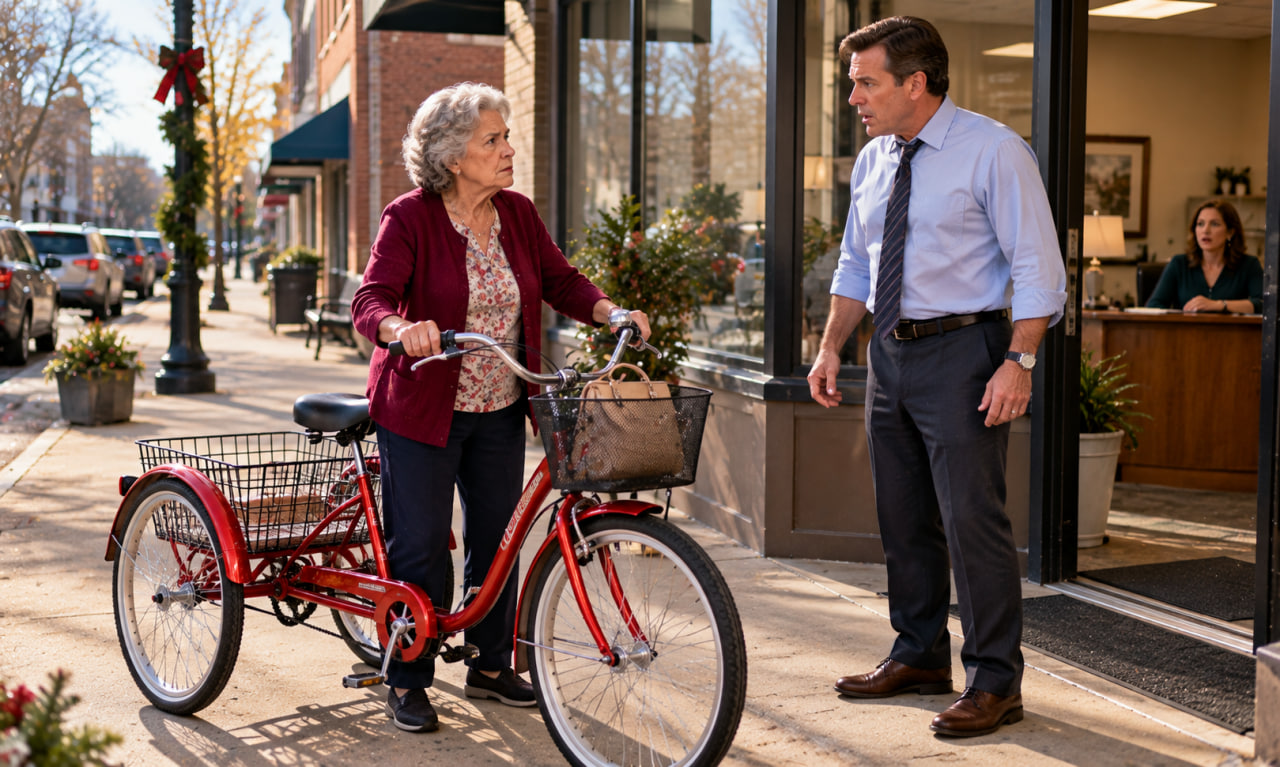
Then I pointed toward Ruby.
“And you owe that bicycle a little respect, too.”
He followed my gaze.
“I’m not riding it.”
“I wasn’t going to ask you to.”
“Good.”
“But you can help me adjust the brakes.”
He sighed.
“Of course I can.”
That afternoon, Brian spent forty minutes examining Ruby’s wheels and tightening a loose bolt. Megan helped me plant new flowers beside the porch.
Before they left, Brian stood beside the bicycle and examined the chrome bell.
“Where did you get this?”
“The young man at the bicycle shop gave it to me.”
“Why?”
“Because he thought somebody ought to give me something.”
Brian ran his thumb over the bell.
Then he reached into his pocket, pulled out a small screwdriver, and tightened its mounting screw.
“There,” he said. “Now it won’t rattle.”
I rang it.
The sound was bright and clear.
“Perfect,” I told him.
For the first time in weeks, we said goodbye without anyone feeling defeated.
But repairing our relationship would take more than one apology.
And I was about to discover that the hardest part of growing older was not learning to accept help.
It was learning which help to accept—and how to refuse the rest.
The following month, I visited my doctor.
He examined my eyes, reviewed my medications, and asked about my driving history.
I told him about the mailbox.
He listened without judgment.
“An accident like that doesn’t automatically mean you should stop driving,” he explained. “But at your age, it is sensible to assess your vision, reaction time, and any other factors that might affect safety.”
He referred me for a formal driving assessment.
I completed it several weeks later.
The assessor recommended some changes, including avoiding night driving and heavy rain until I had completed additional practice and review. He also advised me to remain alert to any changes in my vision.
I followed his recommendations.
For the first time, I understood that independence did not mean refusing every restriction.
It meant making informed choices instead of allowing someone else to make them for me.
I also started taking a weekly exercise class at the community center. Wilma came with me, mostly because she claimed the instructor was handsome.
He was seventy-two, married, and had a hearing aid.
Wilma said those were minor details.
I began walking to the library, visiting the farmers’ market, and riding Ruby along quieter streets during daylight hours.
Sometimes Brian drove me to appointments.
Sometimes I took the bus.
Sometimes I stayed home because I wanted to.
That last part mattered more than I expected.
For months, I had felt that every choice I made was being measured against my age. If I went out, I was risking something. If I stayed home, I was becoming frail. If I asked for help, I was dependent. If I refused it, I was stubborn.
I was tired of being treated like a problem that needed solving.
I was still Evelyn Bennett.
I liked crossword puzzles, cinnamon toast, old movies, and the sound of rain against the kitchen window.
I liked gardening before breakfast and having coffee with Wilma on Fridays.
I liked my son, even when he frustrated me.
And I liked the fact that I could still learn new things.
One afternoon, I rode Ruby to the grocery store. I parked her near the entrance and went inside.
A young woman in her twenties held the door open for me.


One Comment on “PART6: My Son Sold My Buick on My 76th Birthday—So I Rode a $389 Bicycle to His Office”