PART7
“That’s a beautiful bicycle,” she said.
“Thank you. She’s a good girl.”
The woman smiled.
“I’m thinking of buying one for my grandmother. She says she’s too old to learn.”
“Tell her that I learned at seventy-six.”
“Really?”
“Really.”
The woman thanked me and went on her way.
I stood for a moment beside the shopping carts, smiling at nothing in particular.
Perhaps my bicycle would never take me as far as my Buick had.
Perhaps there would come a day when I could no longer ride it, either.
But that day had not arrived.
And I was done mourning things I had not yet lost.
By early spring, Brian had changed in small but meaningful ways.
He called before visiting.
He asked whether I wanted him to handle certain errands instead of simply doing them.
When he disagreed with me, he explained his concerns and listened to my response.
Sometimes we still argued.
One Saturday, he arrived at my house and found me carrying a bag of garden soil from the shed.
“Mom, let me take that.”
“I can carry it.”
“It’s heavy.”
“So am I, and I manage that every day.”
He laughed despite himself.
“Please let me help.”
I handed him the bag.
Not because he had ordered me to.
Because I had decided to.
That distinction became the foundation of our new relationship.
We also reviewed my financial arrangements with Mr. Collins. I updated my will, confirmed that my accounts were properly documented, and made sure any future authority to act on my behalf would be clearly defined and based on my wishes.
Brian was not excluded from my life.
He was simply no longer allowed to confuse being included with being in charge.
One evening, as we sat on the porch, he asked me something unexpected.
“Mom, do you think Dad would be disappointed in me?”
I looked at him.
“Why would he be?”
“Because I treated you that way.”
I considered the question.
“Your father could be stubborn,” I said. “He once spent three hours trying to repair a toaster that cost less than the replacement parts.”
Brian laughed.
“And when I told him he was wasting his time, he said that wasn’t the point. The point was that he wanted to finish what he’d started.”
I looked toward the garden.
“Your father loved you. He would want you to learn from your mistakes, not spend the rest of your life punishing yourself for them.”
Brian nodded.
“I wish I could ask him what to do.”
“So do I, sweetheart.”
We sat in silence for a while.
Then he said, “I miss him.”
I reached over and rested my hand on his.
“Me too.”
It was a small moment, but something shifted between us.
For the first time, we were not a frightened son trying to control his mother or an angry mother trying to prove her independence.
We were two people who had lost someone we loved and were learning how to live with that loss together.
Almost a year after my birthday, Brian invited me to lunch.
He chose the same supper club where he’d taken my keys.
When I arrived, he was waiting at a table near the window.
He stood when he saw me.
“Happy birthday, Mom.”
“My birthday is tomorrow.”
“I know. I wanted to beat everyone else to it.”
There was a small gift beside his plate.
I sat down.
“What’s that?”
“Open it.”
Inside was a framed photograph.
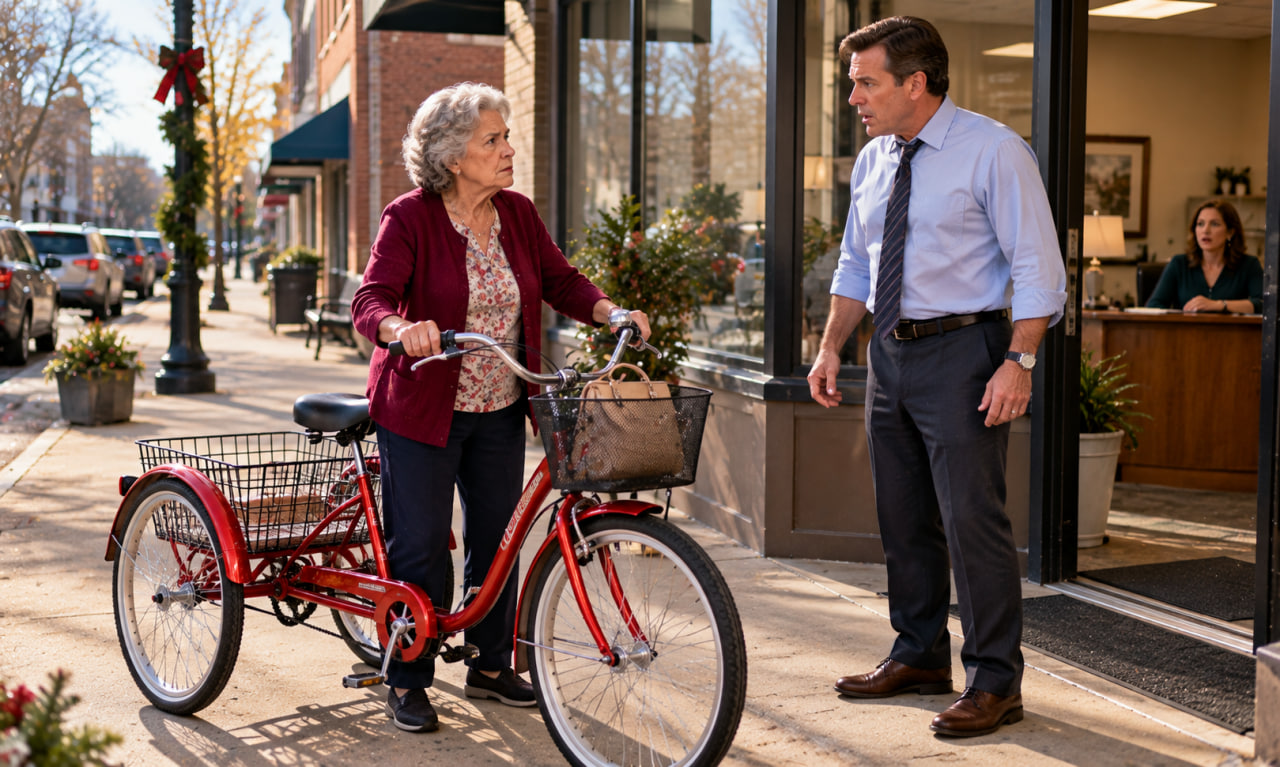
It showed me on Ruby, riding down Main Street with my cardigan buttoned to the neck and my purse in the basket. My hair was blowing in the wind, and my face was turned toward the camera.
I looked ridiculous.
I also looked happy.
“Where did you get this?”
“Linda took it from the office window that morning. She sent it to me a few weeks ago.”
I studied the photograph.
In the background, Brian stood outside his office, staring at me with an expression that seemed to contain fear, embarrassment, and something else I couldn’t quite identify.
“What were you thinking that day?” I asked.
He looked at the picture.
“That I had no idea what to do.”
“And now?”
He smiled faintly.
“Now I know I should have asked you.”
I put the photograph back in its frame.
“That’s a good start.”
He took a deep breath.
“There’s something else I want to tell you.”
I waited.
“I’ve been thinking about Dad’s title paperwork. I helped you put my name on the Buick because I thought it would make things easier after he died. I never imagined I’d use it to make a decision you didn’t agree with.”
“I know.”
“I should have checked with you first.”
“Yes.”
He nodded.
“I can’t change what happened. But I want you to know that I understand why you were hurt.”
I looked at him for a long moment.
Then I reached across the table and took his hand.
“Brian, I don’t need you to spend the rest of your life feeling guilty. I need you to remember this the next time you’re tempted to make a decision for someone because you’re afraid.”
He squeezed my hand.
“I will.”
Our food arrived, and we talked about ordinary things: the grandchildren’s school projects, Megan’s new job, Wilma’s latest argument with the community center instructor.
We laughed.
We ate.


One Comment on “PART7: My Son Sold My Buick on My 76th Birthday—So I Rode a $389 Bicycle to His Office”