FINAL PART
I pressed the letter against my chest.
For eight years, I had missed my husband in a thousand small ways.
I missed the sound of his footsteps in the hallway. I missed the way he read the newspaper aloud when he thought a story was ridiculous. I missed having someone beside me who could understand what I was feeling before I had found the words to explain it.
But I had also spent those years trying to be everything for everyone else.
Reading his words, I felt as though a part of him had finally found its way back to me.
Emily was crying, too.
She reached for a tissue, then looked at me.
“Mom, I think I understand now.”
I folded the letter carefully.
“I hope you do.”
She took a shaky breath.
“I thought I was helping everyone. I thought if I could make the arrangements, nobody would have to worry. But I never stopped to ask what you wanted.”
I waited.
“And when you said no, I felt embarrassed. Instead of admitting I had made a mistake, I tried to make you look unreasonable.”
Her voice broke.
“I told Patricia things about you that weren’t true. I made it sound like you needed help because I didn’t want to admit that I had promised something that wasn’t mine to promise.”
Daniel quietly excused himself to give us a few minutes alone.
Emily turned toward me.
“I am so sorry, Mom.”
This time, she didn’t follow the apology with an excuse.
She didn’t blame Robert.
She didn’t mention the stress of the move.
She didn’t ask me to forget what happened.
She simply sat there, crying, and allowed herself to be accountable.
I reached across the table and took her hand.
“I love you, Emily. But we have a lot of work to do.”
She nodded.
“I know.”
“And things cannot go back to the way they were.”
Her expression changed.
“What do you mean?”
“I mean that I will always be your mother, but I won’t spend the rest of my life chasing after your approval. I won’t accept being excluded from your life and then expected to rescue you whenever something goes wrong.”
She looked down at our joined hands.
“I don’t want that either.”
“Then we have to build something different.”
For the first time, I believed she might actually be ready to try.
The weeks that followed were not magically perfect.
Emily returned to her home, and Robert eventually came back after they began working through their problems with a marriage counselor.
Patricia and James settled into their temporary rental. Their new home closed a few weeks later, and they moved in without further complications.
Patricia sent me a handwritten Christmas card thanking me for the kindness I had shown her despite the difficult circumstances.
I placed it on the mantel beside Thomas’s photograph.
As for Emily, she began calling me for reasons other than asking for help.
Sometimes she called to tell me about a book she was reading. Sometimes she wanted to share a recipe. Occasionally, she asked whether I would like to meet her for lunch.
At first, I didn’t know how to respond.
I had become so accustomed to disappointment that I found myself suspicious of even the smallest gestures.
But I reminded myself that rebuilding trust was not about pretending the past hadn’t happened.
It was about allowing new behavior to prove itself over time.
Emily also began acknowledging the years I had spent alone during the holidays.
One afternoon, she called and asked, “Mom, would you like to come to our house for Christmas this year?”
I looked out at the snow-covered trees beyond my window.
For years, that invitation had been the one thing I wanted more than anything else.
Now that it had finally arrived, I realized I needed to ask myself a different question.
Did I want to go?
Not because I was afraid of hurting Emily’s feelings.
Not because I thought a good mother should accept every invitation.
But because I genuinely wanted to spend Christmas with her.
“I’d love to see you,” I replied. “But I’d also like to host Christmas dinner here.”
There was a pause.
“Here?”
“Yes. At my house. I’d like to invite you, Robert, Patricia, and James. We can cook together, decorate the tree, and spend the day without anyone feeling that they have to impress anybody else.”
Emily was quiet for a moment.
Then she said, “That sounds wonderful.”
And so we made plans.
Christmas Eve arrived with a clear blue sky and fresh snow covering the mountains.
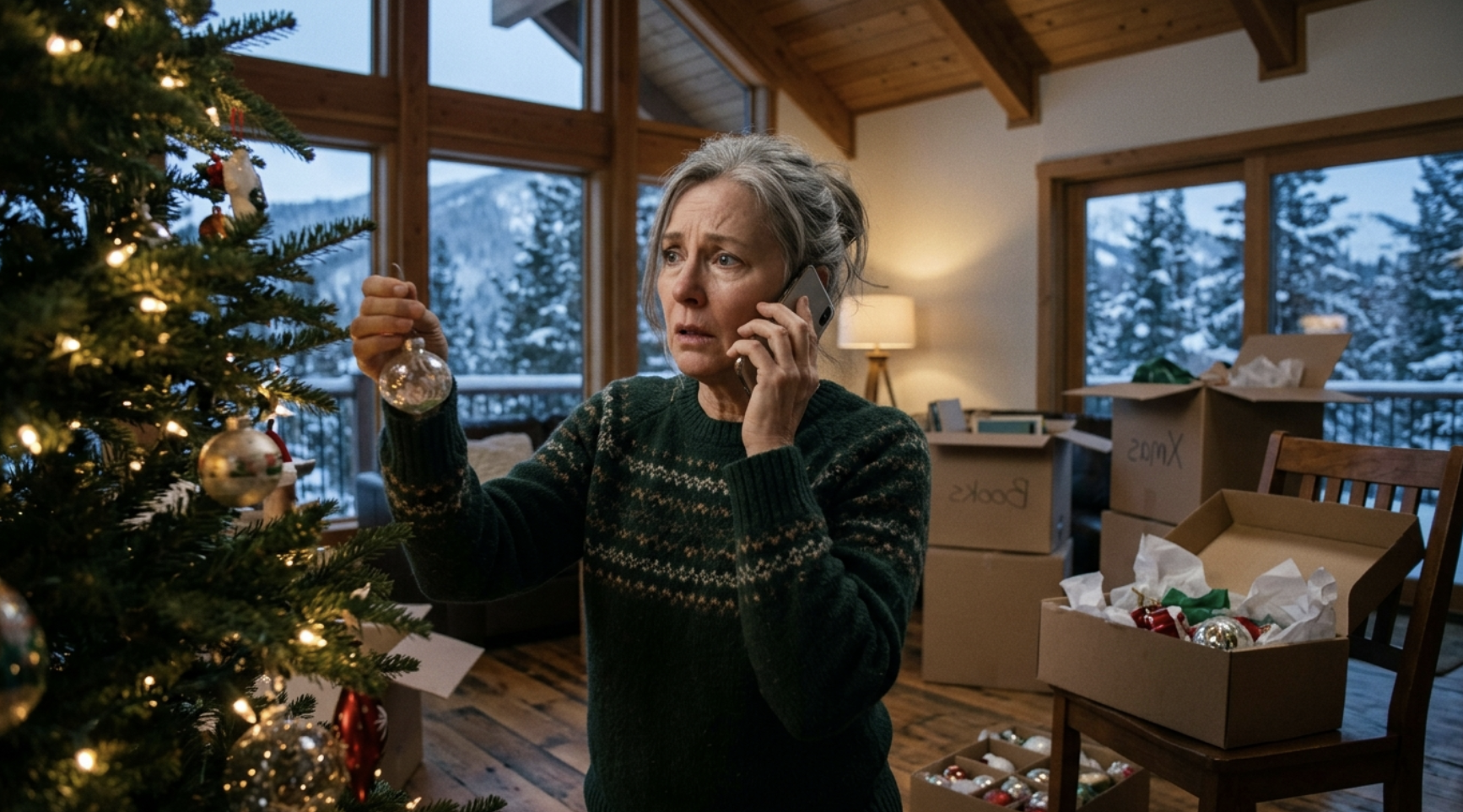
I woke early and made coffee. Then I opened the curtains, turned on the Christmas lights, and stood in the living room looking at the tree.
The little wooden angel still hung from the lowest branch.
I touched its chipped wing and smiled.
At noon, Emily arrived carrying two bags of groceries.
Robert followed with a box of pastries, while Patricia and James brought a basket of homemade food.
Nobody arrived with a moving truck.
Nobody arrived expecting to be handed a key.
They came as guests.
And that distinction made all the difference.
We spent the afternoon preparing dinner. Patricia helped me arrange the table, James tended the fireplace, and Robert carried extra chairs from the garage.
Emily stood beside me in the kitchen, chopping vegetables.
For a while, neither of us said anything.
Then she spoke.
“Mom?”
“Yes?”
“Do you remember when I was little and you used to let me decorate the entire Christmas tree myself?”
I laughed.
“You put all the ornaments on the bottom branches.”
“Because I couldn’t reach the top.”
“And you insisted that every ornament had to face the same direction.”
She smiled.
“I thought that was how trees worked.”
We laughed together.
Then her expression softened.
“I miss those days.”
I set down the knife.
“So do I.”
She looked at me.
“I wish I had called you more often. I wish I hadn’t made you feel like you weren’t part of my life.”
I felt a familiar ache, but it was different now.
It wasn’t the helpless pain of waiting for someone to recognize what they had done.
It was the sadness of acknowledging something that had happened while still being able to imagine a better future.
“I missed you, too,” I told her.
She reached for my hand.
“I can’t promise I’ll never make mistakes again. But I can promise I’ll stop assuming that you have to fix them for me.”
I squeezed her fingers.
“That would mean a great deal to me.”
She nodded.
Then she glanced toward the living room.
“Can I ask you something?”
“Of course.”
“Would you ever consider spending a few weeks with us sometime? Not because you need help. Just because we’d like to have you around.”
I thought about the question.
“Perhaps,” I said. “But I’ll decide when the time comes.”
She smiled.
“Fair enough.”
It was a small exchange.
But to me, it was more meaningful than a dozen dramatic apologies.
She had asked.
I had answered honestly.
And neither of us had treated the other’s decision as a betrayal.
That evening, we gathered around the dining table.
The food was simple. The decorations weren’t perfect. James spilled gravy on his napkin, Patricia laughed so hard that she nearly dropped her fork, and Robert insisted that his mother’s pie was better than anyone else’s.
For the first time in years, Christmas felt less like a performance and more like a family gathering.
After dinner, we exchanged gifts.
Emily gave me a framed photograph of the two of us taken when she was seven years old.
We were standing beside our old Christmas tree, and I was holding her in my arms.
On the back, she had written:
Mom, thank you for loving me enough to tell me no. I’m learning that your love doesn’t mean I can ask you to give up yourself. I hope we can keep learning how to be a family.
I pressed the frame against my chest.
Then I hugged her.
Not because everything was suddenly perfect.
Not because the past had disappeared.
But because I could finally see the possibility of something better.
Later that evening, after everyone had gone home, I stood by the fireplace with Thomas’s letter in my hands.
The house was quiet again.
But this time, the silence didn’t feel like rejection.
It felt like peace.
I had spent so many years believing that being a good mother meant keeping my door open no matter how often someone walked away.
Now I understood that I could love my daughter without surrendering my independence. I could forgive her without pretending she had never hurt me. And I could welcome her into my home without allowing her to decide who belonged there.
My house had three bedrooms, a beautiful fireplace, and windows overlooking the mountains.
But its greatest gift wasn’t the space it offered other people.
It was the space it had finally given me to become myself again.
And the following Christmas, when Emily called to ask whether she could bring dinner to my house, I smiled before answering.
Because she was no longer telling me what I would do.
She was asking whether I wanted to share something with her.
And that was how I knew we were finally finding our way back.



One Comment on “FINAL PART: My Daughter Promised My Mountain Home to Her In-Laws Without Asking Me—Then They Arrived to Find an Envelope at My Door”
Comments are closed.