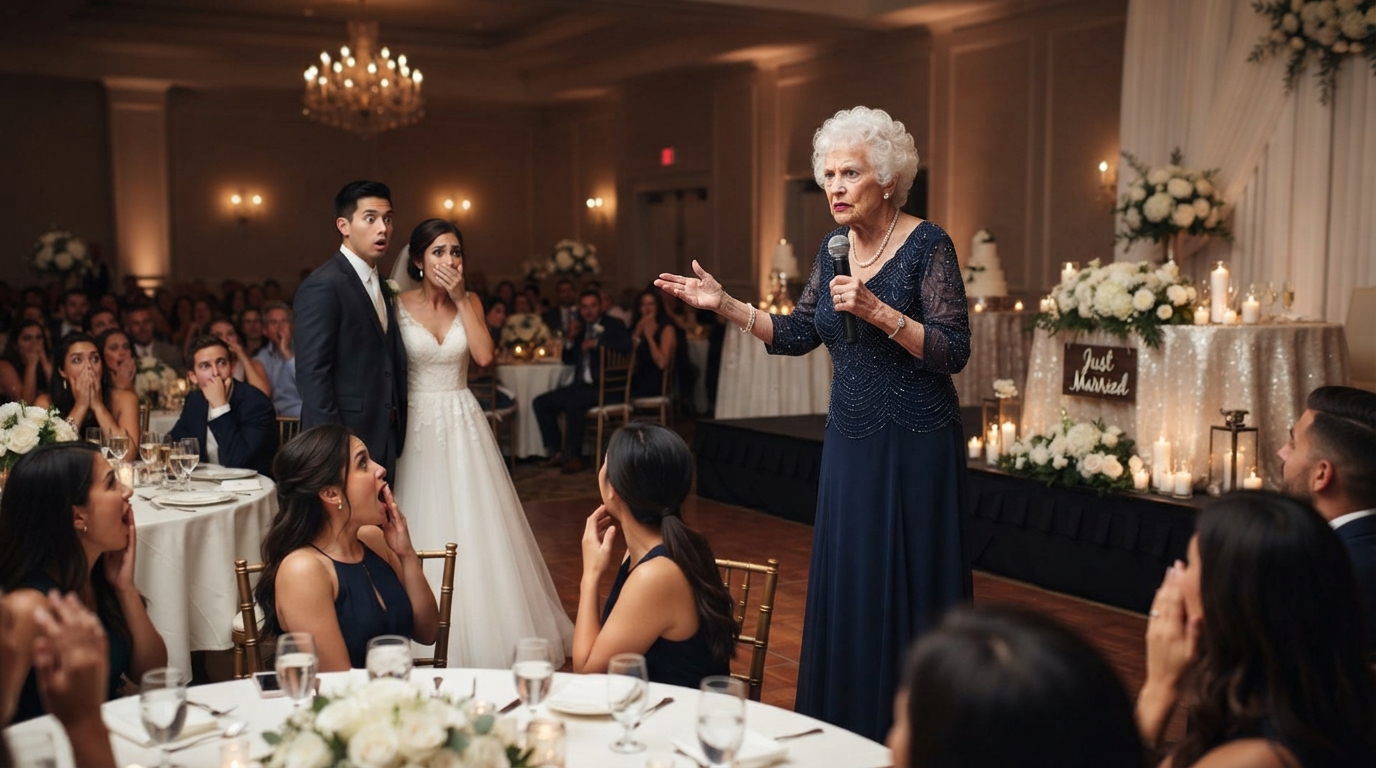
PART6
Not because of the language I had learned.
Not because I had exposed a lie.
But because we were two older women who had trusted the people we loved and discovered that love could sometimes make us blind.
The wedding guests began moving away from the courtyard in small groups. Some approached Daniel to offer their sympathy. Others spoke quietly to the grandmother. A few apologized to me for believing the printed cards without questioning them.
I accepted their apologies.
But my attention remained on my son.
He was standing near the fountain, looking at the woman he had planned to marry.
She approached him slowly.
“Daniel, please. Can we talk somewhere private?”
He stared at her for a long moment.
Then he nodded once.
They walked toward the far end of the garden, beneath the same trees where their wedding photographs had been scheduled to take place.
I wanted to follow him.
Every instinct in me wanted to protect him from another hurtful word.
But I stayed where I was.
He was thirty-eight years old. He had built his business through years of hard work. He had survived losing his father. And although he was hurting, he deserved the chance to decide for himself what his future would be.
So I sat beside the grandmother and waited.
Because sometimes the hardest part of being a mother is understanding that you cannot make every painful decision for your child.
You can only tell him the truth, hold his hand when he needs you, and trust him to find his own way forward.
And what happened next would determine whether my son walked away from that garden with his heart broken—or with the beginning of a very different life.
Twenty minutes later, my son returned from the garden alone.
I knew the moment I saw his face that something had changed.
He wasn’t crying. He wasn’t angry anymore, either. His shoulders were straight, his expression was calm, and the familiar look of hope that had once filled his eyes had been replaced by something painful but unmistakable.
He had made his decision.
He walked toward me, knelt beside my chair, and took both my hands.
“Mom, I’m sorry.”
I brushed a tear from his cheek.
“You don’t have to apologize for loving someone, sweetheart.”
“But I do have to apologize for not listening to you.”
He looked down at our joined hands.
“You tried to warn me. You noticed things I didn’t want to see because I was so determined to believe I had finally found the right person.”
I squeezed his fingers.
“Love makes us hopeful. Sometimes, it also makes us afraid to ask difficult questions.”
He nodded.
“That’s exactly what happened.”
Then he told me what had happened in the garden.
His fiancée had admitted that she knew about the false speech. She had also known that her father wanted financial help from Daniel. She insisted that she had never intended to steal his money, that she had only wanted to help her family escape its financial difficulties.
But when Daniel asked her one simple question, everything changed.
“If your father had never needed my money, would you still have agreed to humiliate my mother?”
She had stared at him for several seconds.
Then she had answered, “I don’t know.”
Those three words had broken something inside him.
Not because she had admitted to being uncertain, but because she had finally stopped pretending that she had done nothing wrong.
Daniel had spent three years building their relationship. He had pictured their future home, the children they might have, the holidays they would celebrate together, and the quiet evenings they would share after retirement.
He had believed that he was marrying a woman who loved him for the person he was.
Now he understood that he had never fully known the person he intended to marry.
“What did you tell her?” I asked.
He looked toward the garden.
“I told her I couldn’t marry someone who thought your dignity was an acceptable price to pay for her family’s financial problems.”
My heart ached for him.
“And what did she say?”
“She cried. She said she loved me. She said we could postpone the wedding celebration, get counseling, and work through everything.”
He took a long breath.
“I told her that love isn’t just what someone says when they’re afraid of losing you. It’s what they do when they believe they can get away with hurting you.”
I couldn’t speak for a moment.
My son had grown into a man who understood something that had taken me many years to learn myself.
Sometimes, the most loving decision is to walk away.
Then Daniel reached into his jacket and removed a small velvet box.
Inside was the wedding ring he had intended to place on his bride’s finger during the reception.
He closed the box.
“I’ll speak to the officiant and the wedding coordinator. There won’t be a marriage today.”
I held his hand tightly.
“Are you sure?”
He looked directly at me.
“For the first time in weeks, Mom, I’m sure of something.”
He stood and offered me his arm.
“Let’s go home.”
But before we could leave, the bride’s grandmother approached us.
She was carrying a small handbag and a folded envelope.
“Daniel,” she said softly, “may I speak with you both?”
We sat with her at a quiet table beneath the trees.
She placed the envelope in front of us.
“I don’t expect you to forgive my family,” she began. “And I won’t ask you to pretend that what happened today was acceptable.”
She looked at me.
“Your speech reminded me of something I had forgotten. A person’s character is not measured by how beautifully they speak when people are watching. It is measured by what they do when they believe nobody can hear them.”
She opened the envelope.
Inside were copies of several financial documents.
“I have suspected for some time that my son was hiding the true condition of the hotel from me. I gave him money to keep the business operating, but he repeatedly refused to show me complete accounts. When I questioned him, he told me I was too old to understand business matters.”
Her voice trembled.
“Today, I heard him speak about Daniel’s savings as though that money already belonged to him. I can no longer ignore what I have seen.”
She explained that the hotel had accumulated substantial debts over several years. Some of the borrowing had been used to keep the business afloat, while other financial decisions had never been properly explained to the family.
She did not know the full extent of the problem.
But she had decided that she would no longer hand over money without independent advice and a complete accounting.
“I cannot promise you that everything will be resolved quickly,” she said. “But I can promise that I will no longer pretend that nothing is wrong.”
Daniel thanked her.
Then she turned to me.
“I wish I could give you back the beautiful day you came here expecting.”
I reached across the table and took her hand.
“You cannot change what happened today. But you can choose what happens tomorrow.”
She smiled sadly.
“And so can you.”
We left the wedding venue shortly afterward.
Behind us, the flowers remained arranged beneath the trees. The musicians packed away their instruments. The champagne glasses stood untouched on the tables.
It was a beautiful wedding that never became a marriage.
And although I felt sorrow for my son, I knew something far worse would have happened if he had gone through with it.
He would have spent years wondering whether every act of kindness concealed another demand, whether every promise came with a hidden condition, and whether the woman sleeping beside him truly loved him.


One Comment on “PART6: They Thought I Was Too Old to Understand Their Language—Until I Exposed Their Wedding Scam in Front of 140 Guests”
Comments are closed.