PART5
“Did you really learn our language just for this wedding?”
I smiled sadly.
“Yes. I wanted to surprise everyone with a toast.”
She looked at the folded speech in my hand.
“Would you read it?”
The bride’s father shook his head.
“This is enough. The guests do not need to hear any more.”
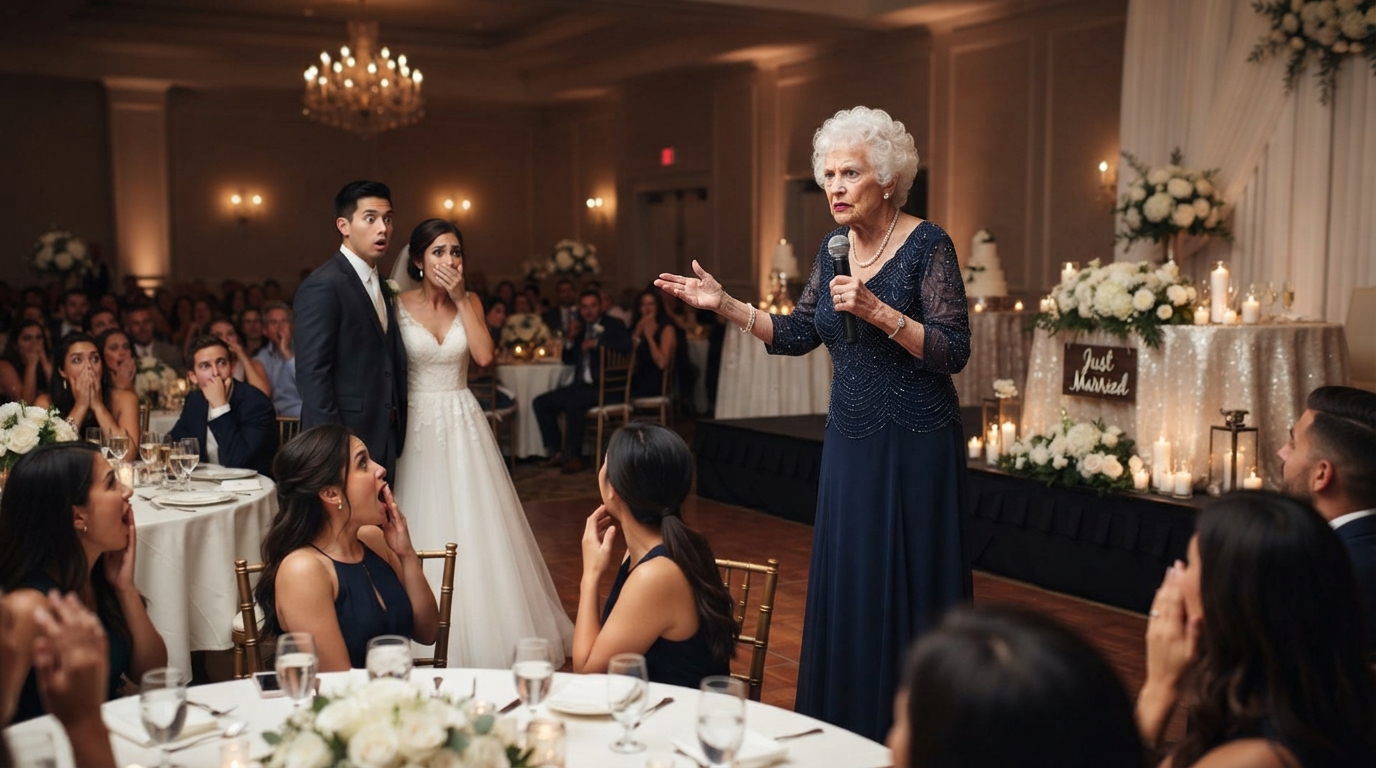
The grandmother turned toward him.
“Be quiet.”
A ripple of astonishment moved through the crowd.
She had not raised her voice, but somehow that simple command carried more authority than anything he had said all afternoon.
Then she looked at me again.
“Please. I would like to hear the words you actually wrote.”
I glanced at Daniel.
He nodded.
So I unfolded my original speech.
My hands were shaking now, not because I was frightened, but because I had suddenly remembered why I had written it in the first place.
I took a breath and began.
“Today, I do not stand here merely as the mother of a groom. I stand here as a woman who has spent nearly four decades teaching young people that knowledge is a gift, kindness is a choice, and character is revealed most clearly when we believe nobody is watching.”
Several guests lowered their eyes.
I continued.
“My son has brought me to your beautiful country because he wishes to build a life with someone he loves. I know that marriage is not simply a promise between two people. It is a promise to treat each other’s families with respect, to protect one another during difficult times, and to tell the truth even when the truth is inconvenient.”
I looked at Daniel.
“When his father died, my son learned that life could change in a single afternoon. He learned that money could disappear, that plans could fail, and that people we love could leave us before we were ready to say goodbye.”
My throat tightened.
“But he also learned that love does not disappear when life becomes difficult. Love is the person who stays. The person who helps you stand up when the world has knocked you down. The person who tells you the truth when a lie would be easier.”
Daniel’s eyes filled with tears.
I turned toward his fiancée.
“When I first met you, I saw how happily my son smiled when you entered a room. I saw the hope in his eyes. I saw a man who believed he had found someone with whom he could share his future. And I welcomed that hope with all my heart.”
I paused, allowing the words to settle.
“My wish for this marriage was never wealth. It was never a magnificent house, an expensive celebration, or a perfect life. My wish was simple: that my son and the woman he loves would always be safe telling each other the truth.”
I looked around at the guests.
“Because a marriage can survive financial hardship. It can survive illness, disappointment, and the many mistakes people make while learning how to love each other. But it cannot become healthy if one person must constantly wonder whether the other is telling the truth.”
The grandmother began crying quietly.
I reached the final paragraph.
“So today, I raise my glass to the possibility that love can make us better people. May this couple learn to protect each other’s dignity, may their home be filled with honest conversations, and may they never confuse the generosity of another person with an obligation to take more.”
I lifted my champagne glass.
“And may every family represented here remember that the greatest inheritance we can leave our children is not money. It is the example we set when we believe nobody is watching.”
I lowered the paper.
For a moment, the courtyard remained silent.
Then the grandmother began to clap.
One slow clap.
Then another.
A woman near the front joined her. An elderly gentleman stood up. Within seconds, several guests were applauding, and others were wiping tears from their eyes.
But I did not feel triumphant.
I felt exhausted.
Because I had not wanted to expose anyone.
I had wanted to celebrate my son’s marriage.
And now, standing beneath those beautiful trees, I had to face the possibility that the celebration was already over.
Daniel walked toward me.
He took the microphone gently from my hand and turned to the guests.
“I owe my mother an apology,” he said in English. “I should have listened when she told me something felt wrong. I thought she was being overly cautious because she was worried about me. I didn’t realize she was trying to protect me from people I trusted.”
He swallowed hard.
“I am also sorry to everyone here who was given a false speech in her name. My mother came to this wedding with love and respect. She deserved the same in return.”
Then he turned toward his fiancée.
“I need to know whether any part of the future we planned together was real.”
She reached for him.
He stepped back.
“Please don’t touch me right now.”
Her hand fell to her side.
And just as the courtyard seemed to settle into a terrible, sorrowful quiet, the bride’s brother made one final mistake.
He grabbed a stack of the remaining printed cards from the table and shouted, “These cards are meaningless! She is manipulating all of you!”
He threw them onto the ground.
A few guests flinched.
But the grandmother did something nobody expected.
She bent down, picked up one of the cards, and turned toward him.
“You told me you had prepared a beautiful speech for the groom’s mother,” she said. “You told me it was a tribute to her generosity.”
Her grandson said nothing.
She held up the card.
“You lied to me, too.”
His expression changed.
Because it was one thing to be exposed by a foreign guest.
It was another thing entirely to lose the trust of the person who had helped raise you.
The grandmother looked at her son, the bride’s father.
“And you.”
He stiffened.
She continued in a low, shaking voice.
“I gave you my savings when the hotel was struggling. I sold the little apartment your father left me because you promised the business only needed one final investment. I believed you.”
The bride’s father looked away.
She gripped her cane.
“Now I discover that you intended to take money from a man who came here to marry your daughter, while teaching your children to humiliate his mother.”
“Mother, please,” he muttered.
“No. You have asked me to remain silent for years because you said family matters should stay inside the family.”
Her eyes filled with tears.
“I stayed silent when I should have asked questions. I trusted you when I should have demanded answers. And now you have brought shame upon this family in front of people who came here to celebrate love.”
The bride’s father had no response.
The guests watched him, no longer with admiration, but with the uncomfortable realization that the man who had presented himself as a successful businessman and devoted father had been hiding a much darker reality.
I gently touched the grandmother’s arm.
“You don’t have to settle everything today.”
She looked at me.
“Perhaps not,” she whispered. “But today I have finally heard the truth.”
I squeezed her hand.
And then, for the first time since I had arrived in that country, I felt that someone in the bride’s family truly understood me.


One Comment on “PART5: They Thought I Was Too Old to Understand Their Language—Until I Exposed Their Wedding Scam in Front of 140 Guests”
Comments are closed.