PART4
“Because that’s the name of the company mentioned in one of these documents. I assumed it was a reference to a department or internal project. I haven’t yet established the connection.”
He turned a page.
Mom leaned forward.
Dad had started at the mill in 1974, earning barely enough to keep our small house warm and food on the table. He stayed there for more than thirty years. He worked overtime whenever he could, especially when Scott and I were young.
He had been promoted twice, but he never spoke much about his job.
To us, the mill was simply the place where Dad went every morning and returned every evening.
Mr. Cole continued.
“According to the records, in September 1981, your father was involved in an incident concerning a piece of equipment and a series of financial transactions.”
“What kind of incident?” I asked.
“The records don’t give me enough information to answer that yet. But there are references to missing inventory, altered purchase orders, and a substantial sum of money.”
Mom’s face tightened.
“How much money?”
Mr. Cole turned to another page.
“Approximately $186,000 in 1981 dollars.”
I stared at him.
“That much?”
“Yes.”
In today’s money, that would be a considerable fortune.
Dad had never owned anything extravagant. We grew up in the same modest house, drove used cars, and went camping instead of flying somewhere for vacation.
He had never acted like a man who had been anywhere near that kind of money.
“Was my father accused of stealing it?” I asked.
Mr. Cole looked at me carefully.
“His name appears in an internal report, but I haven’t found any evidence that he personally took the money. In fact, the documents suggest he may have been the person who raised concerns about the transactions.”
Mom shook her head.
“Harold would never steal. He worked twelve hours a day when he had to. He used to bring home broken tools because he didn’t want to waste company money buying replacements.”
“I understand,” Mr. Cole said gently. “And I’m not suggesting otherwise.”
He placed a photocopy of a handwritten letter on the table.
The handwriting wasn’t Dad’s.
It was sharp, hurried, and almost impossible to read.
At the bottom was a signature.
Daniel Whitaker.
Mom stared at the name.
“Daniel,” she whispered.
I looked at her.
“You know him?”
She pressed her lips together.
“I knew a Daniel who worked at the mill with your father. They were friends for a while. He came to our house a few times when you were little.”
“What happened to him?”
“I don’t know. One day, your father came home and said Daniel had left the company. When I asked why, he said it wasn’t our business.”
That sounded exactly like Dad.
He never brought work problems into the house.
He believed a man should leave his troubles at the door so his family could have peace.
But now I wondered how much that peace had cost him.
Mr. Cole tapped the letter.
“This was written by Daniel Whitaker on September 17, 1981. It appears to concern the same financial irregularities. There is a sentence here that I find particularly interesting.”
He read it aloud.
“’Harold has the original ledger. If management discovers it, they will make certain neither of us works in this town again.’”
Mom covered her mouth.
I felt the room grow cold.
The original ledger.
Locker 214.
Ask for Daniel.
Dad hadn’t simply left my mother a sentimental message.
He had left her a trail.
And someone, forty-five years earlier, had been afraid of what he knew.
Mr. Cole spent the next hour explaining what he could and couldn’t establish from the records.
The steel mill had changed ownership twice. Some of its old personnel files had been destroyed. Others were stored in an archive maintained by a company that had acquired the remaining industrial property.
The former locker rooms, however, were part of an older building that had been preserved.
“If Locker 214 still exists,” he said, “we may be able to determine what your father was referring to. But before we do anything, I need to establish whether there are any surviving records connected to it.”
“Then let’s go,” I said.
Mom looked at the watch.
“Today?”
“Why not?”
“Because your father died only three months ago,” she whispered. “And I feel as if I’m hearing his voice again, but I don’t know what he’s trying to tell me.”
I reached across the table and held her hand.
“Maybe we don’t have to understand everything today. But we shouldn’t ignore what he left for us.”
She looked at the envelope with her name on it.
Then she nodded.
Mr. Cole gathered the folders.
“I’ll make a few calls first. If the building can be accessed legally, we can arrange a visit. I don’t want anyone entering an abandoned property without permission.”
He gave Mom his card and promised to return the following week.
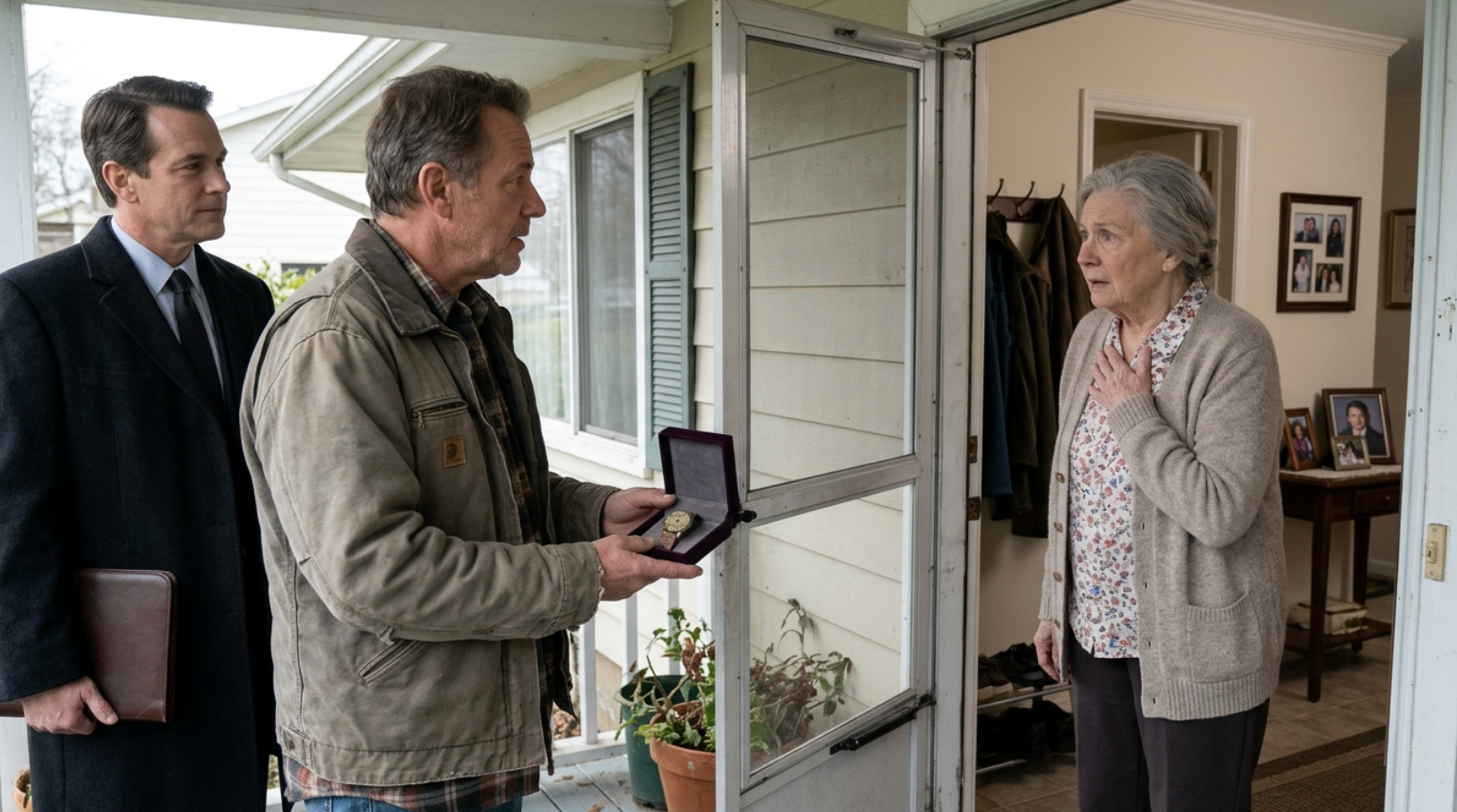
Ed left after thanking us again.
Before he stepped off the porch, I shook his hand.
“You did something good today.”
He looked back toward the kitchen window.
“I hope so. I just kept thinking about my own father. He died with a lot of things left unsaid. If I’d found a message he’d hidden for my mother, I’d want somebody to bring it home.”
I watched him walk to his truck.
Then I went back inside.
Mom was still sitting at the table.
She had placed Dad’s watch beside his reading glasses.
For a long moment, neither of us spoke.
Finally, she asked, “Jenny, do you think your father was afraid?”
I looked at the note.
The date.
The name Daniel.
The locker.
“I don’t know, Mom.”
She rubbed the edge of the table with her thumb.
“He used to wake up sometimes in the middle of the night. I’d ask what was wrong, and he’d say he’d been dreaming about the mill.”
My stomach tightened.
“You never told me that.”
“He didn’t want me worrying. He said it was nothing.”
She stared toward the window.
“One night, maybe thirty years ago, I asked him if he regretted staying there so long. He looked at me for a long time and said, ‘Margaret, sometimes doing the right thing costs more than a man can afford.’”
I felt a chill travel down my arms.
“What did he mean?”
“I thought he meant the long hours. The missed birthdays. The times he couldn’t take a day off because somebody had to work.”
Mom’s eyes filled with tears.
“Now I don’t know what he meant.”
I sat beside her until the afternoon light faded.
We didn’t talk about Scott.
We didn’t talk about the forty dollars.
We talked about Dad.


One Comment on “PART4: My Brother Sold Dad’s 51-Year-Old Watch for $40—Then a Shop Owner Found a Secret Inside That Changed Our Family Forever”
Comments are closed.