PART6
I quickly set my phone aside.
“What’s wrong, buddy?”
He looked at the blue box, then at the photograph in my hand.
“I remember that man.”
My heart began pounding again.
I knelt in front of him.
“You remember the man in the photograph?”
Ethan nodded slowly.
“He came to our house.”
I tried to keep my voice calm.
“Are you sure?”
“He was wearing that same coat.”
Ethan paused, then looked directly into my eyes.
“And Daddy?”
“Yes?”
“Mommy wasn’t crying because he made her sad.”
He tightened his fingers around the flower.
“She was crying because she said he was going to take something away from us.”
I stared at my son, unable to speak.
Then he whispered the words that changed everything.
“Daddy, I heard Mommy tell him that if anything happened to her, you would find out what he did.”
And suddenly, the little blue box no longer looked like a collection of hidden documents.
It looked like the beginning of a truth Laura had been desperately trying to protect us from.
For several seconds, I couldn’t speak.
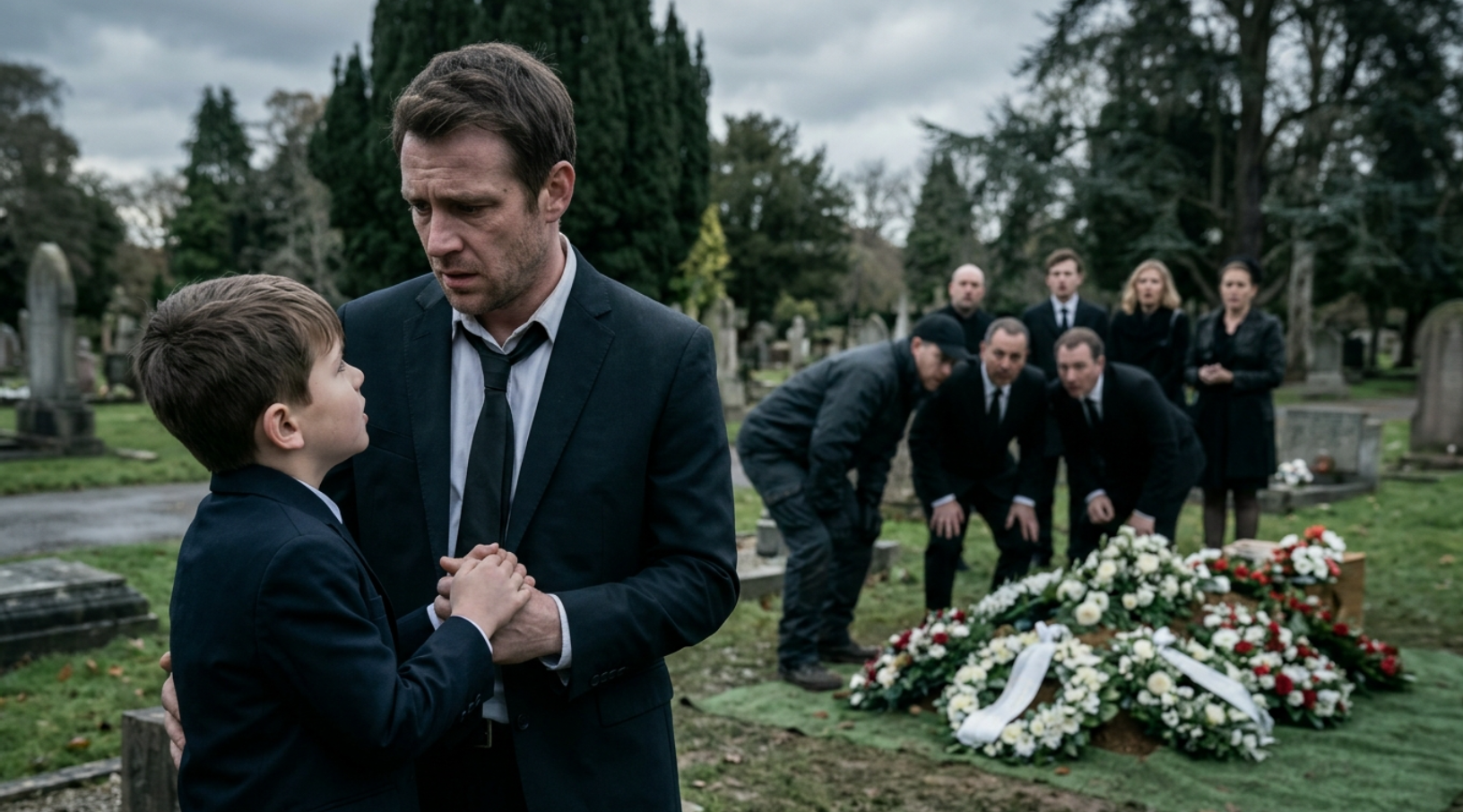
My seven-year-old son stood in our bedroom holding a wilted white flower from his mother’s funeral, telling me that a stranger had threatened to take something away from our family.
And my wife had apparently been afraid enough to hide evidence in a locked box.
I pulled Ethan close.
“You’re safe, buddy. Whatever happened, I’m going to make sure we get help.”
He buried his face against my chest.
“Will Mommy come home now?”
That question nearly broke me.
I wanted to tell him yes. I wanted to promise him that everything would return to the way it had been before three terrible days changed our lives.
But I couldn’t promise something I didn’t know.
So I held him and whispered, “We’re going to find out the truth about Mommy.”
After tucking him back into bed, I returned to the blue box and called Investigator Rebecca Miller.
She answered on the second ring.
“Mr. Walker?”
“Someone just sent me a message telling me to stop investigating my wife’s death. They knew I’d found a box Laura hid in our bedroom.”
Her tone changed immediately.
“Have you responded to the message?”
“No.”
“Good. Please preserve it. Don’t delete anything, and don’t contact the person who sent it. I’m going to arrange for the appropriate officers to speak with you. Given what you’ve described, we need to document the threat and review the material carefully.”
I photographed the message, saved the number, and followed her instructions.
Then I told her about the photograph and the medical documents.
When I mentioned Ethan’s recollection of the man visiting our home, she asked that we arrange an appropriate interview with him rather than question him further ourselves.
Before ending the call, she gave me one final instruction.
“Michael, I know you want answers. But until we understand what is happening, keep your son somewhere safe, and don’t try to investigate this person on your own.”
“I understand.”
After the call, I locked the doors and checked the windows.
Then I sat beside Laura’s empty pillow, staring at the photograph.
I had known my wife for eleven years.
We had met at a friend’s barbecue, married two years later, and spent the following years building a life together. We weren’t wealthy, but we had a comfortable home, a healthy little boy, and plans for the future.
Laura worked as a medical records coordinator at Maplewood Community Hospital. She was organized, compassionate, and meticulous about details.
She was also the person who reminded me to check the locks before bed.
The irony was painful.
The woman who had always made our home feel safe had apparently been frightened inside it.
And I hadn’t noticed.
I spent the rest of the night replaying every conversation we’d had during her final week.
Her unusual tiredness.
The dizziness she’d mentioned.
The phone calls she’d stepped outside to take.
The way she’d looked at me one evening and asked, almost casually, whether I would be able to raise Ethan alone if something ever happened to her.
I’d laughed nervously and told her not to talk like that.
She hadn’t laughed with me.
Instead, she’d hugged me for a long time.
At the time, I’d thought she was simply having an emotional evening.
Now, I wondered whether she’d been trying to tell me something.
I didn’t sleep.
And just before sunrise, my phone rang again.
It was Rebecca.
“Michael, we’ve reviewed the initial information you’ve provided. There’s something we need to discuss in person.”
My heart pounded.
“Have you identified the man?”
“Not conclusively. But we’ve found a connection that makes the medical documents particularly important.”
“What connection?”
“Laura’s employment.”
I sat upright.
“What about it?”
“Some of the records she kept may relate to an internal matter at the hospital. I don’t want to speculate over the phone, but we need to establish what she discovered and whether it has any bearing on her death.”
I looked toward the blue box.
“What should I do?”
“Keep everything as it is. We’ll arrange to collect the materials properly.”
After the call, I stood at the bedroom window, watching the first gray light spread across the neighborhood.
For the first time, I began to understand that Laura might have been carrying a burden I knew nothing about.
And I wondered how much she had endured alone because she believed she was protecting us.
By nine that morning, two officers and Investigator Miller had arrived at our home.
They documented the threatening messages and carefully examined the contents of the blue box. Laura’s original notes, the medical paperwork, the photograph, and the flash drive were collected according to the appropriate procedures.
I answered their questions as accurately as I could.
When Rebecca showed me the photograph again, I noticed something I had missed the previous night.
The building behind Laura wasn’t a hospital.
It was the entrance to a medical research center on the outskirts of town.
“I’ve never been there,” I said.
“Did Laura ever mention it?”
“Not that I remember.”
Rebecca wrote something in her notebook.
“We’ll look into it.”
Before she left, she told me that medical authorities were conducting a more thorough review of Laura’s original assessment.
No final conclusion had been reached.
The unusual findings from the previous afternoon were still being evaluated, and the authorities needed to establish whether any errors had occurred and, if so, how.
I appreciated her honesty.
I had learned that desperate hope could be as painful as despair when it rested on assumptions.
I needed facts.
I needed the truth.
And I needed to protect Ethan while we waited.
That afternoon, Laura’s brother Daniel came over to help.
He brought groceries, made Ethan lunch, and sat with him while I spoke with the officers.
When I finally showed Daniel the photograph, he went very still.
“Michael,” he whispered, “I think I’ve seen this man before.”
I stared at him.
“Where?”
Daniel rubbed his forehead.
“I’m not certain. Laura once introduced me to someone from work at a charity dinner. It might have been him, but I can’t swear to it.”
“Do you remember his name?”


One Comment on “PART6: One Hour After My Wife’s Funeral, My 7-Year-Old Son Whispered, “Daddy, Mommy Called Me…” What We Discovered Changed Everything”
Comments are closed.