PART8
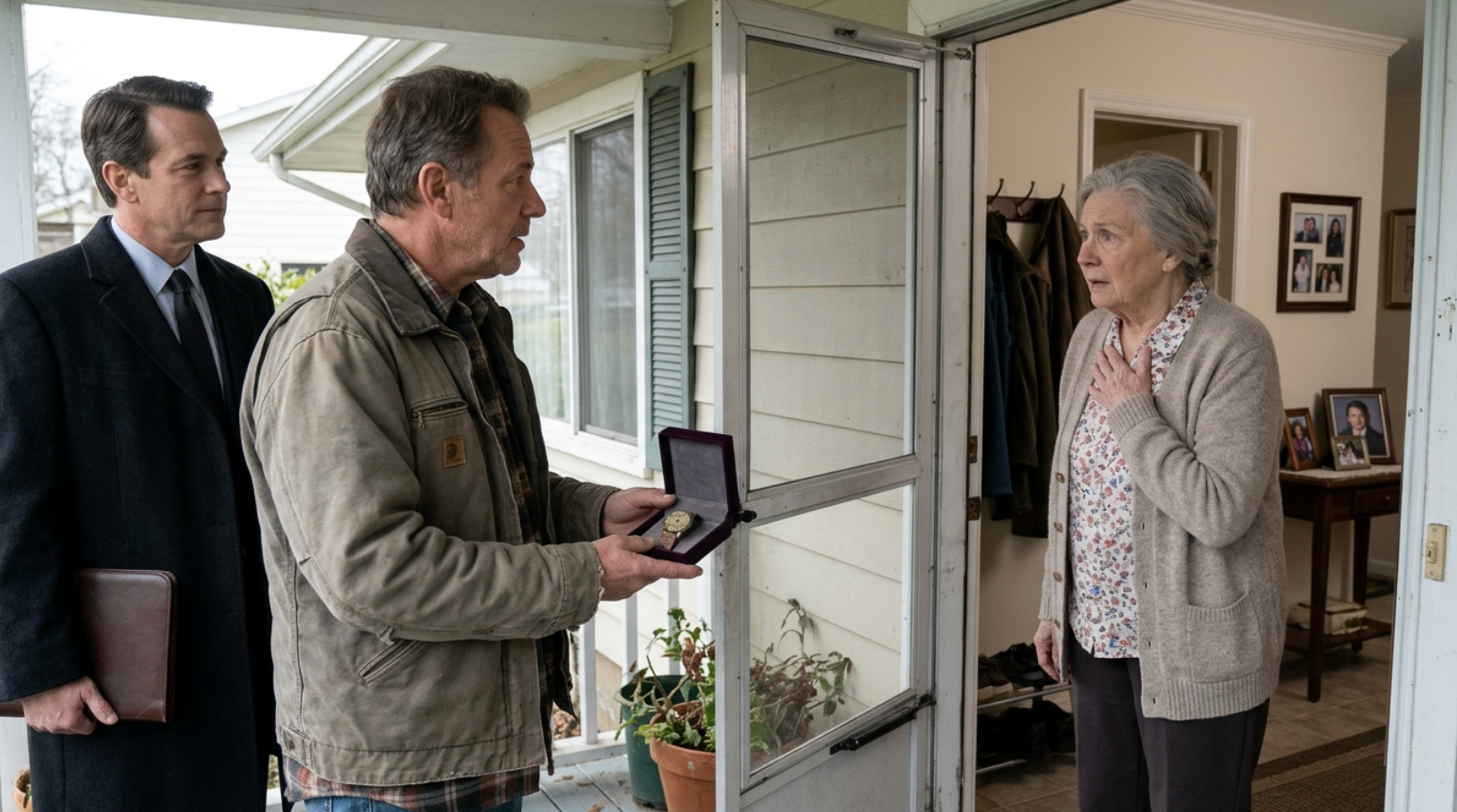
“Because Daniel came to our house the night before he disappeared.”
I nearly dropped the phone.
“What?”
Mom stood and walked to the window.
“I had forgotten about that evening until I saw his photograph. Harold came home late. Daniel was with him. They went into the garage and talked for nearly an hour.”
“What did they talk about?”
“I don’t know. Your father asked me to keep the children inside and not disturb them.”
She paused.
“Before Daniel left, he came into the kitchen. He thanked me for making him coffee, and he said something strange.”
“What?”
Mom looked back at me.
“He said, ‘If anything happens to me, tell Harold he did the right thing.’”
A chill ran through me.
“Did you ask him what he meant?”
“I did. He smiled and told me not to worry. Then he left.”
Mom pressed her fingertips against the window.
“The next morning, Harold went to work as usual. He came home that evening and sat in the garage for hours. When I asked what was wrong, he said Daniel had disappeared.”
I swallowed.
“And you never talked about it again?”
“Not for years. Eventually, I stopped asking because I thought Harold needed to grieve in his own way.”
She turned toward me.
“Jenny, your father never stopped carrying something that happened that night.”
For the first time, I began to understand the cost of his silence.
He hadn’t simply hidden a financial secret.
He had lived for decades with the knowledge that a friend had disappeared, leaving behind a wife and child, and that whatever happened at the mill might have played a role.
I couldn’t imagine waking up every morning with that burden.
But one question remained.
If Dad had known something important about Daniel’s disappearance, why hadn’t he gone to the police?
Mr. Cole was searching for that answer.
And while he did, I decided to confront the one person who seemed determined to stop us from finding it.
My brother.
Scott refused to answer my calls for two days.
On the third day, I drove to his apartment.
He lived in a small building above a laundromat, where the hallway smelled of detergent and stale cigarette smoke. His car was parked outside, although he had told Mom he was working late.
I knocked twice.
No answer.
I knocked again.
“Scott, I know you’re in there.”
I heard footsteps.
The door opened a few inches.
His face appeared in the gap.
“What do you want?”
“To talk.”
“I’m busy.”
“You’ve been busy avoiding me since I mentioned Daniel Whitaker.”
His expression changed.
“Keep your voice down.”
He opened the door and let me inside.
The apartment was cluttered with empty food containers, unpaid bills, and clothes scattered across a chair. A television played quietly in the corner.
Scott looked exhausted.
For a moment, I felt sorry for him.
Then I remembered Mom crying over the missing watch.
“Tell me what you know,” I said.
He rubbed his face.
“I told you. Dad mentioned Daniel years ago.”
“That’s not all.”
“Jenny—”
“Dad left a ledger in Locker 214. It contains records of money transferred through the mill. Daniel disappeared the day after the date written in Dad’s note. And there’s a photograph of Robert Vale’s wife with Dad and Daniel.”
Scott went completely still.
I watched him carefully.
“You know something.”
He turned away.
“I didn’t know about the ledger.”
“But you know something about the people involved.”
He remained silent.
I stepped closer.
“Scott, Dad is gone. You can’t ask him questions anymore. Mom has spent her entire life believing he was simply a hardworking man who loved his family. Now we’re finding out that he carried something painful for forty-five years. Whatever you know, we need to understand it.”
Scott sat on the edge of the couch.
For several seconds, he stared at the floor.
Then he spoke.
“When I was twenty-one, Dad took me to lunch.”
I blinked.
“What does that have to do with anything?”
“Just listen.”
He rubbed his hands together.
“It was shortly before I got into my first serious debt. I had borrowed money from some people I shouldn’t have borrowed from. Dad found out, and he was furious. But instead of yelling, he took me to that little diner near the highway.”
I remembered the place. Dad used to take us there for pancakes.
Scott continued.
“He told me that he’d made a mistake when he was younger. He said one mistake had nearly destroyed somebody else’s life, and he’d spent decades trying to make sure the damage didn’t spread.”
I felt my stomach tighten.
“What mistake?”
“He wouldn’t tell me. I asked him if it had something to do with the mill, and he told me never to ask about Daniel Whitaker.”
“Those were his exact words?”
Scott nodded.
“He said, ‘Some names belong to a time when good people were forced to make terrible choices.’ Then he told me that if anyone ever came asking about Daniel, I should tell them I knew nothing.”
I stared at my brother.
“And you never asked him why?”
“I was young. I thought he was talking about some stupid workplace dispute.”
Scott stood and walked toward the window.
“Then, about six months before Dad died, I visited him one afternoon. He was sitting at the kitchen table with an old envelope. He looked frightened, Jen. I’d never seen him like that.”
“What was in the envelope?”
“I don’t know. He put it away when he saw me.”
“Did he mention Daniel?”
Scott nodded.
“He asked me if I remembered what he’d told me about the diner. I said yes. Then he told me that some things had a way of coming back when a man was too old to run from them.”
I felt tears sting my eyes.
Dad had known his time was running out.
He had tried to prepare someone in the family for what might come after him.
But Scott had been so wrapped up in his own problems that he hadn’t understood.
“What happened to the envelope?” I asked.
“I don’t know.”
“Did Dad say anything else?”
Scott hesitated.
Then he said, “He told me that if I ever found the watch, I should bring it to Mom.”
The words hit me harder than I expected.
I stared at him.
“What?”
Scott’s eyes filled with tears.
“He said that if anything happened to him, the watch belonged to her. He told me never to let it leave the family.”
For a moment, I couldn’t speak.
“You knew that,” I whispered.
Scott nodded.
“And you sold it anyway.”
He covered his face.
“I know.”
“You knew Dad had specifically told you to protect it, and you sold it for forty dollars.”
“I was desperate.”
“You were drunk.”
He lowered his hands.
“Yes.”
The admission hung between us.
For the first time since the funeral, Scott didn’t offer an excuse.
He didn’t blame his circumstances.
He didn’t say the watch was worthless.
He simply stood there, looking like a man who had finally seen the ugliness of his own choices.
“I’m sorry,” he whispered.
I wanted to believe him.
But apologies were easy for Scott.
Changing was harder.
“Why didn’t you tell me about the diner when I called you?”
He swallowed.
“Because I was scared.”
“Of what?”
He looked at me.
“Because Dad told me that if the truth ever came out, someone might come looking for the ledger.”
I stared at him.
“Who?”
“I don’t know.”
“Scott, this is serious.”
“I know!”
His voice broke.
“I know, Jen. I know what I did. I know I hurt Mom. But when you told me about the ledger, all I could think about was Dad sitting at that table, telling me that some people would do anything to keep certain things buried.”
I took a slow breath.
“Then you should help us find out why.”
Scott shook his head.
“What if the truth destroys everything?”
I looked at him.


One Comment on “PART8: My Brother Sold Dad’s 51-Year-Old Watch for $40—Then a Shop Owner Found a Secret Inside That Changed Our Family Forever”
Comments are closed.