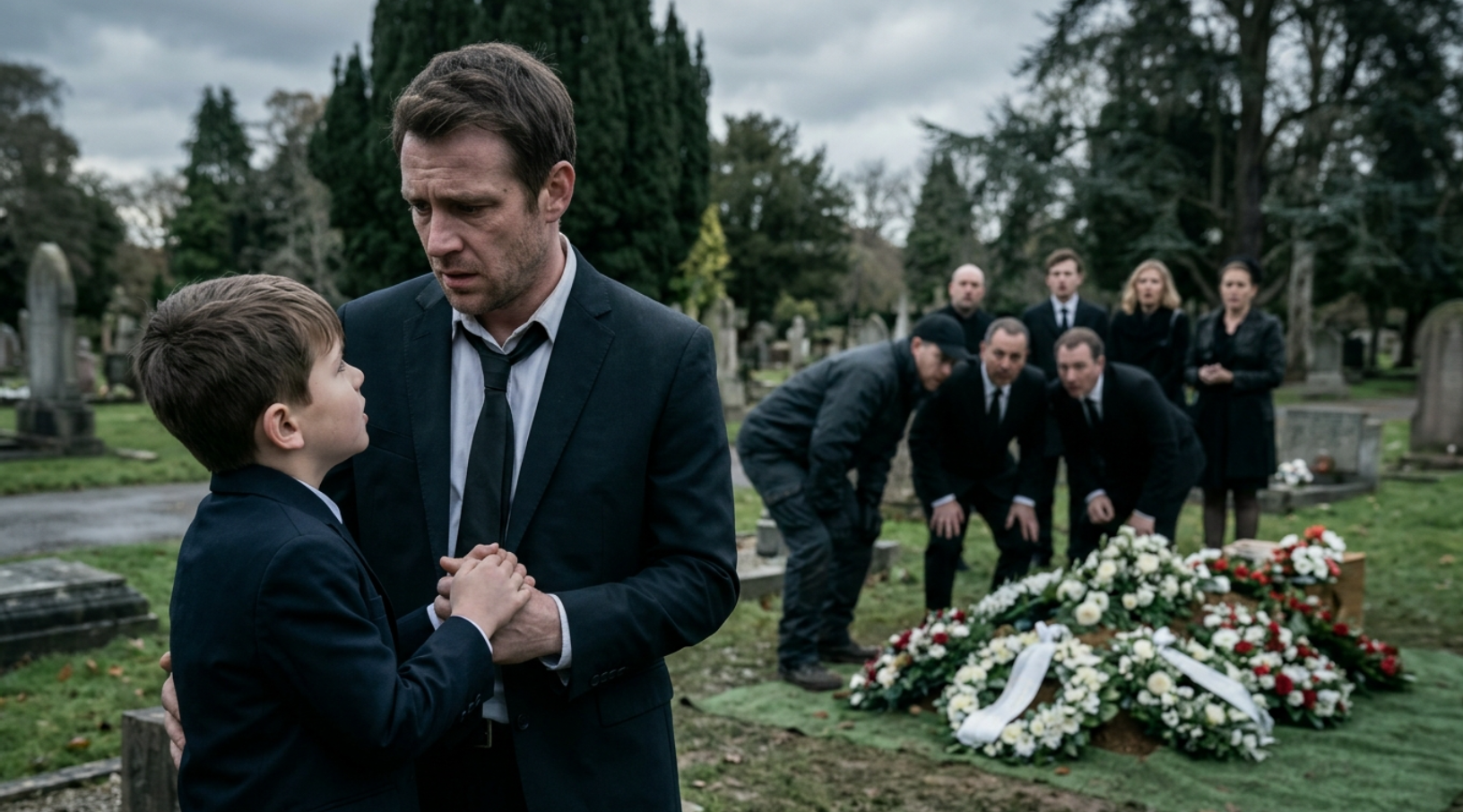
PART8
A week later, the medical review produced a clearer picture of what had happened.
The original assessment had contained significant deficiencies. Certain observations and supporting documentation had not been adequately reconciled before the conclusion was recorded.
The authorities had determined that the circumstances warranted a formal investigation into the decisions made during Laura’s final hours.
The most important discovery, however, came from the hospital’s internal records.
Laura had not merely stumbled upon one questionable file.
She had documented a pattern of discrepancies and raised concerns about whether medical procedures and recordkeeping standards were being followed properly.
Her notes showed that she had attempted to report the matter through internal channels before making copies of the documents.
The authorities were now investigating whether anyone had deliberately interfered with the records.
Dr. Cole had been suspended from his duties while the inquiry continued.
He denied wrongdoing.
I felt no satisfaction at hearing that a man had lost his position. I wanted something much more important: a clear, reliable account of what had happened to my wife.
And I wanted the people responsible, if any were established, to be held accountable.
Then, on a rainy Thursday afternoon, Rebecca called with an update that made my hands tremble.
“Michael, the independent medical review has concluded that Laura’s original assessment was not sufficiently supported by the available documentation. We have identified serious procedural failures, and additional expert analysis has been requested.”
I gripped the edge of the table.
“What does that mean?”
“It means the original conclusion cannot be treated as fully established without further examination. The medical authorities are reviewing the case, and the investigation remains active.”
I closed my eyes.
For days, I had imagined what I might feel when someone finally acknowledged that something had gone wrong.
I thought I would feel relief.
Instead, I felt grief all over again.
Because even if the original assessment had been flawed, it did not automatically mean Laura could have been saved.
It did not establish that she had been alive when the first assessment was made.
And it did not prove that anyone had intentionally caused her death.
Those were separate questions, and they needed separate answers.
“Will we know for certain?” I asked.
“We are pursuing the evidence needed to establish the timeline and the cause. I won’t promise an outcome before the experts have completed their work.”
After the call, I sat at the kitchen table and cried.
Not because I had finally found an answer.
But because I was beginning to understand how many answers were still missing.
Two weeks later, I received another call.
This time, the news was different.
The independent experts had completed additional examinations, and the medical authorities had established that Laura had died before the burial.
There had been no miraculous recovery, no hidden second chance waiting beneath the ground.
My wife was gone.
The specialists had identified evidence consistent with a serious medical event, but the investigation into the precise circumstances and the deficiencies in the original assessment remained ongoing.
I listened without interrupting.
When the call ended, I remained seated for a long time.
I had secretly held on to the possibility that Ethan’s words meant Laura was still somewhere in the world, waiting for us to find her.
Now I had to let that hope go.
It was a terrible kind of relief.
The uncertainty had been consuming us, and at last we had a clearer answer about the one question that mattered most.
But the answer did not bring Laura back.
When Ethan came home from school that afternoon, I sat with him on the couch.
“Buddy, the doctors have finished another examination.”
He looked up at me.
“Did they find Mommy?”
I took both his hands.
“They found out more about what happened. Mommy really has died, sweetheart. She isn’t coming home.”
His face crumpled.
“But I heard her.”
“I know you did.”
“Was I wrong?”
I pulled him into my arms.
“No. You told us what you experienced, and you were brave enough to tell me even when you were scared. You did the right thing.”
He began to cry.
“I wanted to save her.”
I held him tighter.
“You were seven years old. Saving Mommy was never your responsibility. None of this was your fault.”
He cried against my shoulder until his breathing slowly settled.
Then he asked the question I had been dreading.
“Are we still going to find out what happened to her?”
I kissed the top of his head.
“Yes, buddy. We are.”
And we did.
Over the following months, the investigation uncovered additional evidence concerning the handling of medical records and the failure to follow appropriate procedures.
Investigators established that Dr. Cole had pressured Laura to stop raising questions about the discrepancies she had discovered.
They also uncovered evidence that he had attempted to discourage her from sharing certain documents with outside reviewers.
However, the authorities did not find sufficient evidence to establish that he had deliberately caused Laura’s death.
That distinction mattered.
There were allegations, mistakes, and deeply troubling decisions, but each had to be assessed according to the available evidence.
The inquiry eventually concluded that the original assessment had involved serious procedural failures and that those failures had not been properly addressed at the time.
The hospital issued a formal acknowledgment of the deficiencies and agreed to implement additional safeguards for medical assessments, recordkeeping, and independent review.
Dr. Cole faced separate professional proceedings concerning his conduct and handling of the records.
The outcome was not the dramatic confession I had once imagined.
There was no courtroom moment in which a man admitted to murdering my wife.
There was no single revelation that made every terrible thing suddenly understandable.
Instead, the truth emerged through documents, interviews, expert reports, and the careful work of people who refused to treat unanswered questions as acceptable answers.
It was slower than I wanted.
It was less satisfying than revenge.
But it was real.
And eventually, I learned something else about Laura.
She had not hidden the blue box because she expected me to become a hero.
She had hidden it because she wanted the truth to survive even if she couldn’t explain everything herself.
That realization changed the way I remembered her final days.
For a while, I had blamed myself for not noticing her fear.
I wondered whether I should have asked more questions, followed her to the appointment she had planned, or insisted she tell me what was wrong.
But grief has a cruel way of making ordinary moments look like missed opportunities.
I had loved Laura.
I had trusted her.
I had lived beside her without knowing the full weight of what she carried.
That did not mean I had failed her.
It meant I had been human.
And I had to learn to forgive myself.
Six months after Laura’s funeral, I took Ethan back to the cemetery.
The weather was clear that afternoon. The grass had begun to turn green, and a gentle breeze moved through the trees.
We carried a small bouquet of white flowers.
Ethan walked beside me, holding my hand.
When we reached Laura’s grave, he placed the flowers carefully near her name.
For a long time, he said nothing.
Then he knelt.
“Hi, Mommy,” he whispered. “Daddy and I are okay.”
My throat tightened.


One Comment on “PART8: One Hour After My Wife’s Funeral, My 7-Year-Old Son Whispered, “Daddy, Mommy Called Me…” What We Discovered Changed Everything”
Comments are closed.