My Family Mocked Me for Being Poor at the Auction—Then I Bought the $12.5 Million Estate They Thought Was Theirs
PART 3
I looked at him. “That’s an interesting assumption.”
He laughed, but there was something nervous about it now.
The auctioneer continued. “Eleven million seven hundred thousand. Do I hear eleven million eight?”
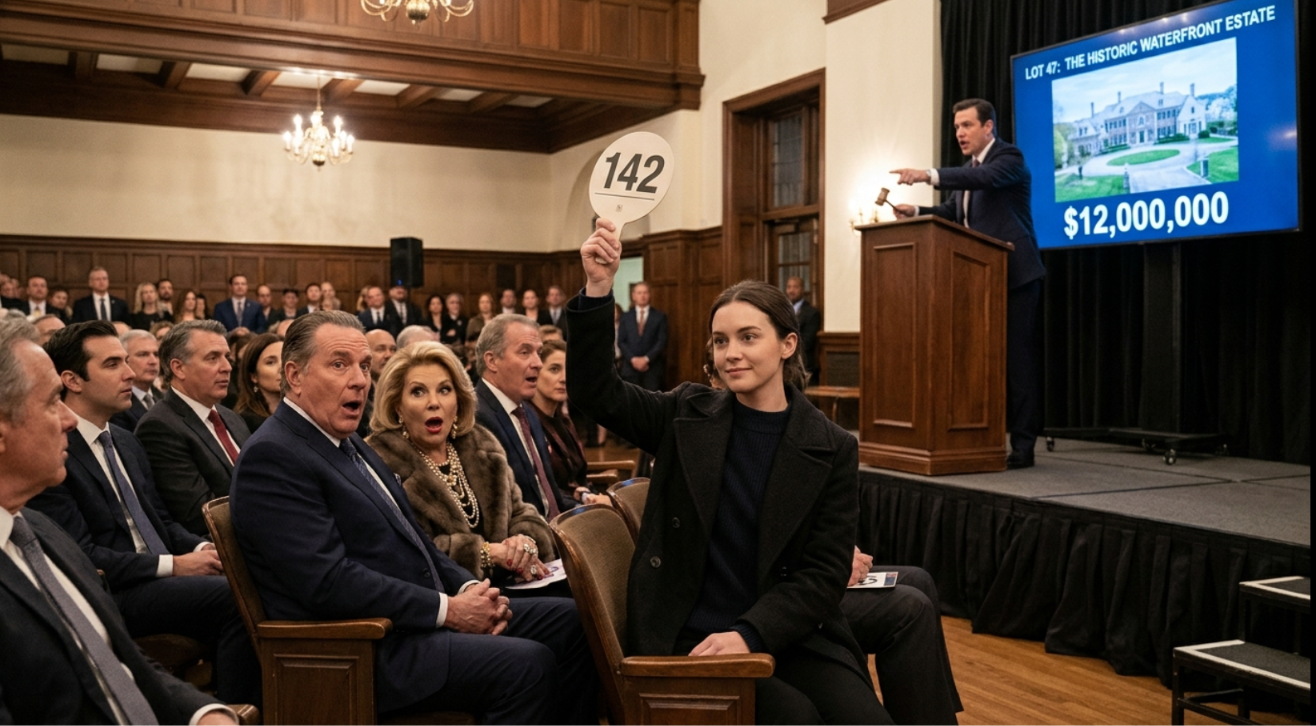
I raised my paddle. “Eleven million eight hundred thousand.”
The room became noticeably quieter. Vanessa’s face turned red.
“Eleven million nine hundred thousand!” Gerald leaned toward her.
“Don’t let her intimidate you. We have the financing.” I watched them whisper.
They believed I was bluffing.
They believed I would eventually become frightened by the numbers and withdraw.
They had no idea that I had spent the previous three years preparing for this exact opportunity.
The auctioneer raised his voice.
“Twelve million dollars.”
Vanessa lifted her paddle immediately.
“Twelve million one hundred thousand!”
I could hear Patricia breathing heavily beside her.
“That’s it, sweetheart,” she whispered. “Don’t let her take it.”
I looked down at my phone.
One message from Lawrence appeared.
The funds are ready. You have full authorization.
I typed one word.
Proceed.
Then I raised my paddle.
“Twelve million five hundred thousand.”
For the first time that afternoon, Vanessa didn’t immediately respond.
Her husband looked at Gerald.
Gerald looked at Patricia.
Patricia looked at her daughter.
The number had reached their maximum approved financing.
I knew because Lawrence had obtained the public financing details before the auction. Their loan approval was conditional, and the bank had already warned them that exceeding the approved amount would require additional documentation.
Vanessa turned toward her father.
“Dad?”
Gerald shook his head slightly.
“Stay calm.”
The auctioneer looked across the room.
“Twelve million five hundred thousand. Do I hear twelve million six?”
Vanessa raised her paddle halfway.
Then lowered it.
Gerald stood.
“Excuse me. We need a moment.”
The auctioneer frowned.
“Sir, we’re conducting an active auction.”
Gerald looked toward the auction manager.
“My daughter has an approved offer. There must be some mistake with the other bidder.”
The manager approached him.
“Sir, all registered bidders have been financially verified. If you have a concern, we can discuss it after the lot closes.”
Gerald’s face tightened.
He turned toward me.
“Stella, I don’t know what you’re trying to prove, but you’re embarrassing this family.”
I almost laughed.
Embarrassing the family?
For seven years, they had made jokes about my apartment, my clothes, my salary, and my life.
They had turned my parents’ death into another reason to look down on me.
And now, because I was finally standing on equal financial ground, I was embarrassing them?
I looked directly at Gerald.
“I didn’t come here to prove anything to this family.”
I paused.
“I came here to buy a property.”
The auctioneer lifted his hand.
“Twelve million five hundred thousand. Going once.”
Vanessa’s hands were shaking.
“Dad, do something!”
Gerald looked helplessly toward the auction manager.
“Going twice.”
Nobody moved.
“Sold! To paddle number 47 for twelve million five hundred thousand dollars!”
The hammer struck the wooden block.
For a moment, the room was completely silent.
Then people began whispering.
I lowered my paddle.
Vanessa stood frozen.
Derek stared at me as if he had just watched someone perform an impossible magic trick.
Patricia’s mouth was slightly open.
Gerald slowly sat down.
I gathered my purse and phone.
Then I walked toward the registration desk.
Behind me, I heard Vanessa shouting.
“Stella! Wait!”
I didn’t turn around.
Not until she said something that made me stop.
“Where did you get that kind of money?”
I turned.
For the first time in many years, I looked at my cousin without feeling smaller than her.
“Vanessa, you have spent seven years telling everyone how poor I am.”
I adjusted my purse.
“Perhaps you should have spent some of that time finding out what I was actually doing.”
Then I continued walking.
At the registration desk, the auction manager greeted me professionally.
“Congratulations, Ms. Whitmore. We’ll need to complete the purchase documentation and arrange the transfer.”
I nodded.
“My attorney will handle the paperwork.”
He smiled.
“Excellent. May I have his details?”
I handed him Lawrence’s business card.
He glanced at it.
Then his expression changed slightly.
“Lawrence Brennan?”
“Yes.”
He looked at the card again.
“Mr. Brennan is representing you?”
“He is.”
The manager nodded slowly.
“Of course. We’ll coordinate directly with his office.”
I didn’t think much about it.
But when I turned around, I noticed Gerald watching the exchange.
He looked unsettled.
And I knew something else was happening in that room.
Something my relatives hadn’t expected.
Twenty minutes later, I was standing outside the auction house when Lawrence called.
“Stella, congratulations.”
“Thank you.”
“The auction house has confirmed the sale. The funds are being processed, and our legal team has received the documentation.”
“Good.”
There was a brief silence.
Then Lawrence asked something unexpected.
“Did your relatives attend?”
I looked through the glass entrance.
Vanessa was still inside, arguing with her parents.
“Yes. They were there.”
“Did they approach you?”
“They made their usual comments.”
Lawrence sighed.
“I’m sorry.”
I leaned against the stone railing.
“It’s fine. I’ve grown accustomed to it.”
“No, Stella. You shouldn’t have had to.”
His voice softened.
“There’s something else we need to discuss. I received a document from the historical property archive this morning. It concerns Whitmore Estate.”
“What kind of document?”
“A copy of an old family trust agreement. It appears your parents may have been investigating the property’s ownership history before their accident.”
My stomach tightened.
“My parents?”
“Yes. I don’t want to jump to conclusions, but there is a reference to your mother’s name and an old ownership interest.”
I stared at the estate building in the distance.
“What exactly are you saying?”
“I’m saying the property may have a much deeper connection to your family than the auction catalogue suggests.”
I didn’t speak.
Lawrence continued.
“Come to my office tomorrow morning. Bring any documents your parents left behind, especially anything related to Whitmore Estate.”
“I’ll be there.”
After we ended the call, I remained outside for several minutes.
I had expected to spend the next few months restoring the estate.
I had not expected to discover that my parents might have left something behind that connected us to it.
Then my phone vibrated.
A message from Vanessa.
You need to call me immediately. Dad says there’s something wrong with the property. You have no idea what you’ve just bought.
I read it twice.
Then another message arrived.
Stella, I’m serious. There are things about Whitmore Estate that you don’t know.
For the first time that afternoon, I felt genuinely uneasy.
Because Vanessa wasn’t laughing anymore.
And I was beginning to suspect that the twelve-million-dollar estate was hiding a secret worth far more than its auction price.
I didn’t reply to Vanessa’s messages.
Instead, I drove home, changed out of my navy-blue dress, and sat at my kitchen table with a cup of coffee.
For the first time since the auction, I allowed myself to think about what had happened.
I had just spent $12.5 million.
It was an extraordinary amount of money, even for someone who had spent years building a successful investment portfolio.
But I hadn’t made the decision impulsively.
Whitmore Estate had been my goal for almost two years.
I had studied its history, reviewed its maintenance records, examined the surrounding land values, and researched the property’s potential.
The estate was worth considerably more than the auction price to the right buyer.
But Lawrence’s phone call had introduced something I hadn’t anticipated.
My parents.
I opened the small drawer where I kept the few belongings they had left me.
Their wedding photograph.
My father’s old watch.
My mother’s handwritten recipes.
And a brown envelope containing documents from their final months.
I had never paid much attention to the envelope. Most of the papers concerned insurance, bills, and ordinary family matters.
But now I opened it.
At the bottom was a folded letter addressed to my mother.
The handwriting was unfamiliar.
It began:
Dear Eleanor,
The Whitmore matter cannot remain unresolved forever. Your father’s intentions were clear, and the original documents should never have been removed from the estate records.
I stopped reading.
My mother’s name was Eleanor.
The letter was dated eleven months before my parents died.
I continued.
If your daughter is ever ready to understand her inheritance, she must be allowed to see the original trust agreement.
I read that sentence three times.
My daughter.
I was the only daughter my parents had.
I immediately called Lawrence.
He answered on the second ring.
“Stella?”
“I found something.”
I read the letter to him.
He became quiet.
“Can you send me a photograph?”
I sent it.
Several minutes passed.
Then he called again.
“Stella, I think we need to investigate this immediately.”
“What does it mean?”
“I can’t tell you yet. But the letter suggests that your mother may have been a beneficiary of an old family trust connected to Whitmore Estate.”
“Why didn’t my parents tell me?”
“Perhaps they intended to. We need to find the original agreement before drawing conclusions.”
I looked at the photograph of my parents on the table.
For seven years, I had believed they had left me nothing but memories and unpaid expenses.
Now I wondered whether they had been protecting something I didn’t understand.
The following morning, I arrived at Lawrence’s office at nine.
He had already prepared several documents.
Beside him sat a woman in her late fifties wearing glasses and a charcoal suit.
“Stella, this is Margaret Ellis,” Lawrence said. “She’s a property and trust specialist. She has been helping us research the Whitmore records.”
Margaret stood and shook my hand.
“It’s a pleasure to meet you. Your parents were mentioned in several historical documents I reviewed.”
She opened a folder.
“Your great-great-grandfather, Thomas Whitmore, established the estate in 1887. But the family history is more complicated than the auction catalogue suggests.”
She showed me an old family tree.
Thomas had three children.
One of them was a daughter named Rose.
Rose was my great-grandmother.
Margaret continued.
“According to the original trust structure, the estate was intended to remain connected to Rose’s descendants. Over time, however, several amendments were made.”
“What kind of amendments?”
“Some were legitimate. Others are questionable.”
She placed another document on the table.
“Your great-grandmother’s branch was supposed to receive a financial distribution from the estate whenever it was sold.”
I looked at the paper.
“How much?”
Margaret pointed to a paragraph.
“Under the original agreement, the distribution was calculated as a percentage of the net sale proceeds. The amount was adjusted in a later amendment.”
“And who was entitled to receive it?”
She looked directly at me.
“Your mother was the last documented beneficiary in that branch. If the trust remained valid, you may have inherited her rights.”
I felt my stomach tighten.
“Are you saying I might have another claim on the property I just purchased?”
“Potentially. We need the complete documents to establish that.”
Lawrence leaned forward.
“There’s another problem. The auction’s title search did not identify any outstanding beneficiary claim. If the original trust remains enforceable, the sellers may have failed to disclose a material interest.”
I sat back.
For the first time, I understood Vanessa’s message.
Something was wrong with the property.
And my relatives knew more than they had admitted.
That afternoon, I drove to Whitmore Estate.
The gates were enormous, painted black, with an iron crest in the center.
I had visited the property once as a child.
I remembered running through the garden with my mother while my father took photographs.
I remembered the lake, the old stone bridge, and the enormous oak tree beside the main entrance.
I also remembered my grandmother telling me that one day I would understand why the house mattered.
At the time, I thought she was simply telling me a family story.
Now I wasn’t so sure.
The property manager met me at the entrance.
“Welcome, Ms. Whitmore.”
He handed me a set of keys.
“The previous owner has left several personal items in the library. The auction company asked us to preserve everything until the new owner could inspect it.”
I walked through the entrance.
The house smelled of old wood and polished stone.
Sunlight entered through tall windows.
I stopped in the main hallway.
There was a portrait of Thomas Whitmore hanging above the staircase.
Below it stood a small wooden cabinet.
Inside were several old photographs.
I recognized my mother in one of them.
She was standing beside an elderly woman in front of the lake.
On the back, someone had written:
Eleanor and Rose, summer gathering, 1989.
I turned to the property manager.
“Who is Rose?”
He looked surprised.
“Mrs. Rose Whitmore? She was one of the last family members to live here.”
“My great-grandmother.”
He nodded.
“Yes. She used to spend most of her time in the east wing.”
I followed him through a corridor.
At the end was a small room with bookshelves covering two walls.
There was an old desk near the window.
The property manager pointed to a locked drawer.
“We found this during the inventory. The auction company instructed us not to remove anything.”
I examined the drawer.
A small brass key was hanging from a hook underneath the desk.
I tried it.
The drawer opened.
Inside was a leather folder.
On its cover were two words.
WHITMORE TRUST.
My hands began to shake.
I opened it carefully.
The first document was an original trust agreement.
The second was a list of beneficiaries.
The third was a letter addressed to Eleanor Whitmore.
My mother.
I sat down and began reading.