PART4
The letter was written by my great-grandmother Rose.
My dearest Eleanor,
I know the family has made you feel unwelcome. I know they have told you that your place in this family is smaller because you chose a different life.
But never forget that Thomas built this home for all his descendants, not simply the ones who became wealthy.
Your father wanted you to have a choice. He wanted you to be free from the pressure of those who believe money gives them authority over everyone else.
If this house is ever sold, remember that your branch of the family must be treated fairly.
At the bottom was a sentence that made me stop breathing.
And if I cannot protect you, I trust that your daughter will one day find the truth.
I closed my eyes.
My mother had known.
She had known that one day I might need to find these documents.
And somehow, she had left me a path.
The following morning, Lawrence reviewed everything.
His expression became increasingly serious.
“Stella, this is significant.”
“Is it valid?”
“The original agreement appears properly executed. However, we need to establish whether the later amendments legally terminated or modified your mother’s rights.”
“What happens if they didn’t?”
He looked at Margaret.
She answered.
“Then the sellers may have sold an asset without properly resolving the interests attached to it.”
I looked at the documents.
“Who made the later amendments?”
Margaret turned to the final page.
“Your great-uncle’s branch.”
I recognized the names.
Gerald’s father had been involved.
Margaret continued.
“Several decades ago, the family created a new holding company. The estate was transferred into that company. The transfer documents reference the original trust, but the financial obligations appear to have been handled inconsistently.”
“So my family knew?”
“We haven’t established who knew what. But there are signatures from people connected to your relatives.”
Lawrence closed the folder.
“I want an independent title examination and a full review of the sale records. Until then, don’t accuse anyone publicly.”
I nodded.
But before I could leave, Lawrence received a call.
He listened for a minute.
Then his expression changed.
“What?”
He listened again.
“Send me the document immediately.”
He ended the call.
I looked at him.
“What happened?”
“The auction sellers have contacted the title company.”
“Why?”
“They’re claiming that a historical trust interest may have been overlooked.”
I stared at him.
“Are they trying to cancel the sale?”
“Possibly.”
He paused.
“But there’s something else.”
“What?”
“Your cousin Vanessa and her father have requested an emergency meeting with the estate’s previous trustees.”
I slowly leaned back.
It was becoming clear that my purchase had disturbed something that had been hidden for years.
And I was no longer certain the auction was the beginning of the story.
It might have been the moment everything finally came to light.
Three days later, I received a message from Gerald.
Family meeting. Saturday. Whitmore Estate. Everyone needs to be present.
I almost deleted it.
Then another message arrived.
This concerns your parents. You owe the family an explanation.
I stared at those words.
I owed them an explanation?
For what?
For buying something legally offered at public auction?
For spending my own money?
For refusing to remain the poor cousin they had grown comfortable mocking?
I called Lawrence.
He advised me to attend, provided he could accompany me.
On Saturday morning, I arrived at Whitmore Estate with him.
The main dining room was full.
Gerald sat at the head of the table.
Patricia sat beside him.
Vanessa and Derek were across from them.
Timothy was there, along with several other relatives.
When I entered, the conversation stopped.
Gerald looked at Lawrence.
“Why did you bring an attorney?”
Lawrence smiled politely.
“Because this meeting concerns a property transaction and a possible trust dispute.”
Gerald’s jaw tightened.
“This is a family matter.”
“Then I’m sure having accurate legal representation will help everyone.”
I took the seat closest to the window.
Vanessa looked exhausted.
Her expensive makeup couldn’t hide the dark circles beneath her eyes.
Gerald began.
“Stella, let’s get one thing straight. Nobody expected you to buy this property.”
“I noticed.”
“This estate has always been a family asset. Your decision to purchase it has created unnecessary complications.”
I looked at him.
“Then perhaps the family should have purchased it.”
Vanessa made a frustrated sound.
“Don’t act clever. You know what we mean.”
Derek leaned forward.
“You bought it knowing our family wanted it.”
I looked at him.
“The auction was public. Anyone could have bid.”
Gerald raised his hand.
“Enough. The real issue is the trust.”
Lawrence opened his briefcase.
“Yes. That’s exactly what we need to discuss.”
He placed copies of the original documents on the table.
Gerald’s face changed.
Patricia leaned closer.
Vanessa picked up one page.
“Where did you get this?”
“From the estate’s library,” I answered.
Gerald reached for the document.
Lawrence gently placed his hand over it.
“Those are copies. The originals remain secured.”
Gerald looked at him.
“You have no right to investigate private family records.”
“Ms. Whitmore is the purchaser and a potential beneficiary. She has every right to investigate documents concerning her legal interests.”
Gerald looked furious.
Then Margaret Ellis entered the room.
She had brought a formal report.
“Good morning, everyone. I’ve completed the preliminary historical review.”
She placed a thick folder on the table.
“Based on the records currently available, Eleanor Whitmore appears to have held an enforceable beneficial interest in the original family trust.”
Patricia gasped.
Vanessa looked at her father.
Gerald didn’t move.
Margaret continued.
“The interest may have passed to Stella upon her mother’s death, subject to the terms of the trust and subsequent legal amendments.”
I felt my heart beating faster.
“So what does that mean for the sale?” I asked.
“It means there may be an additional financial obligation that the sellers must resolve.”
Gerald stood abruptly.
“This is ridiculous. Eleanor gave up her rights years ago.”
Lawrence looked at him.
“Do you have a signed renunciation document?”
Gerald didn’t answer.
“Do you have a court order terminating her interest?”
Silence.
“Do you have a properly executed amendment signed by all required parties?”
Gerald looked toward Patricia.
She lowered her eyes.
Vanessa slowly put the paper down.
I watched them.
Something was wrong.
Very wrong.
Finally, Timothy spoke.
“Dad, you told us everything had been settled.”
Gerald snapped.
“It was settled.”
“Then why are there no documents?”
Gerald looked at him.
“Stay out of this.”
Timothy shook his head.
“No. I’ve already put money into this purchase because you told me Vanessa would own the property. I want to know what’s happening.”
Vanessa turned toward him.
“Timothy, not now.”
But he continued.
“You asked me to invest $400,000 in renovations before the auction. You said everything was guaranteed.”
The room fell silent.
I looked at Vanessa.
“You were already spending money on renovations?”
She didn’t answer.
Derek rubbed his forehead.
“We had contractors ready.”
I slowly realized that their confidence hadn’t come from the property alone.
They had already made plans using money they expected to spend on a house they didn’t own.
Gerald finally spoke.
“The family will resolve this privately.”
Lawrence shook his head.
“Any resolution must be documented properly.”
Then Margaret turned another page.
“I haven’t finished.”
Everyone looked at her.
“There is one additional issue.”
She removed a photocopy from the folder.
It was a document dated fourteen years earlier.
A transfer authorization.
And at the bottom was Gerald’s signature.
I looked at him.
“What is that?”
Margaret answered.
“It appears that a portion of the trust’s funds was transferred to a private holding company.”
“How much?”
She paused.
“Approximately $2.3 million, based on the original accounting records.”
Patricia covered her mouth.
Gerald’s face turned pale.
“That money was used for legitimate family expenses.”
Lawrence looked at the document.
“Then the accounting should demonstrate that.”
Gerald said nothing.
I looked around the table.
For years, these people had treated me as if I were an embarrassment because I didn’t have money.
Now I was discovering that the family wealth they bragged about might have been built partly on assets that were never theirs to control.
And suddenly, nobody wanted to laugh.
Over the next six weeks, Lawrence and Margaret conducted a detailed investigation.
The findings were more complicated than any of us had imagined.
The original trust had been modified several times.
Some amendments were legitimate.
Others lacked the signatures required under the agreement.
The $2.3 million transfer had been made through a company controlled by Gerald’s father.
Part of the money had gone toward property maintenance.
Another portion had been used for business investments.
The records were incomplete.
But one thing was clear.
My mother’s beneficiary rights had never been properly terminated.
The legal review also revealed that the trust contained a provision requiring an independent distribution whenever the estate was sold.
Based on the historical documents and the applicable valuation method, my mother’s branch was entitled to a substantial distribution.
The final amount still needed to be determined by the court and the trustees.
I didn’t want to spend my life fighting my relatives.
I wanted the truth.
I also wanted to understand why my parents had never told me.
One evening, while going through my mother’s old belongings, I found another envelope.
This one had my name written across it.
The handwriting was unmistakable.
My mother’s.
I sat on the living room floor and opened it.
My darling Stella,
If you’re reading this, perhaps the Whitmore family history has finally become important again.
There are things I wanted to explain to you, but I never wanted you to grow up believing that your value came from an inheritance.
Your father and I chose a modest life because we wanted peace. We didn’t want to spend every holiday arguing about property, money, and who deserved more.
Some relatives believe that wealth makes them important. Your great-grandmother knew better.
She believed that a family home should be a place where people feel safe, not a weapon used to control them.
I wiped my eyes.
The letter continued.
I kept copies of the trust documents because I knew the family might one day attempt to change the story. I wanted you to have the truth, but I also wanted you to be free to choose your own life.
If you ever find yourself owning Whitmore Estate, don’t feel obligated to turn it into a monument to our family.
Make it something good.
Make it a place where people are welcomed.
And please remember this: you do not have to become wealthy to prove that you deserved to be loved.
I couldn’t continue for a moment.
I pressed the letter against my chest.
For seven years, I had missed my parents every single day.
But I had never felt as close to them as I did that evening.
They had left me something more valuable than money.
They had left me their values.
The legal proceedings continued for several months.
During that time, the estate remained under my ownership, subject to the outcome of the trust dispute.
The court eventually confirmed that my mother’s beneficiary interest had never been properly extinguished.
The trustees were ordered to complete an accounting and determine the amount owed to her estate.
The final settlement was significant.
It included the value of the distribution that should have been paid when the estate was transferred, adjustments for the later transactions, and associated legal costs.
Gerald’s family was forced to provide financial records they had avoided producing for years.
I didn’t celebrate their difficulties.
But I did feel relieved that the truth had finally been established.
The auction purchase remained valid.
The settlement was handled separately from the property transaction.
One afternoon, Lawrence called me.
“Stella, everything has been finalized.”
I was sitting in the library at Whitmore Estate.
“What was the final amount?”
He told me.
I listened quietly.
It was enough to secure my financial future many times over.
But I wasn’t thinking about the number.
I was thinking about the little girl who used to run through the garden with her mother.
The girl who had once believed that the estate was a magical place where everyone in the family belonged.
Lawrence continued.
“There’s another thing. Gerald has requested a meeting.”
I sighed.
“What does he want?”
“He says he wants to apologize.”
I looked through the window.
“Does he?”
“I believe so.”
I was quiet for a moment.
“Tell him he can come.”
Gerald arrived two days later.
He came alone.
No Patricia.
No Vanessa.
No audience.
He looked older than I remembered.
His expensive suit was slightly wrinkled, and he seemed uncomfortable standing in the library.
“Hello, Stella.”
“Hello, Uncle Gerald.”
He looked around the room.
“I haven’t been here in years.”
I nodded.
He walked toward the window.
“Your great-grandmother used to sit here every afternoon.”
“I know.”
He turned toward me.
“I owe you an apology.”
I didn’t respond immediately.
He continued.
“Your parents were good people. Your mother tried to keep the family together, but we made things difficult for her.”
I watched him carefully.
“Why?”
He looked down.
“Because we thought we were entitled to more than everyone else.”
He sat in the chair opposite me.
“After your parents died, I should have helped you. Instead, I allowed people to make jokes about your situation.”
“You joined them.”
His face tightened.
“Yes.”
I appreciated that he didn’t deny it.
He continued.
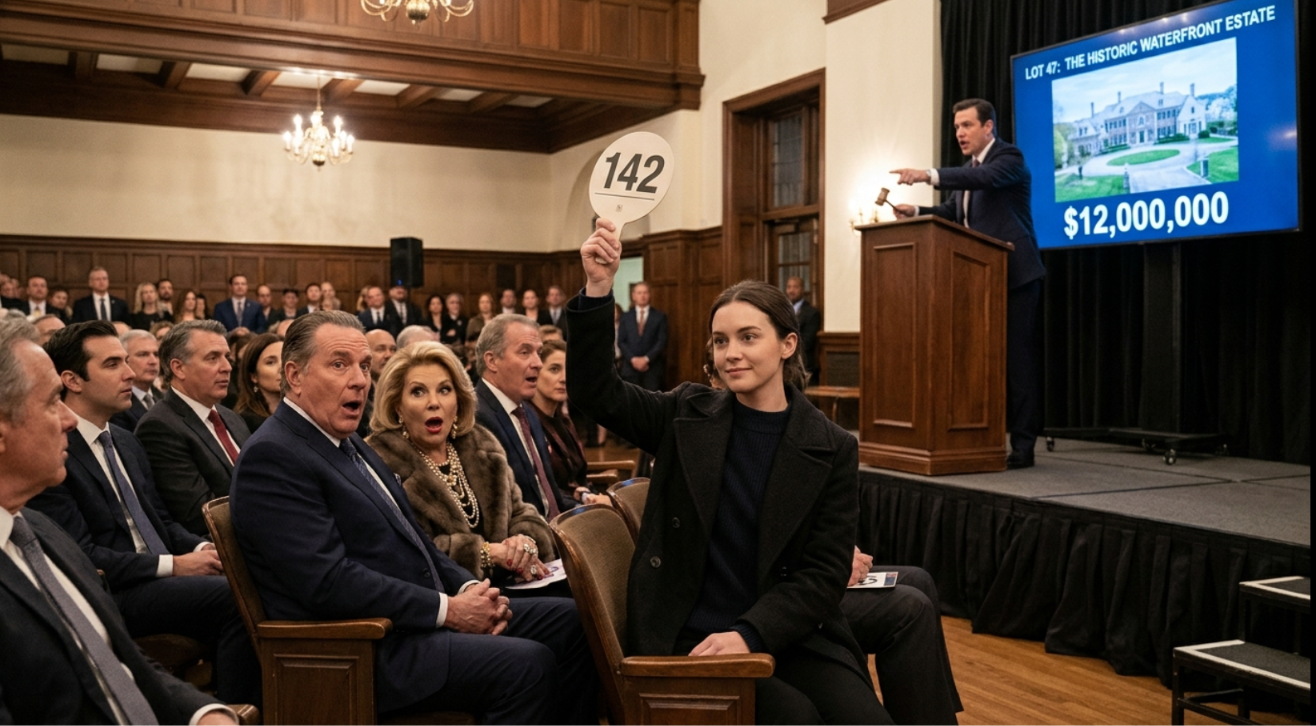
“When you raised that paddle at the auction, I thought you were trying to humiliate us.”



One Comment on “PART4: My Family Mocked Me for Being Poor at the Auction—Then I Bought the $12.5 Million Estate They Thought Was Theirs”
Comments are closed.