PART4
I couldn’t speak.
I looked back at the letter.
Your father became the closest thing Foster ever had to a father. He taught him how to repair a car, how to work with his hands, and how to treat people who had less than he did.
Foster called him Mr. Arthur for years. But one Saturday, when he was sixteen, he accidentally called him Dad.
Your father cried all the way home.
I looked at Foster.
He gave a small, embarrassed smile.
“I remember that day.”
I couldn’t help it.
I started crying again.
All those Saturdays.
All those years.
While I was sitting at home believing my father had another family, he had been helping a little boy who had nobody.
But there was still something I didn’t understand.
“Foster, why did your mother call me the daughter she never had the courage to meet?”
He looked at the letter.
“Keep reading.”
I did.
I wanted to meet you, Amanda. I wanted to tell you that I was not your enemy. I wanted to invite you to my kitchen, make you a pie, and tell you stories about your father.
But your mother was suffering, and I knew how much pain my name caused her.
So I stayed away.
I thought I was protecting your family.
Perhaps I was wrong.
Your father never stopped loving your mother. Even when she refused to speak to him about his Saturdays, he kept her birthday cards in his wallet. He knew what flowers she liked. He remembered the little things.
One Saturday, he came here with a photograph of your mother. He said she had been laughing in the garden, and he wished he could make her laugh like that again.
I covered my mouth.
I remembered those photographs.
My mother in the garden.
My father standing behind her with his arms around her waist.
They had been happy once.
Before the Saturdays became arguments.
Before suspicion took over their marriage.
Before I learned to believe that loving one parent meant rejecting the other.
The letter continued.
There is one last thing I want you to know.
Your father came to see me three weeks before I died. I was already very weak. He sat beside my bed and told me that your mother had passed away.
He cried.
He said he had failed her because he had allowed a misunderstanding to grow into a wall between them.
I told him that he had spent his life trying to do the right thing for everybody and had somehow ended up losing the people he loved most.
He said, ‘I don’t mind people thinking I’m a fool, Idella. I just wish my little girl didn’t think I was a bad man.’
I couldn’t continue.
I pressed the paper against my face.
My father had known I hated him.
He had known every time I ignored his calls.
He had known I believed my mother’s accusations.
And still, every Sunday night, he called me.
“Just checking on you, Sprout.”
I had never understood why he kept doing it.
Now I did.
Foster quietly placed a box of tissues beside me.
I wiped my face and returned to the letter.
Amanda, I am not asking you to forgive anybody. I only hope you will understand that love is sometimes quiet. Sometimes it looks like a man leaving home before sunrise and returning with an empty cooler.
Sometimes the people who help us most are the people we misunderstand.
Please don’t spend the rest of your life carrying a story that was never completely yours to carry.
With love,
Idella.
I folded the letter carefully.
For a long time, neither of us spoke.
Then I asked the question that had been sitting in my heart since I first saw Foster at the funeral.
“Did my daddy have another child?”
Foster looked surprised.
“No, Amanda. He never had another child.”
“Then why did I see that sentence about a daughter?”
Foster took a deep breath.
“My mother considered you her daughter in her heart. She wanted to know you, but she never wanted to take your place in your father’s life.”
He paused.
“She used to say that your daddy had two families to worry about, but only one little girl who called him Daddy.”
I looked away.
I couldn’t bear it.
We spent the next hour going through the boxes.
There were dozens of photographs.
Some showed Daddy fixing the porch.
Others showed Foster sitting on the hood of an old truck.
There was one picture of Daddy teaching Foster how to change a tire.
Another showed the two of them standing beside a Christmas tree.
I picked up that photograph.
“When was this?”
“1989,” Foster said.
I studied the picture.
Daddy was holding a little red toy truck.
I remembered that Christmas.
I had received a bicycle, and Daddy had spent the whole morning putting it together.
Mama had complained that he had been late getting home the night before.
I remembered the argument.
I remembered Daddy sitting alone in the garage after everyone went to bed.
Now I knew where he had been.
He had been making sure a little boy had a Christmas, too.
I looked at Foster.
“Did my daddy ever talk about me?”
Foster smiled sadly.
“All the time.”
“What did he say?”
“He said you were stubborn.”
I almost laughed through my tears.
“That sounds like him.”
“He said you had your mother’s eyes and his temper.”
I shook my head.
“That’s definitely me.”
Foster continued.
“He told me about your wedding. He showed me pictures of Kane. He talked about your children. He even told me when you started driving the school bus.”
I looked at him.
“He knew about that?”
“Of course. He was proud of you.”
I lowered my eyes.
“He never came to see me.”
Foster hesitated.
“Actually, Amanda, he did.”
My head snapped up.
“What?”
“Not inside your house. But he came by your street several times.”
I felt my heart sink.
“Why?”
“He said he didn’t want to upset you. He would park across from your house and watch the children playing in the yard. Sometimes he would see Kane taking out the trash. Sometimes he would see you coming home from work.”
I closed my eyes.
Foster continued.
“One time, he saw your little boy fall off his bicycle. He said he almost got out of the truck to help, but Kane reached him first.”
I put my hand over my mouth.
“Why didn’t he tell me?”
“He thought you would be angry.”
I shook my head.
“I was angry anyway.”
Foster didn’t answer.
And that was the worst part.
My father had spent years trying not to disturb the life I had built.
I had spent those same years making sure he had no place in it.
When I finally stood up, the sun was beginning to set.
I had arrived that morning expecting to confirm my worst suspicions.
Instead, I was leaving with a box full of memories and a heart full of questions.
Foster walked me to my minivan.
“Would you like to take some of his things?”
I looked back at the shed.
“I want the fishing rod.”
He nodded.
“I thought you might.”
“And the hat.”
“Of course.”
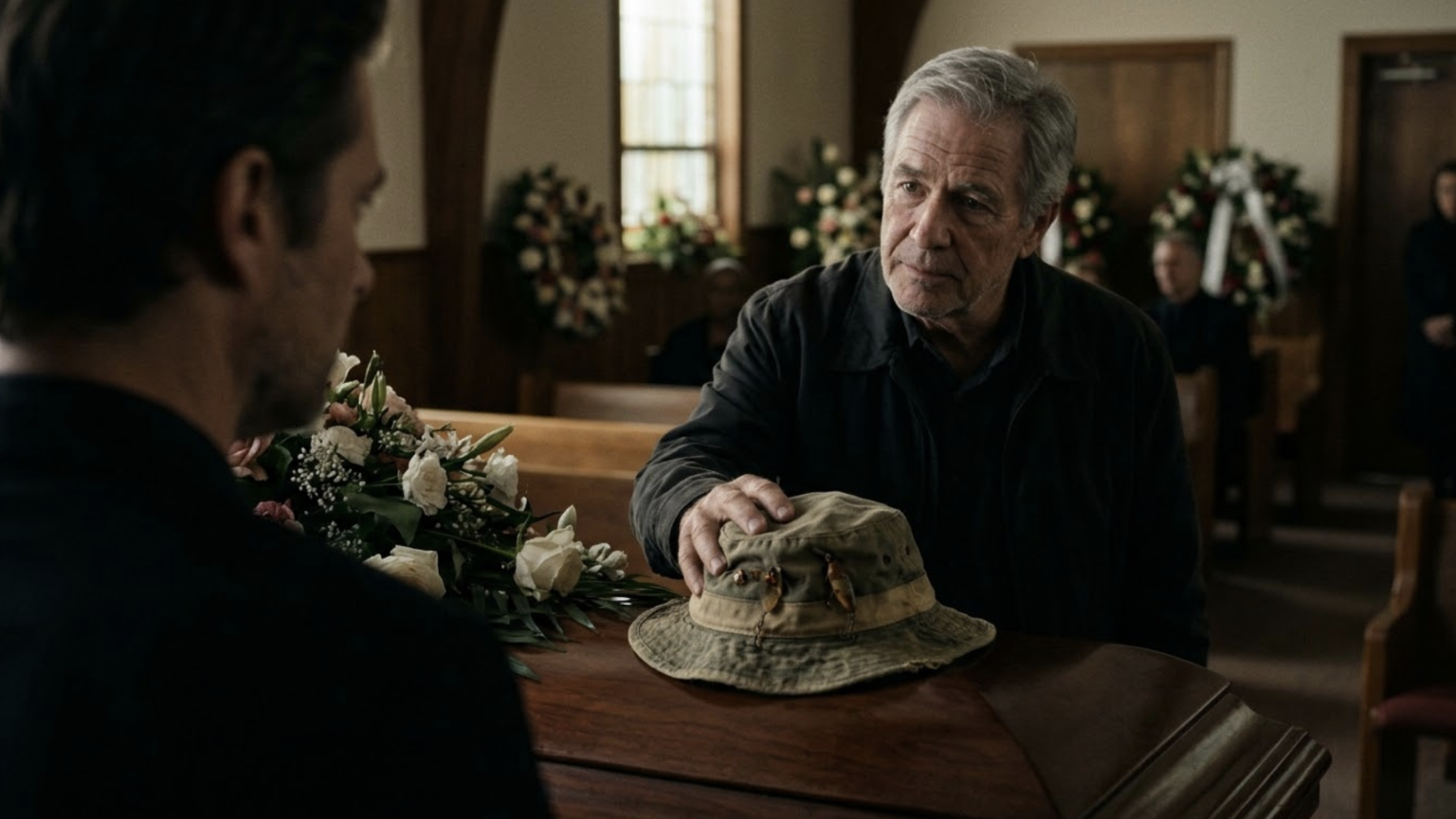
He handed me the old green hat.
The union pin was still crooked.
I held it against my chest.
Then I turned to him.
“Foster?”
“Yes, ma’am?”
“Would you come to my house for dinner sometime?”
He looked surprised.
“You don’t have to do that.”
“I know.”
I took a breath.
“But I think my daddy would have liked it.”
Foster’s eyes filled.
“Yes, ma’am. I’d like that.”
Before I got into the minivan, he said something else.
“Your daddy always hoped the two of us would meet one day.”
I looked at him.
“Well, we finally did.”
He smiled.
“Yeah. We finally did.”
I drove home slowly.
The fishing rod lay across the back seat, and Daddy’s hat sat on the passenger seat.
I kept looking at it.
That old green hat had been part of my childhood.
I could almost hear Daddy’s voice.
“Going fishing, Sprout.”
For the first time, those words didn’t make me angry.
They made me miss him.
When I pulled into the driveway, Kane was waiting on the porch.
He took one look at my face.
“Oh, Mandy.”
I climbed out and started crying before I could say anything.
Kane wrapped his arms around me.
We stood there for a long time.
Eventually, he helped me carry the box inside.
The children were doing homework at the kitchen table.
My youngest, Lily, looked up.
“Mom, why are you crying?”
I sat beside her.
“Because I found out something about Grandpa.”
“Something bad?”
I looked at the fishing hat.
“No, sweetheart. Something good.”
I told Kane everything.
About Idella.
About Foster.
About the little boy my father had helped.
About the letters.
About the Saturdays.
Kane listened without interrupting.
When I finished, he sat quietly for a moment.
Then he said, “Your daddy was trying to do something good, but he made a terrible mistake by keeping it a secret.”
I nodded.
“I know.”
“And your mama was hurt. She probably believed what she believed because nobody ever gave her the whole truth.”
I looked at him.
“I know that, too.”
He took my hand.
“But you were a little girl, Mandy. You shouldn’t have had to carry the weight of their marriage.”
That sentence broke something open inside me.
For years, I had believed I was protecting my mother by hating my father.
I had never considered that I was simply a child caught between two adults who couldn’t find a way to tell each other the truth.
My oldest son came into the kitchen.
“Mom, is that Grandpa’s hat?”
I nodded.
He picked it up carefully.
“I remember him wearing this.”
I smiled sadly.
“He wore it every Saturday.”
My son looked at me.
“Why did he always go fishing?”
I swallowed.
“Because he was helping somebody who needed him.”
My son considered that.
“Did he catch anything?”
I laughed.
It was the first real laugh I had managed since the funeral.
“No, baby. Not once.”
“Then he wasn’t very good at fishing.”
Kane laughed.
I laughed, too.
And for a moment, the kitchen felt warm again.
That night, after the children went to bed, I opened the small box of things Foster had given me.
At the bottom was a stack of cassette tapes.
Each one had a date written on it.
I looked at Kane.
“What are these?”
He picked one up.
“Looks like recordings.”
I found an old cassette player in the closet. Kane had kept it from his father’s house.
We put in the first tape.
There was a little static.
Then Daddy’s voice came through.
“Well, Sprout, if you’re hearing this, I guess Foster finally got you to open that box.”
I covered my mouth.
Kane reached for my hand.
Daddy continued.
“I don’t know when you’ll hear this. Maybe next week. Maybe years from now. Maybe never.”
He chuckled.
“Knowing you, you’re probably mad at me already.”
I laughed through my tears.
Then his voice became serious.
“I wanted to tell you something, sweetheart. I know I wasn’t perfect. I know I should have handled things differently with your mama. I thought keeping quiet would keep the peace. Turns out, sometimes silence makes a bigger mess than the truth ever could.”
There was a pause.
Then he said:
“I hope you’re happy. I hope Kane treats you right. I hope those babies know how lucky they are to have you for their mama.”
I began crying again.
“I miss you, Daddy,” I whispered.
The tape continued.
“And Sprout, if you ever find yourself wondering whether I loved you, don’t.”
He took a breath.
“I loved you every day. Even on the Saturdays you didn’t understand. Even on the Sundays you didn’t call. Even when you stopped talking to me.”
I pressed my hand against my mouth.
“I loved you when you were five and asked me why I didn’t catch fish. I loved you when you wore that yellow dress to school. I loved you when you got married. And I loved you when you had your babies.”
His voice cracked.
“I just wish I’d found a better way to show you.”
Then the recording ended.
I sat in the dark kitchen for a long time.
Kane turned off the cassette player.
“Maybe you should listen to the others tomorrow.”
I nodded.
But before I went upstairs, I picked up my phone.
I opened my voicemail.
There were still several messages from Daddy.
I had never deleted them.
I played the most recent one.
His voice came through.
“Hey, Sprout. It’s me. Just checking on you. I saw your oldest boy’s picture on Kane’s page. Looks like he’s getting tall. Tell him Grandpa says hello. Anyway, I won’t keep you. Love you, sweetheart. Call me when you get a chance.”
The message ended.
I stared at the screen.
That message had been left less than two weeks before he died.
I had listened to it once.
Then I had deleted the notification without calling him back.
I wanted one more chance.
Just one.
I wanted to hear him say my name.
I wanted to tell him I was sorry.
But the phone was silent.
And there was nothing I could do about that.
The following Saturday, I woke up before sunrise.
For a moment, I didn’t know why.
Then I saw the green fishing hat sitting on the dresser.
I got dressed, took the old rod, and went outside.
Kane came down a few minutes later.
“Where are you going?”
I looked toward the road.
“Fishing.”
He smiled.
“Want me to come?”
“Yes.”
We drove out of town with the windows slightly open.
The air was cold, and the sky was still dark.
I followed the road toward Rich Patch Road.
Foster had told me where Daddy used to go after leaving his mother’s house.
There was a small pond behind an abandoned mill property.
It wasn’t much to look at.
A little wooden dock.
Some trees.
A few old benches.
But apparently, Daddy had spent a great deal of time there.
We parked and walked toward the water.
I carried the rod.
Kane carried two cups of coffee.
When we reached the dock, I sat down.
I looked at the fishing line.
No hook.
No bait.
Nothing.
Kane sat beside me.
For a while, we didn’t say anything.
Then I looked at him.
“Do you think he ever wanted to tell me?”
“I think he wanted to tell you many times.”
“Then why didn’t he?”
Kane thought about it.
“Maybe he was afraid of losing you.”
I looked at the water.
“He lost me anyway.”
Kane squeezed my shoulder.
“Sometimes people make decisions because they’re afraid. That doesn’t make those decisions right. But it doesn’t mean there wasn’t love underneath them.”
I nodded.
A few minutes later, I heard a vehicle approaching.
It was Foster.
He got out of his truck and walked toward us.
“I figured I’d find you here,” he said.
I smiled.
“How?”
He pointed at the rod.
“That thing has been more famous than any fish in this county.”
We laughed.
Foster sat down on the other side of me.
He had brought a small paper bag.
“Your daddy used to bring these every Saturday,” he said.
He opened it.
Inside were three biscuits from the bakery.
I stared at them.
“Why three?”
“One for him, one for my mother, and one for me.”
He handed me one.
I took a bite.
It was still warm.
For a moment, I imagined Daddy sitting beside us.
His green hat pulled low.
His coffee in one hand.
His empty fishing rod resting against his knee.
I started crying again.
Foster didn’t say anything.
He just sat there.


One Comment on “PART4: My Daddy Went Fishing Every Saturday for 40 Years and Never Caught a Fish—At His Funeral, a Stranger Revealed the Secret He Took to His Grave”
Comments are closed.