PART5
After a while, I asked him something I had wanted to know since the day we met.
“Did your mother ever forgive my father for not telling the truth?”
Foster looked across the water.
“I think she understood him. But I don’t think she ever stopped wishing things had been different.”
I nodded.
“Me too.”
He turned toward me.
“Amanda, there’s something else I should tell you.”
I looked at him.
“What?”
“Your daddy asked me to make sure you knew something about the money he left behind.”
I frowned.
“What money?”
He pulled an envelope from his jacket.
Inside was a bank statement and a small handwritten note.
I read the note.
Amanda,
I don’t have much to leave behind. The house, the truck, and a little money I saved over the years. But there’s one account I want you to know about.
For years, I put aside a little money every month for Foster’s education and future. When he became old enough, he told me he didn’t need it. He wanted to build his own life.
I kept saving it anyway.
The account is his now.
Don’t let him give it back to you. He earned it by being a good son to a man who wasn’t his father.
I looked at Foster.
He shook his head.
“Your daddy wanted me to have it. I never touched it.”
I looked at the statement.
The amount wasn’t enormous.
But it was more than I expected.
“Why are you showing me this?”
“Because I thought you should know how much he cared.”
I handed the paper back.
“I don’t want his money.”
Foster smiled.
“I know.”
I looked at him.
“But I want you to have something.”
He raised his eyebrows.
“What?”
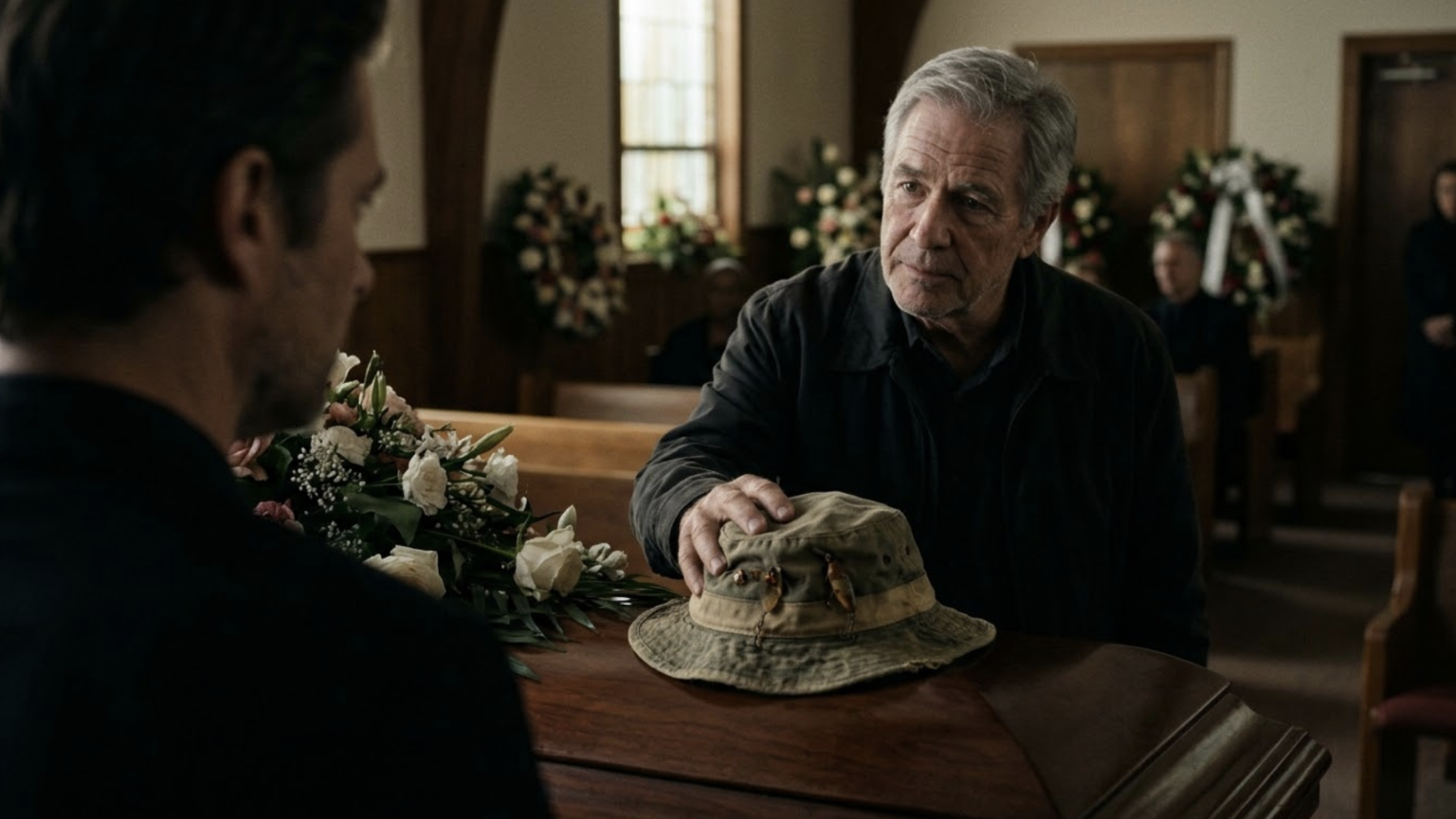
I took Daddy’s green hat and placed it in Foster’s hands.
He looked down.
“No, Amanda. That belongs to you.”
“I know it belonged to my daddy. But you were part of his Saturdays, too.”
He stared at the hat.
“I don’t know if I can take it.”
“You don’t have to wear it. Just keep it.”
His eyes filled.
He nodded.
Then he carefully placed the hat on his head.
It was a little too small for him.
For the first time since Daddy died, I smiled without feeling guilty.
A few weeks later, something unexpected happened.
I was cleaning out Daddy’s old house when I found a small wooden box inside the bedroom closet.
It was hidden behind a stack of blankets.
I opened it.
Inside were old birthday cards, photographs, and several letters addressed to my mother.
I recognized Daddy’s handwriting.
There were dates on the envelopes.
Some were from thirty years ago.
Some were from twenty years ago.
None had been opened.
I sat on the floor and stared at them.
Why had Daddy kept letters he had never sent?
I picked up the oldest one.
It was addressed:
To my beautiful wife,
I opened it.
I know you don’t believe me when I tell you that Idella is not the woman you think she is. I know you are hurt, and I know I have given you reasons to doubt me by refusing to explain everything.
But I need you to understand that I am not going there for myself.
I go because there is a little boy who needs someone to show him how a good man behaves.
I go because his mother has nobody.
And I go because I promised a dying woman that I would not let her child grow up thinking the world had forgotten him.
I stopped.
The letter continued.
I wish you could come with me one Saturday. I wish you could see how that boy smiles when he hears my truck coming up the road.
I wish you could understand that helping him does not mean I love you less.
You are my wife. You are the woman I chose. You are the person I come home to.
I don’t want another life, honey. I just want to make somebody else’s life a little easier.
Please believe me.
I folded the letter.
Then I opened another.
This one was written just a year before Mama died.
I don’t know how much time we have left together.
I know you’re tired. I know you’re angry. I know you don’t want to hear another explanation.
But I still love you.
I still remember our first dance at the church hall. I still remember how nervous I was when I asked your daddy for permission to marry you.
I still remember the day Amanda was born and how you cried when I held her.
I don’t want our last years together to be filled with anger.
If I could go back, I’d tell you everything from the beginning. I’d bring you to Rich Patch Road. I’d introduce you to Idella and Foster. I’d let you see for yourself that there was never another woman in my heart.
But I can’t go back.
I can only hope you know that I loved you.
I cried over that letter.
Not because I suddenly believed my mother had been wrong about everything.
But because I realized how much pain two people could carry when neither knew how to put down their pride.
I found one final envelope.
It had no date.
It was addressed to me.
I opened it.
Sprout,
I know your mama has been telling you things about me. I don’t want you to think badly of her. She loves you. She is hurt, and sometimes hurt people say things they cannot take back.
Please don’t hate your mama for loving me the way she does.
And please don’t hate me for trying to help someone who needed me.
One day, when you’re grown, you’ll understand that people are not always as simple as the stories we tell about them.
Your daddy,
Arthur.
I sat on the bedroom floor until the afternoon light disappeared.
I had spent six years believing that I was honoring my mother’s memory by refusing to speak to my father.
But now I understood something.
My mother had been a woman who loved deeply and feared being betrayed.
My father had been a man who wanted to help everybody but didn’t know how to explain himself.
They had both made mistakes.
And I had inherited their silence.
I didn’t want to pass it down to my children.
PART 6
By December, Foster had become a regular visitor at our house.
The first time he came for dinner, he stood awkwardly in the doorway holding a grocery-store pie.
“I didn’t know what everybody liked,” he said.
I laughed.
“Foster, you don’t have to bring anything.”
“My mother raised me better than that.”
We all laughed.
Kane shook his hand and welcomed him inside.
The children were curious about him.
My youngest asked whether he had really known Grandpa.
Foster told them stories.
He told them about the old truck.
About the broken porch.
About the Christmas when Daddy bought him a toy train.
And about the fishing rod with no hook.
The children laughed.
“Grandpa was pretending to fish for forty years?” my son asked.
Foster nodded.
“Your grandpa was a terrible fisherman.”
Everybody laughed.
Then Foster looked at me.
“But he was a pretty good man.”
I smiled.
“Yes. He was.”
After dinner, we sat around the table with coffee.
Foster told us that he had been fixing up his mother’s old house.
He wanted to keep it.
“I’ve thought about selling it a few times,” he admitted. “But I can’t bring myself to do it.”
I understood.
That little white house held forty years of Saturdays.
It held the sound of my father’s truck.
It held the kindness he had never explained.
And it held the memory of a woman who had wanted nothing more than to raise her son with dignity.
Before Foster left, I walked him to his truck.
“Can I ask you something?”
“Of course.”
“Do you think my daddy was happy?”
Foster thought for a moment.
“I think he was happy when he was helping people. I think he was proud of you. And I think he regretted not telling you the truth.”
I nodded.
“Do you think he knew I loved him?”
Foster looked directly at me.
“Every time he talked about you, he smiled. Even when you stopped answering his calls.”
I looked down.
“I wish I had answered.”
“So do I.”
He paused.
“But you can’t change those Sundays, Amanda. You can only decide what you do with the Sundays you still have.”
I looked at him.
That was something my father might have said.
I hugged Foster.
He hugged me back.
And for the first time, I didn’t feel like I was hugging a stranger.
I felt like I was hugging someone who had known my father in a way I never had.
The following spring, we decided to do something special.
We invited Foster to come with us to the cemetery.
It was the anniversary of Daddy’s death.
Kane brought flowers.
The children brought drawings.
I brought the old fishing rod.
Foster brought a small green hat pin that had belonged to Idella.
We stood around Daddy’s grave.
I placed the flowers down.
Then I looked at the headstone.
ARTHUR WILLIAMS
Beloved Husband and Father.
I ran my fingers across the letters.
For a long time, I couldn’t speak.
Then I finally said what I had wanted to say since the day he died.
“Daddy, I’m sorry.”
The wind moved gently through the trees.
“I’m sorry I didn’t listen. I’m sorry I believed that loving Mama meant I had to stop loving you. I’m sorry I let your calls go unanswered.”
I wiped my eyes.
“I know you weren’t perfect. I know you should have told the truth. But I wish I had given you one more chance.”
Kane put his arm around me.
I continued.
“I understand your Saturdays now.”
I placed the fishing rod against the stone.
“And I understand why you never brought home a fish.”
Foster stepped forward.
He removed his cap.
“Arthur,” he said quietly, “you did right by us. I hope you know that.”
He placed Idella’s little pin beside the flowers.
Then my oldest son stepped forward.
He had brought a drawing.
It showed a man wearing a green hat, holding a fishing rod beside a little boy.
Above it, he had written:
MY GRANDPA WAS A HERO.
I started crying again.
My son looked at me.
“Is that okay, Mom?”
I nodded.
“That’s more than okay, sweetheart.”
He placed the drawing beside the flowers.
We stood there together.
A daughter.
A husband.
Three grandchildren.
And a man who had once been a little boy in need of help.
For the first time, my father’s two Saturdays families were standing in the same place.
And there was no jealousy.
No suspicion.
No accusations.
Just love.
Final Part: He Never Caught a Fish
It’s been almost a year since my daddy died.
I still drive the school bus.
I still wake up early.
I still make breakfast for my children.
And every Saturday morning, I think about him.
Sometimes I take the old fishing rod out to the pond.
I never put a hook on it.
I never bring home a fish.
Kane says I’m wasting perfectly good Saturdays.
I tell him he doesn’t understand the sport.
Then we laugh.
Foster comes with us sometimes.
He usually brings coffee and biscuits.
We sit on the dock and talk about Daddy.
He tells me things I never knew.
How Daddy once drove through a snowstorm to bring Idella medicine.
How he spent three weekends repairing a roof without accepting a penny.
How he taught Foster to drive in an old pickup.
How he cried when Foster graduated high school.
And how, even after all those years, he never stopped asking about me.
One afternoon, Foster gave me the last photograph he had found in his mother’s house.
It was a picture of Daddy sitting on the porch with Idella.
Foster was standing between them.
On the back, my father had written:
Some families are made by blood. Others are made by the promises we keep.
I framed it.
It hangs in my hallway now.
Not because I want to forget my mother.
I loved my mother.
She raised me, protected me, and stood beside me through every difficult moment of my childhood.
But I no longer need to turn one parent into a villain to remember the other with love.
I have a photograph of Mama on the opposite wall.
She is standing in the garden, laughing.
And beside it is a picture of Daddy wearing his green fishing hat.
For years, I thought those two people had spent their lives hurting each other.
Now I understand that they were two imperfect people who loved the same family but didn’t know how to protect it from misunderstanding.
I cannot rewrite their marriage.
I cannot give my father another Sunday night.
I cannot answer the phone when he calls.
But I can tell my children the truth.
I can teach them that love should never require silence.
That helping someone doesn’t make you guilty.
That asking questions is better than building a lifetime around assumptions.
And that sometimes, the people we judge most harshly are carrying burdens we know nothing about.
Last Saturday, my youngest daughter came outside while I was cleaning the fishing rod.
She sat beside me.
“Mom?”
“Yes, baby?”
“Why do you keep that old fishing pole if Grandpa never caught anything?”
I smiled.
I looked at the empty line.
Then I looked toward the pond.
“Because, sweetheart, your grandpa wasn’t really fishing.”
She frowned.
“Then what was he doing?”
I put my arm around her.
“He was helping somebody who needed him.”
She thought about it for a moment.
“Was he a good man?”
My eyes filled.
I kissed the top of her head.
“He was a good man who made some mistakes. And I wish I’d understood him sooner.”
She leaned against me.
“Do you miss him?”
“Every day.”
She looked at the fishing rod again.
“Maybe we should go fishing for him.”
I laughed softly.
“Maybe we should.”
That evening, I went inside and listened to one of his old cassette recordings.
The familiar static came first.
Then his voice.
“Hey, Sprout. Just wanted to tell you I love you. That’s all. Nothing important. Just wanted you to know.”
I closed my eyes.
And for the first time, I didn’t hear a goodbye.
I heard a father.
A father who had spent forty years leaving before sunrise.
A father who came home with an empty cooler.
A father who never caught a single fish.
But who somehow managed to feed two families, protect a little boy, comfort a lonely mother, and leave behind a lifetime of kindness.
I wish I had known the truth while he was still alive.
I wish I had answered those Sunday calls.
I wish I had walked beside him on one of those Saturdays instead of watching him leave through the window.
But life doesn’t give us every chance twice.
Sometimes the truth arrives at a funeral.
Sometimes forgiveness begins after the person who needs it is gone.
And sometimes an empty fishing line tells a story bigger than anything a fish could ever explain.
My daddy went fishing every Saturday for forty years.
He never brought home a fish.
But he brought home something far more important.
He brought home the proof that a good man’s heart can be bigger than the world understands.
And I will spend the rest of my life making sure my children know his name.
Because my daddy wasn’t the man I thought he was.
He was the man I should have taken the time to know.
And I will always love him.


One Comment on “PART5: My Daddy Went Fishing Every Saturday for 40 Years and Never Caught a Fish—At His Funeral, a Stranger Revealed the Secret He Took to His Grave”
Comments are closed.