PART5
The documents showed that they had discussed using my inheritance as collateral for emergency financing.
In one email, my father had written:
Once Preston signs the restructuring agreement, we will have sufficient authority to stabilize the situation. He won’t need to know the details of the transactions.
I read that sentence several times.
He hadn’t simply wanted to manage my money.
He had planned to hide the transactions from me.
There was also evidence that Desmond had known about the proposed arrangement.
His name appeared in several communications.
I asked Silas to arrange a meeting with him.
Desmond arrived at my apartment that afternoon.
He looked different.
His usual designer jacket had been replaced by a plain sweater, and he hadn’t bothered styling his hair.
He sat across from me.
For almost a minute, neither of us spoke.
Finally, he said, “I know you hate me.”
“I don’t hate you.”
He looked surprised.
“Really?”
“I don’t have the energy to hate you, Desmond.”
He lowered his eyes.
“I knew Dad was trying to get access to your money.”
I waited.
“I didn’t know about the forged signature at first.”
“But you knew about the agreement.”
He nodded.
“Dad told me it was a family arrangement. He said you were going to approve it.”
“And you believed him?”
Desmond rubbed his face.
“I wanted to believe him.”
“Why?”
“Because my company was collapsing.”
He took a long breath.
“The investors were threatening legal action. The construction costs had increased. Some of the partners withdrew. I had already borrowed money from people I shouldn’t have borrowed from.”
I remained quiet.
He continued.
“I thought if we could get the inheritance temporarily, I could save the company and repay everything.”
“Did you ever consider asking me honestly?”
He didn’t answer.
I leaned forward.
“You could have called me and told me the truth. You could have said you were in trouble. You could have asked for advice.”
“I know.”
“But instead, you helped Dad prepare a plan to take my inheritance.”
Desmond’s eyes became wet.
“I know.”
I looked at him for a long time.
Then I asked something I had wanted to know since we were children.
“Why was it always like this?”
He frowned.
“What?”
“Why did you always get everything while I was expected to understand?”
He stared at me.
I continued.
“When we were eighteen, Dad took my college savings and bought you a Porsche. I worked nights to pay for school. When you wanted to start your company, Dad helped you financially. When I got promoted, he immediately asked for access to my investments.”
Desmond swallowed.
“I know.”
“No, I don’t think you do.”
I paused.
“I never wanted your life. I never wanted your money. I just wanted to feel like my parents were proud of me.”
He looked down.
“I was jealous of you.”
That caught me off guard.
“Jealous?”
“You worked hard. You got promoted. Grandma trusted you. People respected you because you earned it. I had money, connections, and opportunities, but I was always afraid I wasn’t good enough.”
He rubbed his eyes.
“So when my company started failing, I couldn’t admit it. I couldn’t accept that I had made a terrible mistake.”
I sat quietly.
For the first time, I saw something behind my brother’s arrogance.
Insecurity.
It didn’t excuse what he had done.
But it explained some of it.
“Desmond, I hope you take responsibility for your business. I hope you find a way to repay the investors. But I won’t rescue you with Grandma’s inheritance.”
He nodded slowly.
“I understand.”
“And if you want to rebuild your life, do it honestly.”
He stood up.
Before leaving, he turned around.
“Preston?”
“Yes?”
“Grandma was right about you.”
I didn’t respond.
He opened the door.
“I should have treated you better.”
Then he left.
The legal consequences unfolded over the following months.
The independent review confirmed that the proposed transfer had never been authorized by me.
The financial institutions maintained the protective restrictions on the trust while the relevant authorities reviewed the suspected forged documents and attempted unauthorized access.
Pierce provided records and communications from his office.
He also cooperated with the investigation into how the transfer authorization had been prepared and submitted.
My father was required to answer questions about his involvement.
Several business relationships were suspended.
His reputation, which he had spent decades carefully building, began to collapse.
Desmond’s company eventually entered formal restructuring.
The investors continued pursuing their claims, and Desmond had to sell several personal assets to help satisfy legitimate obligations.
His luxury apartment in Miami was sold.
His expensive car collection disappeared.
The lifestyle he had once believed was permanent suddenly became something he could no longer afford.
My father also sold one of his investment properties.
For years, he had insisted that his properties represented his success.
Now they were being used to address financial problems he had helped create.
I didn’t celebrate any of it.
I didn’t feel victorious watching my family struggle.
But I also refused to feel guilty for protecting myself.
The most difficult part was accepting that the family I had wanted to believe in wasn’t the family I actually had.
My mother and I began speaking more regularly.
She apologized repeatedly.
Sometimes she cried.
Sometimes I did too.
I told her that forgiveness would take time.
She didn’t argue.
She simply accepted it.
And that was a beginning.
Three days later, I boarded my flight to London.
I stood near the airport window, watching the aircraft move slowly across the runway.
My phone vibrated.
A message from Silas.
The trust is secure. The latest independent valuation is confirmed at $18,740,000. Your grandmother would be pleased that you protected what she worked so hard to build.
I smiled faintly.
Then another message appeared.
It was from my mother.
Have a safe flight, sweetheart. Your grandmother would be so proud of you. I love you.
I read it twice.
Then I replied.
Thank you, Mom. I’ll call you when I land.
A few seconds later, my phone vibrated again.
This time, it was a message from my father.
We need to talk. You cannot leave things this way. I’m still your father.
I stared at the screen.
For years, those words would have made me feel guilty.
I would have called immediately.
I would have apologized, even when I had done nothing wrong.
I would have tried to repair something that I hadn’t broken.
But that morning, I simply placed the phone in my pocket.
I didn’t block him.
I didn’t send an angry response.
I just decided that I didn’t have to answer every demand.
Then I boarded the plane.
As the aircraft climbed above Boston, I looked out at the city where I had grown up.
The streets became smaller.
The buildings became distant.
And for the first time, leaving didn’t feel like running away.
It felt like moving forward.
Six months later, I was settling into my new life in London.
My position was everything I had hoped it would be.
I worked with talented engineers, traveled across Europe, and helped oversee major cybersecurity infrastructure projects.
I rented a beautiful apartment overlooking the Thames.
It wasn’t enormous.
It wasn’t extravagant.
But every corner belonged to me.
I furnished it slowly, choosing things I actually liked instead of things designed to impress other people.
I also established a charitable education fund in my grandmother’s name.
The first contribution was $500,000.
Its purpose was to help students from low-income families pay for university tuition, textbooks, and essential living expenses.
I remembered working nights at the data center.
I remembered counting every dollar.
And I remembered how different my life might have been if someone had helped me when I needed it.
The fund was one small way of making sure someone else didn’t have to face the same struggle alone.
Silas helped oversee the financial structure.
He also reminded me that my grandmother would have appreciated the decision.
One afternoon, I received a call from Desmond.
I almost didn’t answer.
But something made me pick up.
“Hey.”
“Hey, Preston.”
His voice sounded different.
Less confident.
More genuine.
“How are you?”
“I’m good. How are you?”
“I’m working.”
I smiled.
“Working?”
“Yeah. I got a job with a property management company. Nothing impressive.”
“That’s good.”
He laughed softly.
“Trust me, after everything that’s happened, I’m just happy to have a paycheck.”
We spoke for nearly twenty minutes.
He told me that he was living in a smaller apartment and working to resolve his remaining business obligations.
He had also started attending counseling to understand why he had spent so many years measuring his worth through money and status.
Before hanging up, he said something unexpected.
“I visited Grandma’s grave last weekend.”
I remained quiet.
“I told her I was sorry.”
My throat tightened.
“What did you say?”
“That I should have listened to her. That I should have treated you like a brother instead of someone I was competing against.”
I looked through the window at the London skyline.
“Thank you for telling me.”
He paused.
“Do you think we can ever be close again?”
I thought about it.
“I think we can try. But we have to start with honesty.”
“I understand.”
“And no more secrets.”
“Agreed.”
We ended the call.
It wasn’t a perfect reconciliation.
But it was real.
And sometimes, real beginnings are more valuable than perfect apologies.
Almost a year after the meeting in Boston, I returned home for a short visit.
My mother invited me to dinner.
This time, there was no expensive restaurant, no business discussion, and no stack of legal documents.
She cooked one of my grandmother’s favorite meals.
Desmond came too.
My father was not there.
He had sent an invitation through my mother, but I had declined.
I wasn’t ready.
And I had finally learned that being ready mattered more than satisfying someone else’s expectations.
During dinner, my mother brought out an old photograph.
It showed my grandmother sitting between Desmond and me in her garden.
I was about twelve.
Desmond was fifteen.
Both of us were laughing.
Mom placed the photograph on the table.
“She always said you boys were different, but equally important to her.”
Desmond looked at the picture.
“I wish I had understood that earlier.”
I smiled faintly.
“Me too.”
After dinner, I took the photograph home.
I placed it on a shelf in my London apartment beside my grandmother’s letter.
Sometimes, when work became stressful or life felt uncertain, I read that letter again.
Especially the final sentence.
You are allowed to say no, even to family.
It took me nearly thirty years to understand how important those words were.
I used to believe that being a good son meant sacrificing whatever I had to keep everyone happy.
I believed that being a good brother meant accepting unfair treatment without complaint.
I believed that family loyalty meant never walking away.
But I had confused love with obligation.
And I had confused forgiveness with allowing people to hurt me repeatedly.
My grandmother had understood something I hadn’t.
Money doesn’t reveal someone’s character by itself.
It simply gives people more opportunities to demonstrate the character they already have.
My parents had seen my inheritance as an opportunity.
My brother had seen it as a solution to his problems.
My grandmother had seen it as a chance for me to build a life without being controlled by anyone.
And eventually, I chose to honor her intention.
I never gave my father control over the inheritance.
I never paid Desmond’s business debts.
I never signed the agreement Pierce had placed in front of me that morning.
The $18.74 million remained protected under the independent trust structure, managed according to the estate documents and my grandmother’s wishes.
I continued building my career.
I continued helping students.
I continued living.
And slowly, I learned to build relationships based on respect rather than fear.
My mother and I rebuilt some of our relationship.
Desmond and I began speaking again.
My father and I remained distant.
Perhaps one day that would change.
Perhaps it wouldn’t.
But I finally understood that I didn’t need his approval to have a meaningful life.
On my thirty-first birthday, I received a small package from my mother.
Inside was my grandmother’s old fountain pen.
The same kind she used to sign her letters.
There was a note.
For Preston, who finally learned that his signature belongs to him.
I held the pen for a long time.
Then I placed it beside her photograph.
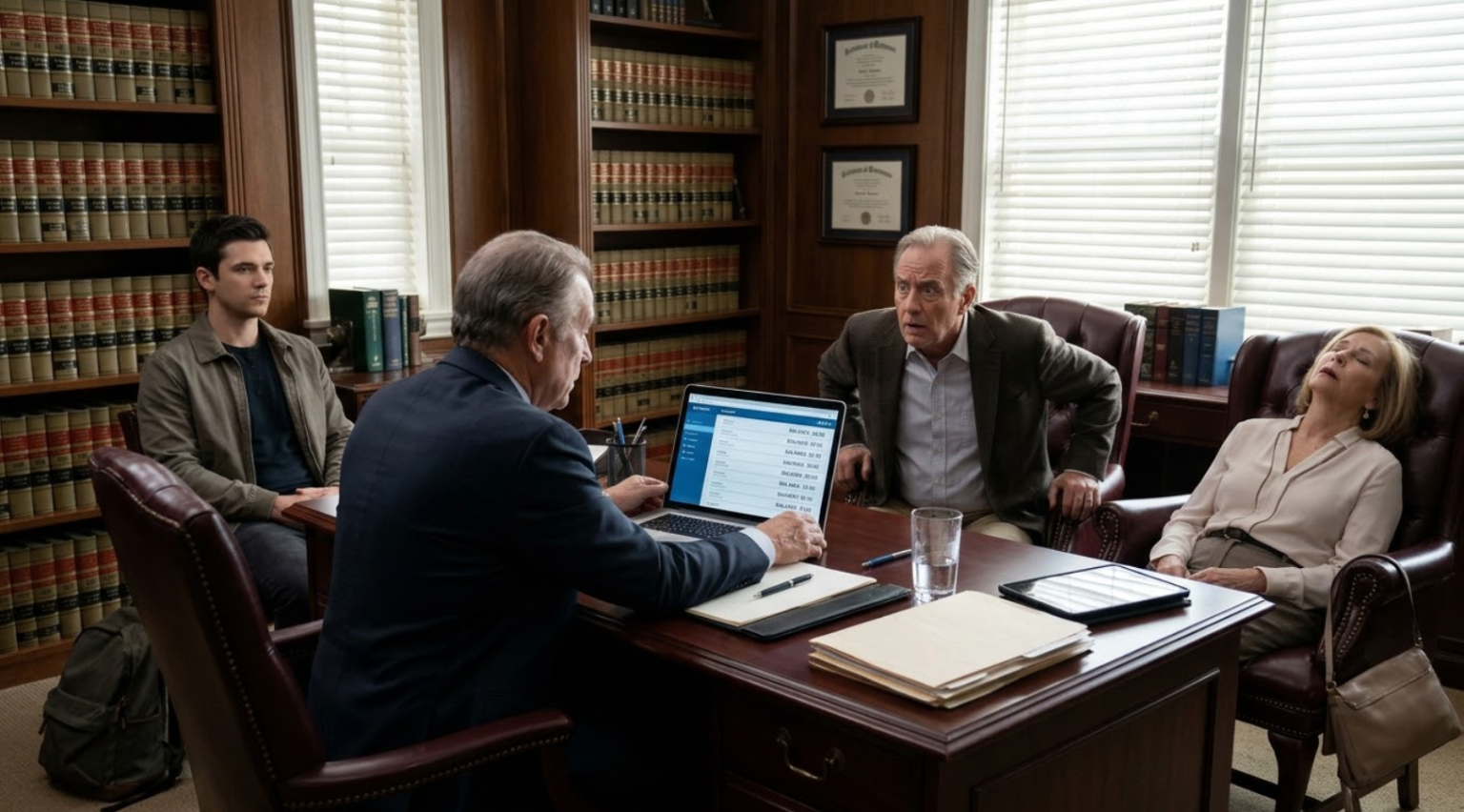
I thought about that morning in the Boston law office.
My father’s hand striking the table.
My mother’s trembling fingers.
Desmond complaining about lunch.
Pierce typing account numbers into his computer.
And that moment when the screen showed nothing but zeros.
They had entered that room believing I was about to surrender my future.
They had prepared forty pages of paperwork.
They had brought a gold fountain pen.
They had even arranged a celebratory lunch.
But they had forgotten one important thing.
I wasn’t the eighteen-year-old boy who had silently accepted losing his college savings anymore.
I was an adult who had worked for everything he had.
And I finally understood the difference between being someone’s son and being someone’s possession.
That morning, my parents thought they were taking control of my $10 million inheritance.
Instead, they lost control of the one thing they had always relied on.
Me.
And that was the most valuable thing I ever reclaimed.



One Comment on “PART5: My Parents Tried to Steal My $18.7 Million Inheritance Before I Moved to London—But One Empty Bank Account Exposed Their Entire Scheme”
Comments are closed.