
Part 4: The Truth on the Mahogany Table
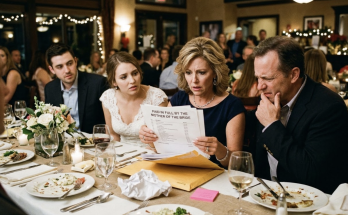
Arthur Pendelton stepped forward to the head of the table, unlatched his calfskin briefcase, and removed three thick, heavy legal folders bound in navy blue cardstock. With deliberate precision, he laid them flat across the white tablecloth, directly in front of Mark’s untouched plate, pushing aside a crystal water goblet.
“Good evening, everyone,” Arthur said, addressing the room with the practiced poise of a senior estate litigator. “My name is Arthur Pendelton, managing partner at Pendelton, Hayes, and Mercer. For the past thirty-two years, I have served as general counsel to Vance Industrial Holdings and personal attorney to Mrs. Eleanor Vance.”
Richard Sterling, the bank executive seated two chairs away, leaned forward slowly, his eyes narrowing as he stared at the gold-embossed notary seals on the folders. “Pendelton? Wait a minute. Vance Industrial Holdings? As in the manufacturing conglomerate out of Chicago?”
“The very same, Mr. Sterling,” Arthur replied smoothly.
Mark let out a sharp, panicked laugh. “That’s ancient history! My father sold his shares before he passed away, and whatever was left went into my trust! This house is mine! My name is on the property tax bills!”
“Your name is listed as the occupant of record for municipal utility purposes, Mark,” Arthur corrected him, opening the first folder and sliding a certified county deed toward Richard Sterling so the banker could see it clearly. “However, as any real estate executive should know, a utility bill is not a title.”
Arthur tapped a thick finger against the bold header of the document.
“This property—all four-point-two acres and the twelve-thousand-square-foot residence—was purchased in cash six years ago by the Eleanor Vance Revocable Living Trust. Mrs. Vance is the sole grantor, the sole trustee, and the sole owner of record. You and your wife have never paid a single dollar in mortgage interest, property taxes, or homeowner’s insurance. You have been living here entirely at Mrs. Vance’s discretion, under a revocable verbal license.”
Silence descended on the room so heavy you could hear the hum of the central air conditioning.
Chloe’s face went pale as chalk. She lunged forward across the corner of the table, grabbing the deed with trembling, manicured fingers. Her eyes darted frantically down the page until they landed on the signature line at the bottom: Eleanor Margaret Vance, Sole Trustee.
“No…” Chloe whispered, her voice cracking. “No, Mark told me… Mark, you told me your father left the estate to you!”
Mark didn’t answer her. He was staring at the documents as if they were venomous snakes. “Mom… what is this? Why would you let us think…”
“Why did I let you think you owned it?” Eleanor repeated quietly, stepping closer to the table. She looked at her son—really looked at him—and for the first time, the guests saw the deep reservoir of hurt beneath her composed exterior.
“When your father died five years ago, Mark, he wanted to leave everything directly to you,” Eleanor said, her voice steady despite the emotion tightening her throat. “I begged him not to. I told him that sudden wealth without wisdom destroys a young man’s character. So we structured the estate into a discretionary trust. The agreement was simple: I would fund your lifestyle, pay for this home, and provide your twenty-five-thousand-dollar monthly stipend while I lived quietly in the guest wing, helping raise my grandson and watching to see what kind of man you would become.”
Eleanor paused, glancing over at Chloe, who looked as though she might faint.
“For three years, I cooked your dinners when your housekeeper quit. I stayed up with Leo when he had fevers while the two of you flew to Cabo and Milan. I wore simple clothes and drove an eight-year-old sedan because I didn’t care about impressing anyone. I only wanted a family.”
A murmur of shock rippled through the wealthy guests. Across the table, a prominent female philanthropist set her napkin down sharply, glaring at Chloe with undisguised disgust.
“And how did you repay that?” Eleanor continued, her gaze locking onto Mark’s. “On my sixty-fifth birthday—the exact milestone your father had set to evaluate whether you were ready to take over the trust—you packed my clothes into a suitcase, handed me a twenty-dollar bill like a stray dog, and locked me outside in a freezing November storm because Chloe said I was ‘a burden’ and ‘ruined the aesthetic’ of your home.”
“Mom, I didn’t—” Mark stammered, his voice rising in desperation. “Chloe pushed me! We were stressed about the gala! I was going to call you tomorrow!”
“Tomorrow never came, Mark,” Eleanor said coldly. “It has been seven days.”
Arthur opened the second and third folders, sliding them beside the deed.
“Document number two,” Arthur announced briskly, “is a formal Thirty-Day Notice to Quit and Vacate Premises, duly notarized and filed with the county clerk’s office this afternoon. You have until five o’clock in the evening on December twenty-eighth to remove your personal belongings from this residence. Anything remaining after that hour becomes the property of the trust.”
“And the third document?” Chloe asked weakly, gripping the edge of the table to keep her knees from buckling.
“Document number three,” Arthur said, closing his briefcase with a sharp metallic snap, “is the permanent termination of your monthly trust distributions, effective as of five o’clock today. Furthermore, all corporate credit cards, leased luxury vehicles registered under Vance Holdings, and country club memberships have been frozen and scheduled for repossession on Monday morning.”
Across the table, Richard Sterling slowly pushed his chair back and stood up. He looked at Mark with cold, professional disdain.
“I think it’s safe to say,” Richard said quietly, “that Oakridge National Bank will be withdrawing our financing commitment for your commercial project, Mark. I don’t do business with men who throw their mothers onto the street.”
One by one, the remaining twenty-three guests stood up from the table. Nobody touched their wine. Nobody offered a polite goodbye. Within three minutes, the grand dining hall had emptied completely, leaving behind twenty-four untouched plates of food and the echoing footsteps of high society walking out the front door.


One Comment on “PART 4: They threw their 65-year-old mother out in the rain on her birthday… thinking she was broke. Biggest mistake of their lives”
Comments are closed.