I Put $10 in a Church Roof Fund Every Sunday for 52 Years. The New Finance Chair Called It Worthless—Until I Opened an Old Coffee Can.

PART 3
Then she turned to the last page. Her smile disappeared.
She looked at the balance. Then she looked at the previous entry.
Then she looked at me. “Mr. Gaskins…” “Keep reading.”
She turned the page again, searching for something. Her fingers moved more slowly now.
Behind her, people were still talking after Sunday service. Children were running through the fellowship hall. Somebody was asking Pastor Jordan about the upcoming Thanksgiving dinner.
But Whitney wasn’t listening to any of it.
“Where did this money come from?” she finally asked.
I took my time answering.
“Every dollar in that account came from me, Ernestine, and a few people who believed the church ought to have a roof over its head.”
She looked at the passbook again.
“How much is in here?”
“That depends on what the bank says today.”
“Mr. Gaskins, I need a number.”
I leaned a little closer.
“Last time I checked, it was a little over three hundred thousand dollars.”
Her mouth opened.
Then closed.
“Three hundred thousand?”
“Plus whatever interest has accumulated since the last statement.”
She looked at me as if I had suddenly started speaking another language.
“That’s impossible. The church’s financial records don’t show anything close to that amount.”
“I know.”
“How can you have a church account that isn’t in our financial records?”
I nodded toward the folded paper in her other hand.
“That’s why I brought you the agreement.”
She unfolded it.
The paper was yellow with age. The corners were soft from years of being handled. There were two signatures at the bottom.
Mine.
And Reverend Lyle Barfield’s.
Whitney began reading.
I watched her face change as she moved through the first paragraph.
Then the second.
Then the third.
She stopped.
“Mr. Gaskins, this says…”
“Read it.”
She swallowed.
“The funds are to remain in a separate savings account for the exclusive purpose of maintaining, repairing, and eventually replacing the sanctuary roof of Pleasant Grove United Methodist Church.”
“That’s right.”
She continued.
“The funds shall not be transferred to the general operating account, used for salaries, utilities, administrative expenses, or any other church purpose.”
“That’s right.”
Her eyes moved to the bottom of the page.
“And the account is to remain under the original trusteeship until the purpose of the fund has been fulfilled.”
I nodded.
“Pastor Barfield wrote that part himself.”
Whitney looked up.
“Who are the original trustees?”
I pointed to the signatures.
“Pastor Barfield and me.”
“But Reverend Barfield passed away decades ago.”
“1989.”
“So who controls the account now?”
“That’s something we’re going to have to discuss with the bank and the church’s legal representative.”
She stared at the document.
For the first time since I’d known her, Whitney Strickland didn’t have an immediate answer.
“Why didn’t you tell anyone about this?”
I looked at her.
“I’ve been putting ten dollars in an envelope every Sunday for fifty-two years. I didn’t exactly hide what I was doing.”
“But nobody knew about the account.”
“People knew there was a roof fund. They knew I was collecting money. Mrs. Pope knew. Mr. Ransom knew. Reverend Barfield knew. Your predecessor knew enough to accept the envelopes.”
“Then why wasn’t it reported?”
“That’s a good question. Maybe you ought to ask the people who kept the books before you.”
She looked uncomfortable.
I didn’t enjoy seeing that.
I wasn’t trying to embarrass a young woman in front of her church.
But I wasn’t going to let fifty-two years of work be dismissed as a little tradition, either.
Whitney closed the passbook.
“I need to take this to the pastor.”
“That’s fine.”
“And I need to verify the balance.”
“That’s fine, too.”
“And I think we need to have a special council meeting.”
I nodded.
“Now you’re talking sense.”
She walked away carrying the passbook and agreement.
I watched her cross the sanctuary.
Pastor Jordan was standing near the front doors, shaking hands with members. Whitney approached him and said something quietly.
He looked at the papers.
Then at me.
Then back at the papers.
His expression changed.
He excused himself from the conversation and followed Whitney into his office.
I put on my old brown jacket and went home.
I had no reason to stay.
I’d done what I came to do.
But that afternoon, something happened that I hadn’t expected.
At 3:17 p.m., my phone rang.
It was Pastor Jordan.
“Mr. Gaskins, could you come by the church tomorrow morning?”
“What’s wrong?”
“Nothing is wrong exactly. But there’s something about that account we need to understand.”
“Didn’t Whitney explain it?”
“She did. But there’s another issue.”
I sat down at my kitchen table.
“What issue?”
There was a pause.
Then he said something that made me put my coffee cup down.
“Mr. Gaskins, I called the bank. They found the account.”
“And?”
“They confirmed that it’s still active.”
“Well, that’s good.”
“Yes. But the account has a restriction on it that nobody here seems to understand.”
“What kind of restriction?”
He took a breath.
“The bank says the funds cannot be released or transferred based on a simple church council vote. They need the original trust agreement reviewed, and they want to speak with the current trustees or their legal successors.”
I looked at the yellow agreement lying on my kitchen table.
“That sounds about right.”
“But there’s something else.”
I waited.
“The bank says the account received a significant deposit in 1998.”
“Yes.”
“Then another in 2004.”
“Yes.”
“And several more after that.”
“That’s right.”
“Mr. Gaskins, who was making those deposits?”
I looked toward the back window.
The afternoon sun was shining on the old shed.
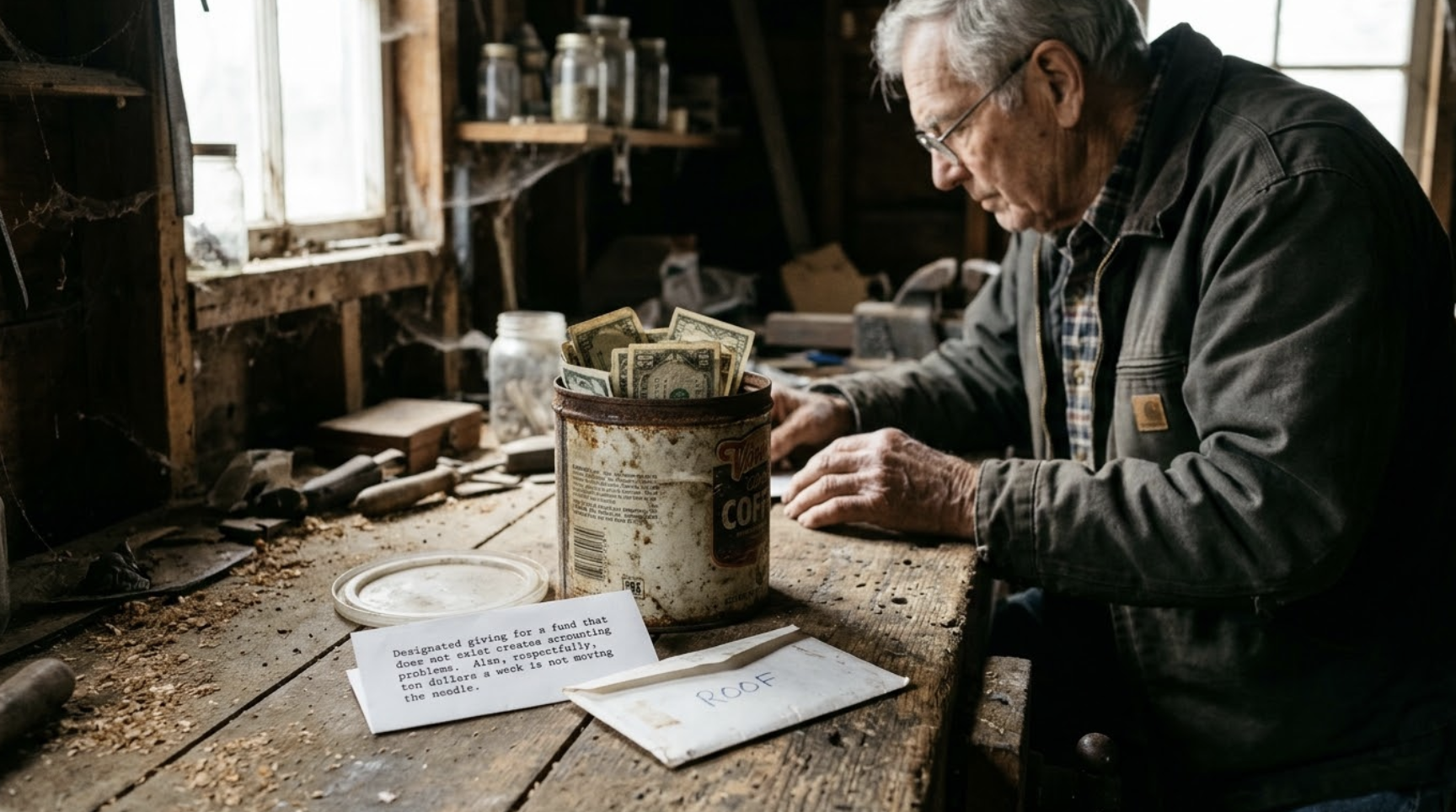
I could almost see Ernestine standing there, holding the Maxwell House can while I counted the money.
“Some of us never forgot what that roof meant,” I said.
Pastor Jordan was quiet.
Then he asked, “Would you be willing to tell us everything tomorrow?”
“I’ll tell you what I know.”
“Thank you, sir.”
We hung up.
I sat there for a long time.
Then I went back out to the shed.
There was something else in that coffee can.
Something I hadn’t given Whitney.
A small envelope, folded twice, with Ernestine’s handwriting on the front.
It said:
For the day they forget why we started.
I sat down on the old wooden stool.
My hands weren’t as steady as they used to be, so I opened it carefully.
Inside was a photograph.
It was taken in 1974, the day we finished repairing the church roof.
There I was, thirty years old, standing beside Reverend Barfield. My work shirt was covered in dust. Ernestine was holding a tray of sandwiches. Three of my roofing men were sitting on the church steps.
And on the back, in Ernestine’s handwriting, were seven words:
A church is more than its building.
I smiled.
Then I noticed something else inside the envelope.
A second piece of paper.
This one wasn’t written by Ernestine.
It was a letter from Reverend Barfield, dated December 1974.
I had completely forgotten it was there.
I unfolded it.
The letter was short.
“Dear Ozell,
I know you believe the money you are putting aside will one day repair the roof. I pray that is all it will ever need to do.
But I want you to remember something.
If the day comes when the church has more money than wisdom, or more ambition than gratitude, make sure the people understand that this fund was created to serve the church, not the people who happen to be in charge of it.
Buildings can be repaired. People can be replaced. But trust, once broken, is difficult to rebuild.
May God bless the hands that built this church and the hands that will keep it standing.
Your brother in Christ,
Lyle Barfield.”
I read it twice.
Then I folded it and put it back in the envelope.
I didn’t know what was waiting for me at the church the next morning.
But I knew one thing.
The roof wasn’t the only thing that needed repairing.
And I had a feeling that the next church council meeting was going to be a lot more interesting than Whitney Strickland’s PowerPoint presentation.
Because the following morning, when I arrived at Pleasant Grove, there were already seven cars in the parking lot.
And sitting in Pastor Jordan’s office was a man I hadn’t seen in nearly twenty years.
Faye Pope’s older brother.
Daniel Pope.
The former church treasurer.
He was holding a thick brown folder.
When he saw me walk through the door, he stood up.
“Ozell,” he said quietly. “I was hoping you’d bring that coffee can.”
I stopped.
“What do you mean?”
Daniel looked at Pastor Jordan.
Then he looked back at me.
“Because there’s something in those old financial records that Whitney hasn’t found yet.”
He opened the brown folder.
And the first document on top had my wife’s name written across it.
Ernestine Gaskins.
I felt my stomach tighten.
“What does my wife have to do with this?”
Daniel lowered his voice.
“More than you know, Ozell. A whole lot more than you know.”
And then he turned the page.
For a moment, I couldn’t move.
I stood in Pastor Jordan’s office, looking at that piece of paper with my wife’s name printed across the top.
Ernestine Gaskins.
I’d seen her name on thousands of things over the years. Birthday cards. Hospital records. Our mortgage papers. The little notes she used to leave beside my coffee cup when I went out early to work.
But I’d never expected to see it in a church financial folder.
“What does my wife have to do with this?” I asked again.
Daniel Pope pulled out a chair.
“Sit down, Ozell.”
“I’d rather stand.”
He nodded.
Pastor Jordan closed the office door.
Whitney Strickland was sitting at the desk with her laptop open. She looked unusually quiet. Her usual confidence had been replaced by something I couldn’t quite identify.
Daniel opened the folder.
“Back in 1974, when Reverend Barfield and you established the roof account, there was another person involved.”
“Who?”
“Ernestine.”
I looked at him.
“Of course she was involved. She helped me save the money.”
“No, Ozell. I’m talking about the legal paperwork.”
He slid a document across the desk.
It was a bank deposit authorization dated December 1974.
My wife’s signature was at the bottom.
I picked it up.
There it was.
Ernestine Gaskins.
Her handwriting was unmistakable.
“What is this?”
Daniel explained.
“Your wife was appointed as the second financial custodian of the roof fund. Reverend Barfield insisted on having someone outside the church’s regular financial committee involved. Someone who would keep an independent record.”
I stared at the paper.
“She never told me.”
Daniel gave a small smile.
“She probably thought you knew.”
I shook my head.
“That woman could keep a secret better than anybody I’ve ever met.”
Whitney leaned forward.
“Mr. Gaskins, there’s something else. The bank records show deposits that don’t appear to have come from you.”
Daniel nodded.
“That’s what I was trying to explain.”
He pulled out another sheet.
It was a handwritten ledger.
There were names, dates, and amounts.
Some deposits were five dollars.
Some were ten.
Some were twenty-five.
One was fifty.
I recognized several names.
Mrs. Clara Pope.
Mr. and Mrs. Jenkins.
Reverend Barfield.
My old roofing partner, Henry Mills.
And Ernestine.
There were dozens of entries.
Daniel pointed to the bottom.
“Your wife kept this ledger for years. Every time someone contributed, she recorded it. She also recorded the interest earned and every bank statement.”
I looked at the handwriting.
It was hers.
The same careful handwriting she used when she wrote grocery lists.
For fifty-two years, I’d believed I was putting ten dollars a week into something Ernestine and I had started together.
Now I was discovering that she had been doing something much bigger.
“How much did she contribute?” I asked.
Daniel turned another page.
“Over the years, she contributed nearly twelve thousand dollars of her own money.”
I stared at him.
“Twelve thousand?”
“Yes.”
“Where did she get that?”
“Her sewing work. Christmas bonuses from the department store. Money she saved from household expenses. She also contributed some of the money she earned helping Mrs. Jenkins with childcare.”
I looked down at the ledger.
I remembered those years.
I remembered Ernestine sitting at the kitchen table late at night, sewing dresses for women in town.
I remembered telling her she didn’t need to work so hard.
She’d always smiled and said she was just keeping busy.
Now I understood.
She wasn’t just keeping busy.
She was building something.
Something she believed would outlast both of us.
I rubbed my forehead.
“That woman never told me anything.”
Daniel smiled.
“She told me something once.”
“What?”
“She said, ‘Ozell will give you the shirt off his back if you ask him, but he’ll never think about tomorrow unless somebody puts a calendar in front of him.’”